 Woyɛ dino bɛn? Nsɛmmisa agoro
 Dino ko
 Dino mmirikatuo
 Dino agodie nketewa
 Stika nwoma
 Dino TOP nhyehyɛeɛ
 Ma me nwanwa!
Paludidraco
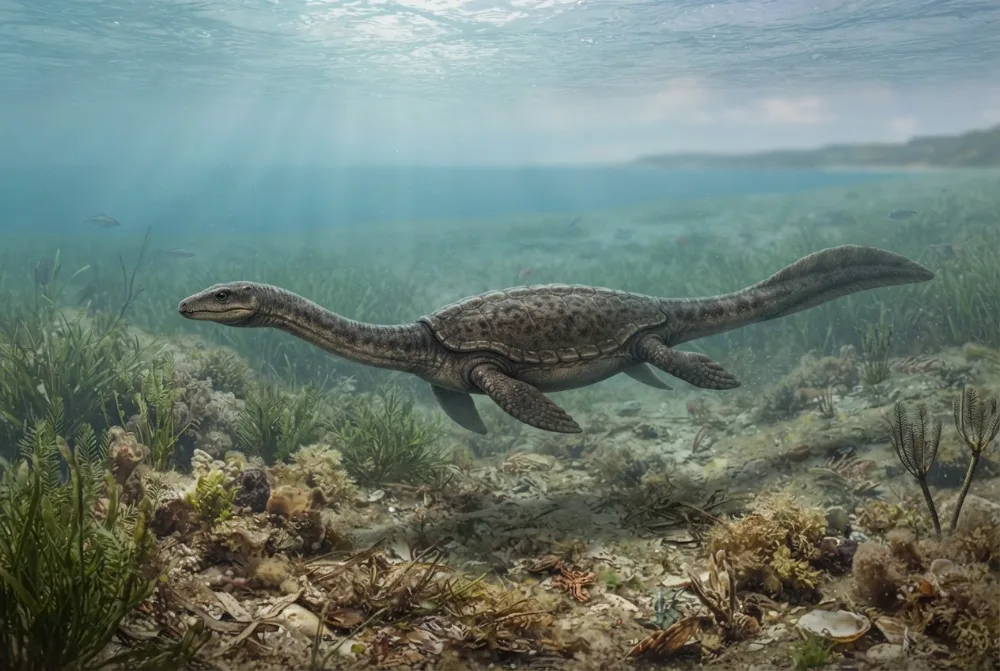
Paludidraco was a strange marine reptile that lived in shallow seas over 200 million years ago. It had a very heavy, dense skeleton that helped it stay underwater without swimming much, like a manatee. Its jaws were weak and filled with many tiny teeth, so it probably sucked up soft plants or small animals from the seafloor.2
Berɛ bɛn na ɛtenaa ase?
Na ne kɛseɛ yɛ sɛn?
Na ne tenten yɛ sɛn?
 ne tenten te sɛ nkraman 2.5 firi hwene kɔsi dua🍌ne tenten te sɛ kwadu 14 a wɔde abɔ toatoa so🏊anka ɔbɛtumi aguare nsuguarebea kɛseɛ (50 m) tenten wɔ sikɛn 8.6 mu
Paludidraco kɛseɛ yɛ sɛn sɛ wode toto WO ho a?
Akontaa nko ara wɔ wo browser mu. Yɛnkora biribiara so, na yɛmmfa biribiara nkɔ baabiara.
Na ɛyɛ ntɛm sɛn?


Nsɛm a ɛyɛ anigye
Paludidraco had an extremely heavy, pachyostotic skeleton, meaning its bones were very thick and dense. This helped it float at shallow depths without using much energy, just like modern manatees.2
Its jaws were very slender and weak, and its teeth were small, curved, and set in a groove (pleurodont implantation). This is very different from most other marine reptiles of its time.1
Paludidraco had more than 15 teeth in its premaxilla (the front part of the upper jaw), which is a unique feature among its family, Simosauridae.1
Scientists think Paludidraco was not an active predator. Its weak jaws could not catch struggling prey, and its heavy body made it slow and not very maneuverable.1
The name Paludidraco comes from Latin words meaning 'marshy dragon', because its fossils were found near a reservoir called El Atance in Spain.1
Paludidraco lived during the Late Triassic period, about 237 to 205 million years ago, in what is now central Spain.4
Ma dino ho animdefoɔ
- Nyansahu din
- Paludidraco
- Obi a ɔtoo din
- de Miguel Chaves et al. 20184
- Kuo
- Ɛpo mu mmoa a wɔwea
- Abusua / kuo kɛseɛ
- Simosauridae4
- Nkyekyɛmu
- Nothosauria > Sauropterygia4
- Abotan no mfeɛ
- mfeɛ ɔpepem 237 kɔsi 206 (Carnian / Norian)4
- Abotan nhyehyɛeɛ
- Keuper4
- Aman
- Spania4
- Fɔsil nkyerɛwee
- 1 wɔ The Paleobiology Database mu4
- Nhunumu
- Paludidraco multidentatus was named in 2018 by scientists de Miguel Chaves, Ortega, and Pérez-García. They described it from two well-preserved skeletons found at the El Atance site in central Spain.41
- Wɔda so gye ho akyinnye
- Scientists are not sure whether Paludidraco was a true filter feeder like some whales, or if it used its comb-like teeth to scrape soft plants from the seafloor. Its skull lacks some features seen in modern filter feeders.1
Baabi a nsɛm no firi
- New highly pachyostotic nothosauroid interpreted as a filter ... (pmc.ncbi.nlm.nih.gov)
- New highly pachyostotic nothosauroid interpreted as a filter-feeding Triassic (royalsocietypublishing.org)
- Paludidraco (en.wikipedia.org)
- Paludidraco in The Paleobiology Database (CC BY 4.0): mfeɛ, mmeaeɛ, abotan nhyehyɛeɛ, nkyekyɛmu.
Asɛm biara a ɛwɔ krataafa yi so wɔ nɔma a ɛkyerɛ baabi a ɛfiri. Sɛ yɛfom biribi a, kafra, yɛyɛ dino dɔfoɔ, yɛnyɛ nyansahu nsɛmma krataa. Ka kyerɛ yɛn wɔ [email protected] na yɛbɛsiesie.
 Ɔkɔm de Rex! Dino Wiki yɛ agya bi adwuma a ɔyɛɛ maa ne babarima a ɔdɔ dino. Ɛyɛ kwa, dawurubɔ biara nni mu, akyidifoɔ biara nni mu. Mpanimfoɔ bɛtumi ama Rex aduane kakra, na aboa ama Dino Wiki atena intanɛt so.Ma Rex aduane
 Nothosaurus
 Placodus
 Lariosaurus
 Cyamodus
 Cymatosaurus
 Proneusticosaurus
 Massospondylus
 Plateosaurus
 Coelophysis
 Podokesaurus
 Thecodontosaurus
 Eudimorphodon