 Woyɛ dino bɛn? Nsɛmmisa agoro
 Dino ko
 Dino mmirikatuo
 Dino agodie nketewa
 Stika nwoma
 Dino TOP nhyehyɛeɛ
 Ma me nwanwa!
Psephochelys
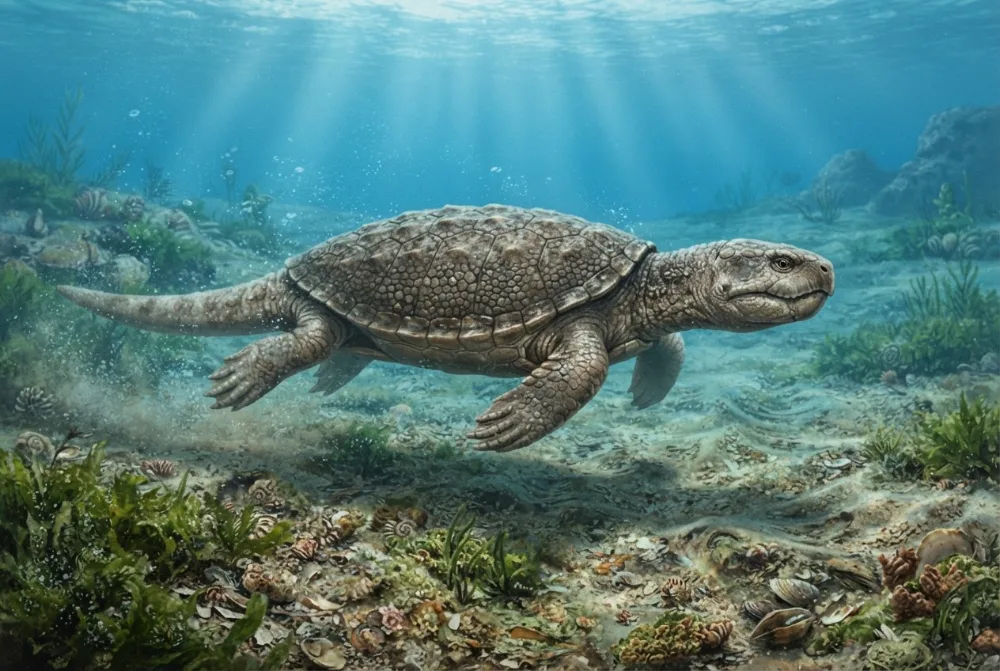
Psephochelys was a turtle-like marine reptile that lived in the Late Triassic period, about 233 to 227 million years ago. It had a shell on its back made of many small bony plates, but no shell on its belly, just loose bones. It swam in warm seas where China is today.12
Berɛ bɛn na ɛtenaa ase?
Na ɛyɛ ntɛm sɛn?


Nsɛm a ɛyɛ anigye
Psephochelys is known from only one species, Psephochelys polyosteoderma, and the first fossil was a partial skeleton found in the Falong Formation in China.1
Unlike turtles, Psephochelys had no hard shell on its belly. Instead, it had rib-like bones and small bony plates that were loosely connected.1
A subadult specimen shows that the shell of Psephochelys grew by fusing small plates together, starting from the middle and edges, similar to how a turtle's shell develops.3
Psephochelys belonged to a group called placodonts, which were marine reptiles that looked like turtles but are not closely related to them.1
The name Psephochelys means 'pebbly turtle' because its shell was made of many small, pebble-like bony plates.1
Psephochelys lived during the Carnian age of the Late Triassic, between about 233 and 227 million years ago.2
Ma dino ho animdefoɔ
- Nyansahu din
- Psephochelys
- Obi a ɔtoo din
- Li and Rieppel 20024
- Kuo
- Ɛpo mu mmoa a wɔwea
- Abusua / kuo kɛseɛ
- Placochelyidae4
- Nkyekyɛmu
- Placodontia > Sauropterygia4
- Abotan no mfeɛ
- mfeɛ ɔpepem 234 kɔsi 227 (Carnian)4
- Abotan nhyehyɛeɛ
- Xiaowa4
- Aman
- Kyaena4
- Fɔsil nkyerɛwee
- 1 wɔ The Paleobiology Database mu4
- Nhunumu
- Psephochelys was named by Chinese paleontologist Chun Li and Swiss paleontologist Olivier Rieppel in 2002, based on a single partial skeleton found in Guizhou, China.12
- Wɔda so gye ho akyinnye
- Scientists are still debating exactly how Psephochelys is related to other placodonts, and whether its shell grew in a way that hints at a common ancestor with turtles.3
Baabi a nsɛm no firi
- Psephochelys (en.wikipedia.org)
- PBDB Taxon (paleobiodb.org)
- First subadult specimen of Psephochelys polyosteoderma (Sauropterygia, Placodontia) implies turtle-like fusion pattern of the carapace (onlinelibrary.wiley.com)
- Psephochelys in The Paleobiology Database (CC BY 4.0): mfeɛ, mmeaeɛ, abotan nhyehyɛeɛ, nkyekyɛmu.
Asɛm biara a ɛwɔ krataafa yi so wɔ nɔma a ɛkyerɛ baabi a ɛfiri. Sɛ yɛfom biribi a, kafra, yɛyɛ dino dɔfoɔ, yɛnyɛ nyansahu nsɛmma krataa. Ka kyerɛ yɛn wɔ [email protected] na yɛbɛsiesie.
 Ɔkɔm de Rex! Dino Wiki yɛ agya bi adwuma a ɔyɛɛ maa ne babarima a ɔdɔ dino. Ɛyɛ kwa, dawurubɔ biara nni mu, akyidifoɔ biara nni mu. Mpanimfoɔ bɛtumi ama Rex aduane kakra, na aboa ama Dino Wiki atena intanɛt so.Ma Rex aduane
 Nothosaurus
 Placodus
 Lariosaurus
 Cyamodus
 Cymatosaurus
 Proneusticosaurus
 Massospondylus
 Plateosaurus
 Coelophysis
 Podokesaurus
 Thecodontosaurus
 Eudimorphodon