 Woyɛ dino bɛn? Nsɛmmisa agoro
 Dino ko
 Dino mmirikatuo
 Dino agodie nketewa
 Stika nwoma
 Dino TOP nhyehyɛeɛ
 Ma me nwanwa!
Qianxisaurus
Qianxisaurus was a marine reptile that swam in the warm seas of China about 238 million years ago. It had a long body, a long tail, and a snout longer than the rest of its skull. This creature was not a dinosaur, but a type of eosauropterygian, a group of ancient sea reptiles.1
Berɛ bɛn na ɛtenaa ase?
Na ne kɛseɛ yɛ sɛn?
Na ne tenten yɛ sɛn?
 ne tenten te sɛ fie agyinamoa 1.5 firi hwene kɔsi dua🍌ne tenten te sɛ kwadu 4 a wɔde abɔ toatoa so🏊anka ɔbɛtumi aguare nsuguarebea kɛseɛ (50 m) tenten wɔ sikɛn 26 mu
Qianxisaurus kɛseɛ yɛ sɛn sɛ wode toto WO ho a?
Akontaa nko ara wɔ wo browser mu. Yɛnkora biribiara so, na yɛmmfa biribiara nkɔ baabiara.
Na ɛyɛ ntɛm sɛn?


Nsɛm a ɛyɛ anigye
Qianxisaurus had 28 back vertebrae and four sacral vertebrae, which is unusual for early sauropterygians.1
Its skull was only 7.6 cm (3 inches) long, but the whole animal was over 80 cm (2 feet 7 inches) in length.1
The name Qianxisaurus comes from 'Qianxi', meaning western Guizhou in Chinese, and 'saurus' meaning lizard.1
Qianxisaurus had a very small supratemporal fenestra, a hole in the skull roof, which was only slightly larger than a foramen in the parietal bone.1
Its dorsal ribs had a longitudinal groove on the upper-back surface, a feature shared with some other early marine reptiles like Corosaurus and Sanchiaosaurus.1
The only known fossil of Qianxisaurus was discovered in 2006 near the Huangnihe River in Xingyi, Guizhou, and is now kept at the National Museum of Natural Science in Taiwan.1
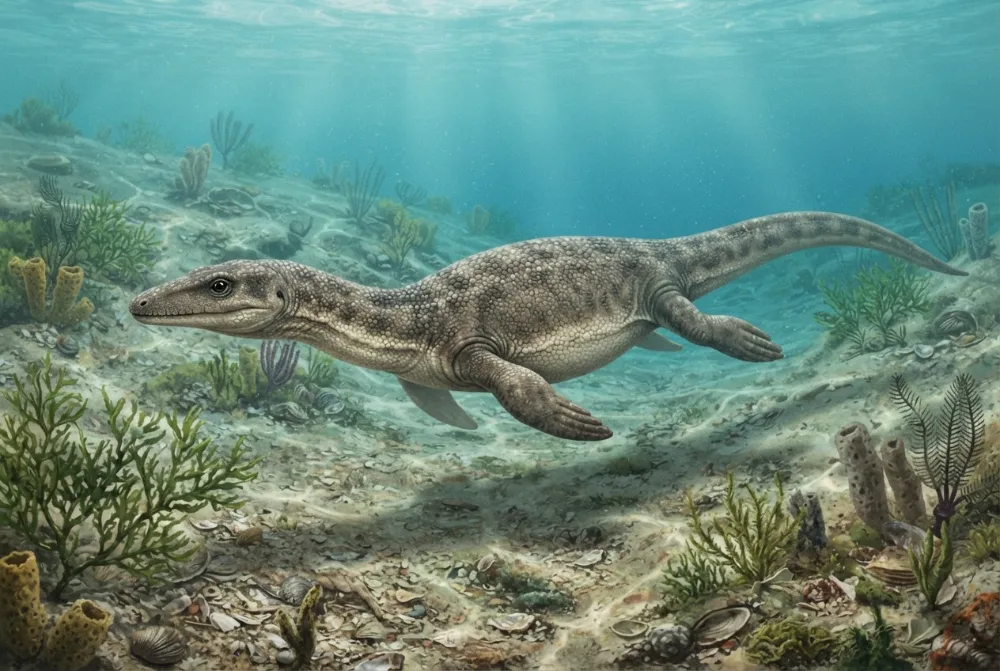
Ma dino ho animdefoɔ
- Nyansahu din
- Qianxisaurus
- Obi a ɔtoo din
- Cheng et al. 20122
- Kuo
- Ɛpo mu mmoa a wɔwea
- Abusua / kuo kɛseɛ
- Eosauropterygia2
- Nkyekyɛmu
- Sauropterygia2
- Abotan no mfeɛ
- mfeɛ ɔpepem 241 kɔsi 237 (Ladinian)2
- Abotan nhyehyɛeɛ
- Falang2
- Aman
- Kyaena2
- Fɔsil nkyerɛwee
- 1 wɔ The Paleobiology Database mu2
- Nhunumu
- Qianxisaurus was named by Yen-Nien Cheng, Xiao-Chun Wu, Tamaki Sato and Hsi-Yin Shan in 2012 based on a nearly complete skeleton found in the Zhuganpo Member of the Falang Formation in Guizhou, China.1
- Wɔda so gye ho akyinnye
- Scientists are not sure whether Qianxisaurus was a pachypleurosaur or a more basal eosauropterygian, and its exact relationships within the group are still debated.1
Baabi a nsɛm no firi
- Qianxisaurus (en.wikipedia.org)
- Qianxisaurus in The Paleobiology Database (CC BY 4.0): mfeɛ, mmeaeɛ, abotan nhyehyɛeɛ, nkyekyɛmu.
Asɛm biara a ɛwɔ krataafa yi so wɔ nɔma a ɛkyerɛ baabi a ɛfiri. Sɛ yɛfom biribi a, kafra, yɛyɛ dino dɔfoɔ, yɛnyɛ nyansahu nsɛmma krataa. Ka kyerɛ yɛn wɔ [email protected] na yɛbɛsiesie.
 Ɔkɔm de Rex! Dino Wiki yɛ agya bi adwuma a ɔyɛɛ maa ne babarima a ɔdɔ dino. Ɛyɛ kwa, dawurubɔ biara nni mu, akyidifoɔ biara nni mu. Mpanimfoɔ bɛtumi ama Rex aduane kakra, na aboa ama Dino Wiki atena intanɛt so.Ma Rex aduane
 Nothosaurus
 Placodus
 Lariosaurus
 Cyamodus
 Cymatosaurus
 Proneusticosaurus
 Chonespondylus
 Cymbospondylus
 Phalarodon
 Mixosaurus
 Chaohusaurus
 Chensaurus