 Woyɛ dino bɛn? Nsɛmmisa agoro
 Dino ko
 Dino mmirikatuo
 Dino agodie nketewa
 Stika nwoma
 Dino TOP nhyehyɛeɛ
 Ma me nwanwa!
Berɛ bɛn na ɛtenaa ase?

Na ne kɛseɛ yɛ sɛn?
Na ne tenten yɛ sɛn?
Na ne korɔn yɛ sɛn?
Na ne mu yɛ duru sɛn?
 ne tenten te sɛ nkraman 5 firi hwene kɔsi dua🍌ne tenten te sɛ kwadu 29 a wɔde abɔ toatoa so🍉ne mu duru te sɛ watamɛlɔn 82🧸ne mu duru te sɛ nkɔkɔaa sukuu mmofra 22🎒ne mu duru te sɛ sukuu mmofra 13🏃anka ɔbɛtumi atu mmirika mita 100 wɔ sikɛn 8.2 mu (onipa a ɔyɛ ntɛm sen biara hia 9.6)
Rugops kɛseɛ yɛ sɛn sɛ wode toto WO ho a?
Akontaa nko ara wɔ wo browser mu. Yɛnkora biribiara so, na yɛmmfa biribiara nkɔ baabiara.
Na ɛyɛ ntɛm sɛn?


Nsɛm a ɛyɛ anigye
Rugops is known from only a partial skull, which is about 31.5 centimetres (12.4 inches) long.2
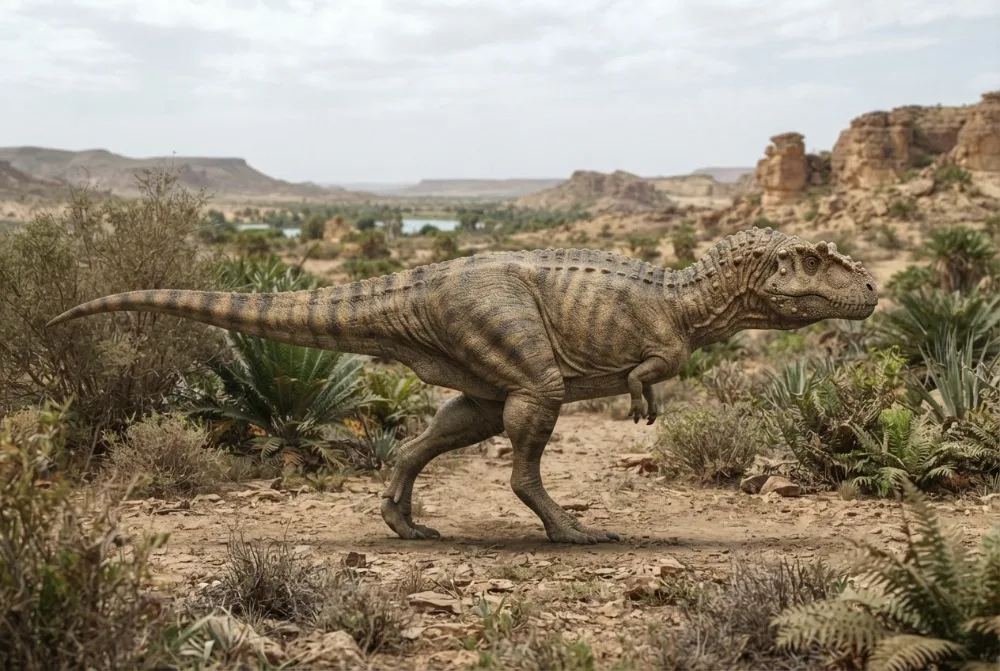
The top of its skull had many pits and bumps, which would have supported scales and a tough, armour-like skin on its snout.2
Rows of holes in the skull may mean Rugops had a crest or some kind of display structure on its head.1
Rugops lived alongside other huge predators like Carcharodontosaurus and Spinosaurus.2
The type specimen might have been a subadult, because its skull bones were not fully fused together.2
Rugops was one of the earliest abelisaurids, a group of horned, short-snouted theropods that lived in the southern continents.2
Nsɛm a wɔbisa bebree fa Rugops ho
?How big was Rugops?
Scientists estimate Rugops was about 4.4 to 5.3 metres (14 to 17 feet) long and weighed around 410 kilograms (900 pounds). Some earlier estimates suggested it was up to 6 metres (20 feet) long and 750 kilograms (1,650 pounds).2
?What did Rugops eat?
Rugops was a carnivore, meaning it ate meat. Its delicate skull suggests it was a scavenger that fed on dead animals rather than a hunter that killed its own prey.13
?Where did Rugops live?
Rugops lived in what is now Niger, Africa, about 95 million years ago. Its fossils were found in the Echkar Formation, which was a river and lake environment.2
?Did Rugops have feathers?
Nobody knows for sure. Rugops is known only from a skull, and no feathers or feather impressions have been found with it. Its skull had pits and bumps that supported scales, not feathers.2
?Why is it called Rugops?
Rugops means 'wrinkle face' in Latin and Greek. It was named for the wrinkled, bumpy texture on its skull bones.2
?Was Rugops bigger than T. rex?
No, Rugops was much smaller. Rugops was about 4.4 to 5.3 metres (14 to 17 feet) long, while T. rex was over 12 metres (40 feet) long.2
Ma dino ho animdefoɔ
- Nyansahu din
- Rugops
- Obi a ɔtoo din
- Sereno et al. 20044
- Kuo
- Dino a wɔwe nam
- Abusua / kuo kɛseɛ
- Abelisauridae4
- Nkyekyɛmu
- Theropoda > Ceratosauria > Abelisauridae4
- Abotan no mfeɛ
- mfeɛ ɔpepem 100 kɔsi 94 (Cenomanian)4
- Abotan nhyehyɛeɛ
- Echkar4
- Aman
- Naigya4
- Fɔsil nkyerɛwee
- 1 wɔ The Paleobiology Database mu4
- Nhunumu
- Rugops was named in 2004 by paleontologist Paul Sereno and his team, based on a partial skull found in the Echkar Formation of Niger during an expedition funded by the National Geographic Society.2
- Wɔda so gye ho akyinnye
- Scientists are not sure exactly how Rugops is related to other abelisaurids; some studies place it as the most primitive, while others put it in a group with several other genera.2
Baabi a nsɛm no firi
- Rugops | Natural History Museum (nhm.ac.uk)
- Rugops (en.wikipedia.org)
- Discoveries | Paul Sereno - Paleontologist | The University of Chicago (paulsereno.uchicago.edu)
- Rugops in The Paleobiology Database (CC BY 4.0): mfeɛ, mmeaeɛ, abotan nhyehyɛeɛ, nkyekyɛmu.
Asɛm biara a ɛwɔ krataafa yi so wɔ nɔma a ɛkyerɛ baabi a ɛfiri. Sɛ yɛfom biribi a, kafra, yɛyɛ dino dɔfoɔ, yɛnyɛ nyansahu nsɛmma krataa. Ka kyerɛ yɛn wɔ [email protected] na yɛbɛsiesie.
 Ɔkɔm de Rex! Dino Wiki yɛ agya bi adwuma a ɔyɛɛ maa ne babarima a ɔdɔ dino. Ɛyɛ kwa, dawurubɔ biara nni mu, akyidifoɔ biara nni mu. Mpanimfoɔ bɛtumi ama Rex aduane kakra, na aboa ama Dino Wiki atena intanɛt so.Ma Rex aduane
 Allosaurus
 Carnotaurus
 Dilophosaurus
 Giganotosaurus
 Compsognathus
 Paronychodon
 Tyrannosaurus
 Triceratops
 Velociraptor
 Spinosaurus
 Ankylosaurus
 Parasaurolophus