 Woyɛ dino bɛn? Nsɛmmisa agoro
 Dino ko
 Dino mmirikatuo
 Dino agodie nketewa
 Stika nwoma
 Dino TOP nhyehyɛeɛ
 Ma me nwanwa!
Berɛ bɛn na ɛtenaa ase?

Na ne kɛseɛ yɛ sɛn?
Na ne tenten yɛ sɛn?
Na ne korɔn yɛ sɛn?
Na ne mu yɛ duru sɛn?

 ne tenten te sɛ nkraman 7 firi hwene kɔsi dua🍌ne tenten te sɛ kwadu 39 a wɔde abɔ toatoa sone mu duru te sɛ nkraman 140🍉ne mu duru te sɛ watamɛlɔn 560🎒ne mu duru te sɛ sukuu klaas mũ 4 mu mmofra🐻❄️ne mu duru te sɛ polar bea 6🏃anka ɔbɛtumi atu mmirika mita 100 wɔ sikɛn 21 mu (onipa a ɔyɛ ntɛm sen biara hia 9.6)
Tuojiangosaurus kɛseɛ yɛ sɛn sɛ wode toto WO ho a?
Akontaa nko ara wɔ wo browser mu. Yɛnkora biribiara so, na yɛmmfa biribiara nkɔ baabiara.
Na ɛyɛ ntɛm sɛn?


Nsɛm a ɛyɛ anigye
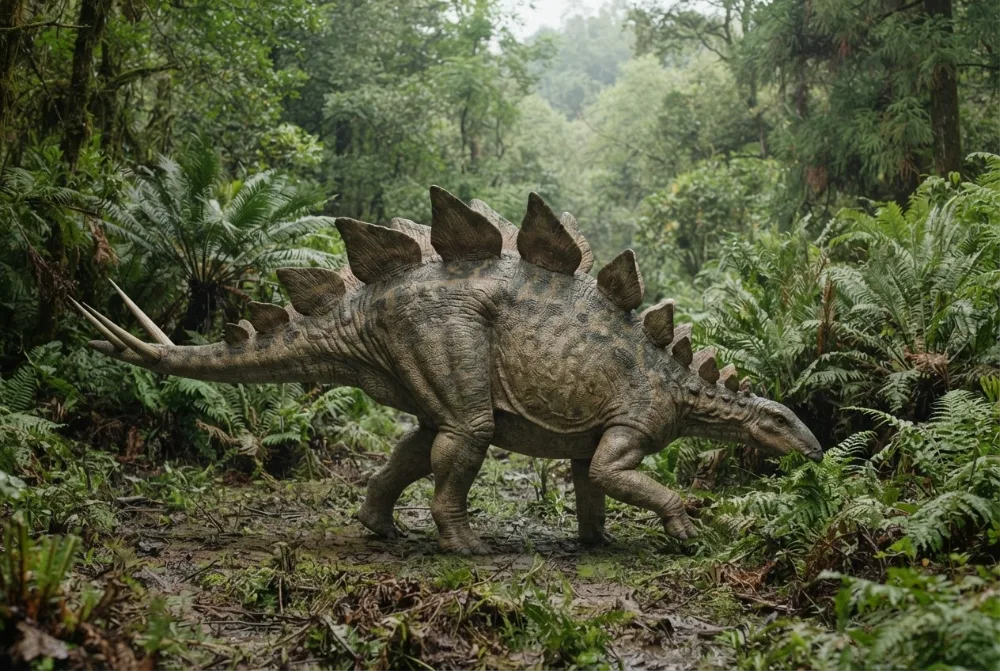
Tuojiangosaurus had about 17 pairs of plates and spikes along its back and tail.2
The spikes at the end of its tail pointed outward at about 45 degrees and are called a 'thagomizer'.2
Unlike Stegosaurus, the plates on Tuojiangosaurus were parallel to each other, not alternating.2
Its front legs were quite short compared to its back legs.2
Tuojiangosaurus lived during the Late Jurassic, about 157 to 154 million years ago.1
The first fossil was found in 1974 during construction of a dam in Zigong, Sichuan.2
Nsɛm a wɔbisa bebree fa Tuojiangosaurus ho
?How big was Tuojiangosaurus?
It was about 6.5 to 7 metres long (21 to 23 feet) and weighed around 2.8 metric tons (3.1 short tons).2
?What did Tuojiangosaurus eat?
It ate low-lying plants like ferns, horsetails, and cycads. It had small snipping teeth and a beaked mouth for plucking vegetation.21
?Did Tuojiangosaurus have a thagomizer?
Yes, it had at least two spikes on each side of its tail tip, pointing outward at about 45 degrees. This spike cluster is called a thagomizer.2
?Where was Tuojiangosaurus found?
Its fossils were discovered in Sichuan Province, China, in 1974 during construction of the Wujiaba dam.2
?Could Tuojiangosaurus stand on its hind legs?
Probably not. Its backbone lacked the special vertebrae needed to rear up, so it likely only ate plants close to the ground.4
?How many plates did Tuojiangosaurus have?
It had about 17 pairs of plates and spikes running along its back and tail. The plates were parallel to each other, unlike Stegosaurus.2
Ma dino ho animdefoɔ
- Nyansahu din
- Tuojiangosaurus
- Obi a ɔtoo din
- Dong et al. 19775
- Kuo
- Dino a apuo wɔ wɔn akyi
- Abusua / kuo kɛseɛ
- Stegosauridae5
- Nkyekyɛmu
- Ornithischia > Stegosauria > Thyreophora5
- Abotan no mfeɛ
- mfeɛ ɔpepem 168 kɔsi 162 (Bathonian / Callovian)5
- Abotan nhyehyɛeɛ
- Shaximiao5
- Aman
- Kyaena5
- Fɔsil nkyerɛwee
- 1 wɔ The Paleobiology Database mu5
- Nhunumu
- Tuojiangosaurus was named and described in 1977 by Dong Zhiming, Zhou Shiwu, Li Xuanmin and Chang Yijong, exactly 100 years after Stegosaurus was named. The holotype skeleton is one of the most complete stegosaur skeletons found in Asia.2
- Wɔda so gye ho akyinnye
- Scientists are not sure exactly where Tuojiangosaurus fits in the stegosaur family tree. Some studies place it outside Stegosauridae, while others group it with Huayangosaurus.2
Baabi a nsɛm no firi
- Tuojiangosaurus | Natural History Museum (nhm.ac.uk)
- Tuojiangosaurus (en.wikipedia.org)
- Tuojiangosaurus - Wikidata (wikidata.org)
- Tuojiangosaurus | Earth and Atmospheric Sciences | Research Starters | EBSCOhost (ebsco.com)
- Tuojiangosaurus in The Paleobiology Database (CC BY 4.0): mfeɛ, mmeaeɛ, abotan nhyehyɛeɛ, nkyekyɛmu.
Asɛm biara a ɛwɔ krataafa yi so wɔ nɔma a ɛkyerɛ baabi a ɛfiri. Sɛ yɛfom biribi a, kafra, yɛyɛ dino dɔfoɔ, yɛnyɛ nyansahu nsɛmma krataa. Ka kyerɛ yɛn wɔ [email protected] na yɛbɛsiesie.
 Ɔkɔm de Rex! Dino Wiki yɛ agya bi adwuma a ɔyɛɛ maa ne babarima a ɔdɔ dino. Ɛyɛ kwa, dawurubɔ biara nni mu, akyidifoɔ biara nni mu. Mpanimfoɔ bɛtumi ama Rex aduane kakra, na aboa ama Dino Wiki atena intanɛt so.Ma Rex aduane
 Stegosaurus
 Diracodon
 Hypsirophus
 Dacentrurus
 Miragaia
 Kentrosaurus
 Ichthyosaurus
 Khudiakovia
 Ophthalmosaurus
 Pterodactylus
 Peloneustes
 Rhamphocephalus