
Amanzia
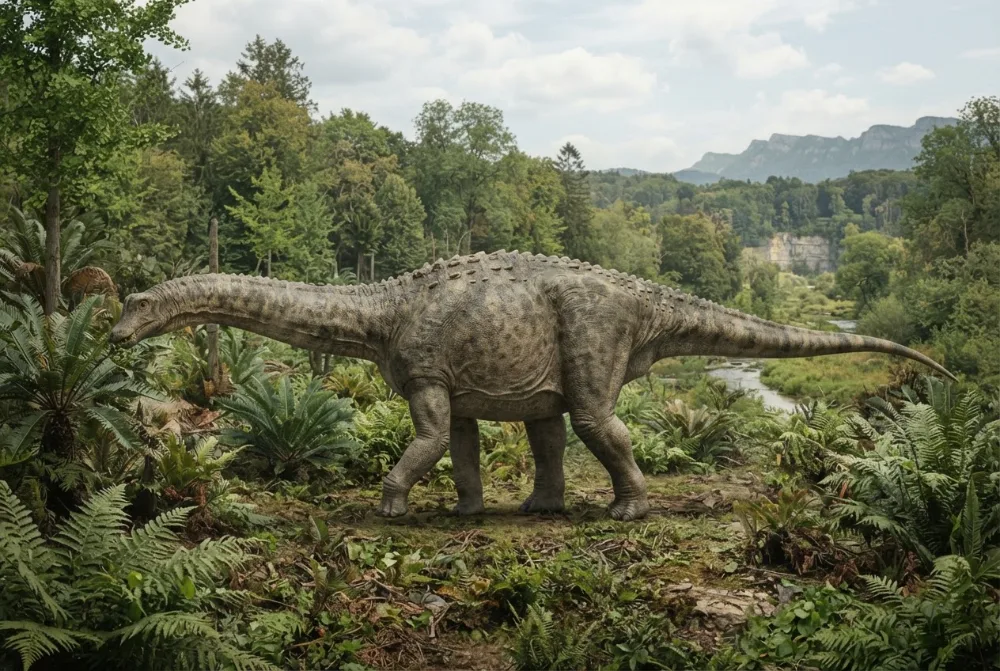
Amanzia was a long-necked plant-eater that lived in what is now Switzerland about 157 million years ago. It was a small sauropod, not much longer than a school bus, and it munched on leaves and ferns. Its bones were found in an old quarry near the town of Moutier.12
When did it live?
How big was it?
How long was it?
How big was Amanzia compared to YOU?
Just maths in your browser. Nothing is saved or sent anywhere.
How fast was it?
Fun facts
Amanzia was first thought to be a different dinosaur called Ornithopsis, and later Cetiosauriscus, before scientists gave it its own name in 2020.12
The fossils include bones from at least four different individuals, some of which were different sizes.1
Amanzia had a special rough patch on the back of its upper arm bone that no other sauropod has.1
Its tail bones were long and had small holes for blood vessels.1
The bones were found in a greenish layer of marl and limestone, which was once a muddy seafloor.1
Amanzia is one of the few sauropods known from Switzerland, and its discovery helped scientists understand European dinosaurs better.1
Most asked questions about Amanzia
?How big was Amanzia?
Amanzia was a small sauropod, not more than 10 metres long. That is about as long as a school bus.12
?What did Amanzia eat?
Amanzia was a plant-eater. It munched on leaves and ferns, like other sauropods.2

Ask Rex about Amanzia
Rex only answers questions about this page. 10 questions a month.
Rex is an AI and can make mistakes. He runs on servers in the EU and questions are never saved. Never type your name or other personal things.
For dino experts
- Scientific name
- Amanzia
- Named by
- Schwarz et al. 20203
- Group
- Long-necks
- Family / clade
- Turiasauria3
- Classification
- Sauropodomorpha > Sauropoda3
- Age of the rocks
- 155 to 152 million years (Kimmeridgian)3
- Rock formations
- Reuchenette3
- Countries
- Switzerland3
- Fossil records
- 2 in the Paleobiology Database3
- Discovery
- The first bones were found in the 1860s in a quarry near Moutier, Switzerland. In 1922, German scientist Friedrich von Huene named them Ornithopsis greppini. In 2020, a new study gave them the new genus name Amanzia, after Swiss geologist Amanz Gressly.12
- Still debated
- Scientists are not sure whether Amanzia was a member of the group Turiasauria or just a close relative of all later sauropods.1
Where the facts come from
- Re-description of the sauropod dinosaur Amanzia (“Ornithopsis/Cetiosauriscus”) greppini n. gen. and other vertebrate remains from the Kimmeridgian (Late Jurassic) Reuchenette Formation of Moutier, Switzerland | Swiss Journal of Geosciences | Springer Nature Link (link.springer.com)
- Amanzia (en.wikipedia.org)
- Amanzia in The Paleobiology Database (CC BY 4.0): age, places, rock formations, classification.
Every fact on this page has a number that points to its source. If we got something wrong, sorry, we are dino fans, not a science journal. Tell us at [email protected] and we will fix it.
 Rex is hungry! Dino Wiki is a dad's project for his dino-loving son, free with no ads. Grown-ups can feed Rex a snack to help keep it online.Feed Rex
 Brachiosaurus
 Diplodocus
 Brontosaurus
 Argentinosaurus
 Camarasaurus
 Morosaurus
 Allosaurus
 Compsognathus
 Camptosaurus
 Nanosaurus
 Rhamphorhynchus
 Ceratosaurus