
Austriadraco
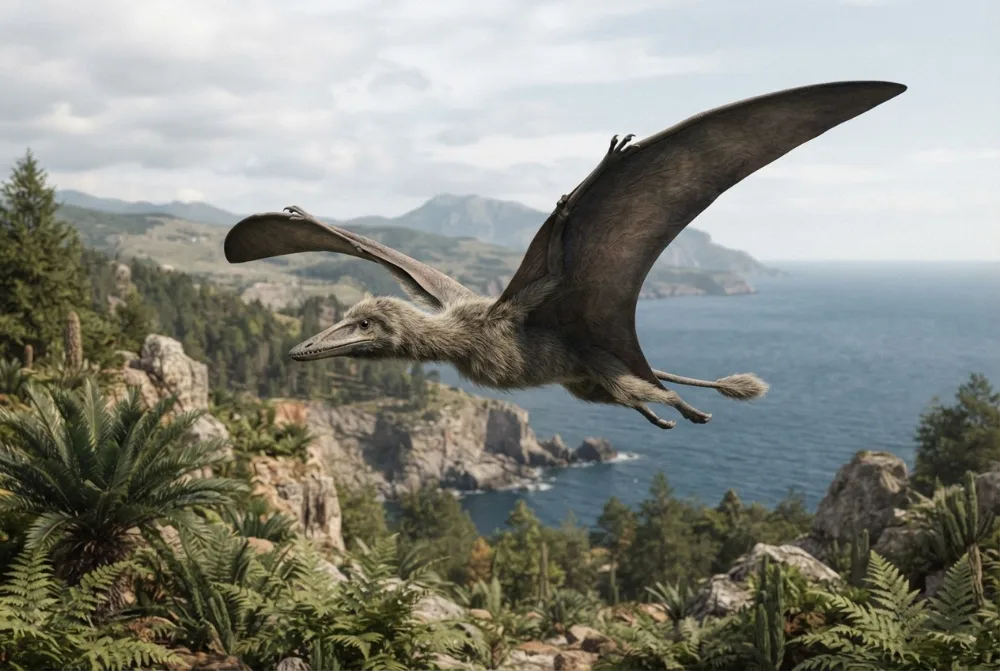
Austriadraco was a small flying reptile that lived during the Late Triassic, about 217 to 213 million years ago. It had a wingspan of about 60 centimeters (2 feet) and likely ate fish. Its fossils were found in Austria, which is how it got its name.13
When did it live?
How big was it?
How wide were its wings?
How big was Austriadraco compared to YOU?
Just maths in your browser. Nothing is saved or sent anywhere.
Fun facts
Austriadraco was once thought to be a young Eudimorphodon, but scientists now know it is a separate genus.12
Its fossils were found on a mountain trail at about 1600 meters (5250 feet) high in Austria.1
The only known skeleton is incomplete and disarticulated, meaning the bones were scattered before they became fossils.1
Austriadraco had a shoulder blade that was 62% longer than its coracoid, a bone in the shoulder.1
Most asked questions about Austriadraco
?How big was Austriadraco?
Austriadraco was a small pterosaur with a wingspan of about 60 centimeters (24 inches) and a humerus (upper arm bone) about 4 centimeters long.13
?What did Austriadraco eat?
Austriadraco likely ate fish, based on its classification as a volant (flying) piscivore (fish-eater).3
?Is Austriadraco a dinosaur?
No, Austriadraco is a pterosaur, a flying reptile that lived at the same time as dinosaurs but is not a dinosaur itself.1

Ask Rex about Austriadraco
Rex only answers questions about this page. 3 questions a day.
Rex is an AI and can make mistakes. He runs on servers in the EU and questions are never saved. Never type your name or other personal things.
For dino experts
- Scientific name
- Austriadraco
- Named by
- Kellner 20153
- Group
- Flying reptiles
- Family / clade
- Pterosauria3
- Classification
- Pterosauria3
- Age of the rocks
- 211 to 206 million years (Norian)3
- Rock formations
- Seefelder Schichten3
- Countries
- Austria3
- Fossil records
- 1 in the Paleobiology Database3
- Discovery
- The fossil was discovered in June 1994 by Bernd Lammerer near Seefeld, Austria. In 2015, Alexander Kellner named it Austriadraco dallavecchiai, honoring pterosaur expert Fabio Marco Dalla Vecchia.12
- Still debated
- Scientists are not sure exactly which other pterosaurs are its closest relatives. Some think it is related to Arcticodactylus, but others are not certain.12
Where the facts come from
- Austriadraco (en.wikipedia.org)
- Brazil - Comments on Triassic pterosaurs with discussion about ontogeny and description of new taxa Comments on Triassic pterosaurs with discussion about ontogeny and description of new taxa (scielo.br)
- Austriadraco in The Paleobiology Database (CC BY 4.0): age, places, rock formations, classification.
Every fact on this page has a number that points to its source. If we got something wrong, sorry, we are dino fans, not a science journal. Tell us at [email protected] and we will fix it.
 Rex is hungry! Dino Wiki is a dad's project for his dino-loving son, free with no ads. Grown-ups can feed Rex a snack to help keep it online.Feed Rex
 Pteranodon
 Quetzalcoatlus
 Dorygnathus
 Rhamphorhynchus
 Anhanguera
 Pterodactylus
 Nothosaurus
 Massospondylus
 Plateosaurus
 Coelophysis
 Podokesaurus
 Simosaurus