When did it live?

How big was it?
Fun facts
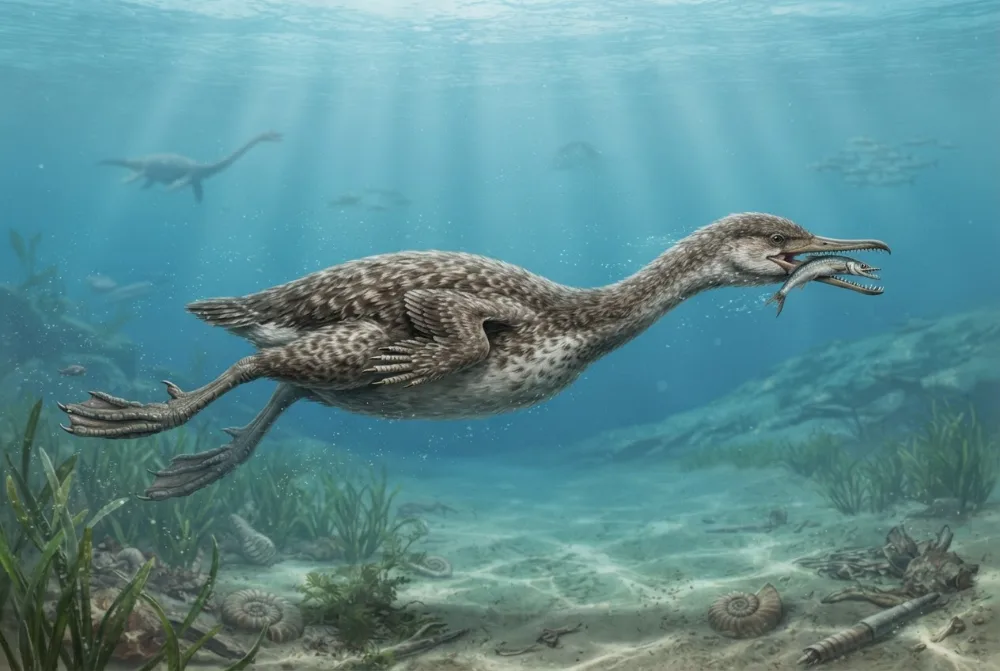
Baptornis had teeth in its beak, which is rare for birds. Most modern birds have no teeth.1
It was a strong swimmer and diver, but on land it was clumsy. It probably pushed itself along on its belly or did small hops.1
Fossils of young Baptornis have been found in Canada and Alaska, suggesting these birds migrated north to breed in summer, like some penguins do today.1
Baptornis lived about 87 to 80 million years ago, when a shallow sea covered much of central North America.1
One Baptornis fossil was found with tiny round coprolites (fossil poop) inside. The poop contained remains of a small sabre-toothed herring.1
Baptornis was one of the first Mesozoic birds discovered, along with Archaeopteryx. It was named by famous fossil hunter Othniel Charles Marsh in 1877.1
A second, much larger species of Baptornis was once named (Baptornis varneri), but later scientists moved it to a different genus called Brodavis.1
For dino experts
- Scientific name
- Baptornis
- Named by
- Marsh 18772
- Group
- Early birds
- Family / clade
- Baptornithidae2
- Classification
- Theropoda > Avialae2
- Age of the rocks
- 90 to 72 million years (Coniacian to Campanian)2
- Rock formations
- Dinosaur Park, Niobrara, Judith River2
- Countries
- Canada, USA, Sweden2
- Fossil records
- 10 in the Paleobiology Database2
- Also known as
- Parascaniornis (older names now counted as the same animal)2
- Discovery
- Othniel Charles Marsh discovered the first fossils of Baptornis in Kansas in the 1870s. He named it in 1877.1
- Still debated
- Scientists are not sure if a fossil from Sweden called Parascaniornis stensioi is actually a second species of Baptornis or just the same species.1
Where the facts come from
- Baptornis (en.wikipedia.org)
- Baptornis in The Paleobiology Database (CC BY 4.0): age, places, rock formations, classification.
Every fact on this page has a number that points to its source. If we got something wrong, sorry, we are dino fans, not a science journal. Tell us at [email protected] and we will fix it.
 Rex is hungry! Dino Wiki is free with no ads. Grown-ups can feed Rex a snack to keep it that way.Feed Rex
 Archaeopteryx
 Hesperornis
 Ichthyornis
 Jurapteryx
 Gobipteryx
 Martinavis
 Triceratops
 Velociraptor
 Spinosaurus
 Ankylosaurus
 Parasaurolophus