
Triceratops
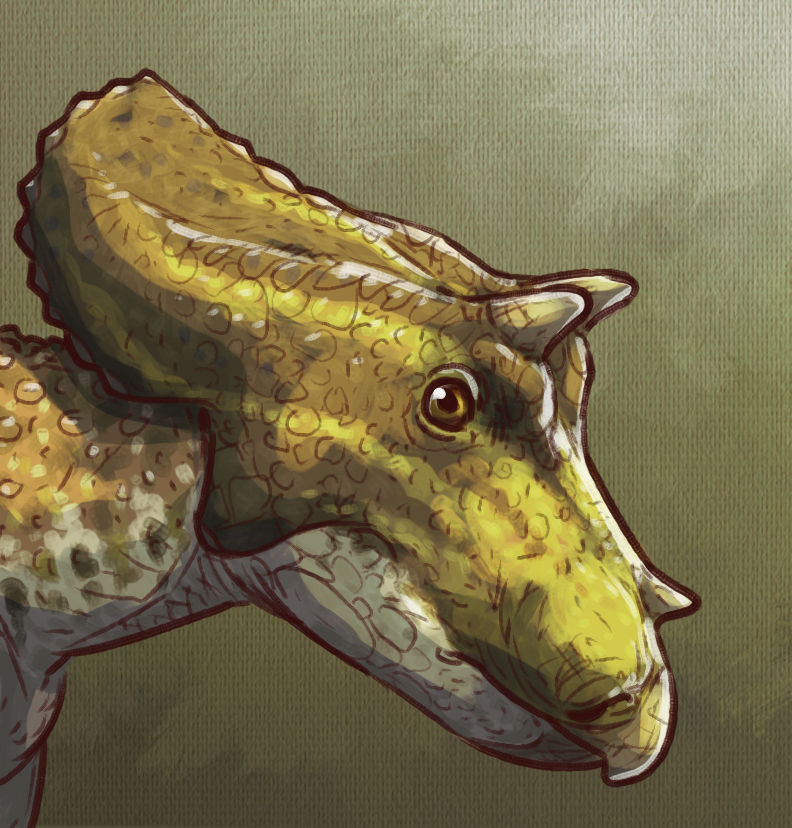
Triceratops was a huge plant-eater with a big frill on its head and three horns. It lived at the very end of the age of dinosaurs, about 66 million years ago. It was one of the last horned dinosaurs to walk the Earth.1
When did it live?
How big was it?
Fun facts
Triceratops had a huge frill made of solid bone at the back of its skull, which may have been used to attract mates or scare off rivals.1
Its name means 'three-horned face' because it had two long brow horns and a smaller horn on its nose.1
Triceratops lived right up to the mass extinction that killed the non-bird dinosaurs, about 66 million years ago.1
Fossils of Triceratops have been found in huge bonebeds, with many individuals together, suggesting they may have lived in herds.1
Triceratops had a strong beak like a parrot's, which it used to bite off tough plants.1
Some scientists think Triceratops could have fought predators like Tyrannosaurus rex using its sharp horns.1
Myth buster
Myth: Triceratops was a slow, clumsy animal that could barely move.
Truth: Triceratops was actually quite fast for its size, able to run at speeds of up to 30 km/h (about 20 mph) on its strong legs.1
For dino experts
- Scientific name
- Triceratops
- Named by
- Marsh 18892
- Group
- Horned dinos
- Family / clade
- Ceratopsidae2
- Classification
- Ornithischia > Ceratopsia > Ceratopsidae2
- Age of the rocks
- 84 to 66 million years (Campanian to Maastrichtian)2
- Rock formations
- Lance, Hell Creek, Frenchman2
- Countries
- USA, Canada2
- Fossil records
- 166 in the Paleobiology Database2
- Also known as
- Diceratops, Diceratus, Nedoceratops, Sterrholophus (older names now counted as the same animal)2
- Discovery
- Triceratops was named by paleontologist Othniel Charles Marsh in 1889, based on fossils found in Wyoming, USA.2
- Still debated
- Scientists still debate whether some fossils belong to Triceratops or to a separate, related dinosaur called Torosaurus.1
Where the facts come from
- Triceratops (en.wikipedia.org)
- Triceratops in The Paleobiology Database (CC BY 4.0): age, places, rock formations, classification.
Every fact on this page has a number that points to its source. If we got something wrong, sorry, we are dino fans, not a science journal. Tell us at [email protected] and we will fix it.
 Rex is hungry! Dino Wiki is free with no ads. Grown-ups can feed Rex a snack to keep it that way.Feed Rex
 Protoceratops
 Ojoceratops
 Tatankaceratops
 Psittacosaurus
 Centrosaurus
 Chasmosaurus
 Velociraptor
 Spinosaurus
 Ankylosaurus
 Parasaurolophus
 Pteranodon