
Parasaurolophus
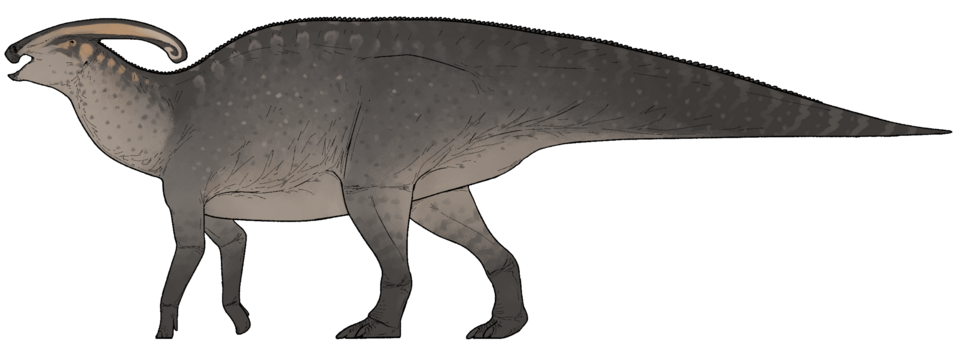
Parasaurolophus was a duck-billed dinosaur with a long, curved crest on its head. It lived in North America during the Late Cretaceous Period, about 77 to 73 million years ago. This plant-eater could walk on two legs or all fours.21
When did it live?
How big was it?
Fun facts
Parasaurolophus had a huge, hollow crest on its head that was shaped like a long tube. Scientists think it may have used the crest to make sounds like a trumpet.1
It had a beak like a duck and cheeks to hold food while chewing. Its teeth were constantly replaced, with hundreds packed together in a 'dental battery'.21
Parasaurolophus could walk on two legs or on all fours. It probably spent most of its time on all fours but could stand on its back legs when needed.2
Three species are known: P. walkeri, P. tubicen, and P. cyrtocristatus. P. tubicen was the largest and had the longest, straightest crest.1
The first Parasaurolophus fossil was found in 1920 near Sand Creek in Alberta, Canada. It was named in 1922 by William Parks.1
Parasaurolophus lived in a warm, swampy environment near the shore of a huge inland sea that split North America in two.1
For dino experts
- Scientific name
- Parasaurolophus
- Named by
- Parks 19223
- Group
- Duck-bills
- Family / clade
- Hadrosauridae3
- Classification
- Ornithischia > Ornithopoda > Iguanodontia > Hadrosauridae3
- Age of the rocks
- 84 to 72 million years (Campanian)3
- Rock formations
- Kirtland, Dinosaur Park, Fruitland3
- Countries
- USA, Canada3
- Fossil records
- 20 in the Paleobiology Database3
- Discovery
- The first Parasaurolophus fossil, a skull and partial skeleton, was found in 1920 by a University of Toronto field party near Sand Creek in Alberta, Canada. William Parks named it Parasaurolophus walkeri in 1922.1
- Still debated
- Scientists debate whether the different crest shapes belong to separate species or are just males and females of the same species.1
Where the facts come from
- Parasaurolophus (en.wikipedia.org)
- Parasaurolophus | Natural History Museum (nhm.ac.uk)
- Parasaurolophus in The Paleobiology Database (CC BY 4.0): age, places, rock formations, classification.
Every fact on this page has a number that points to its source. If we got something wrong, sorry, we are dino fans, not a science journal. Tell us at [email protected] and we will fix it.
 Rex is hungry! Dino Wiki is free with no ads. Grown-ups can feed Rex a snack to keep it that way.Feed Rex
 Edmontosaurus
 Saurolophus
 Hypacrosaurus
 Corythosaurus
 Kritosaurus
 Gryposaurus
 Triceratops
 Velociraptor
 Spinosaurus
 Ankylosaurus
 Pteranodon