
Bistahieversor
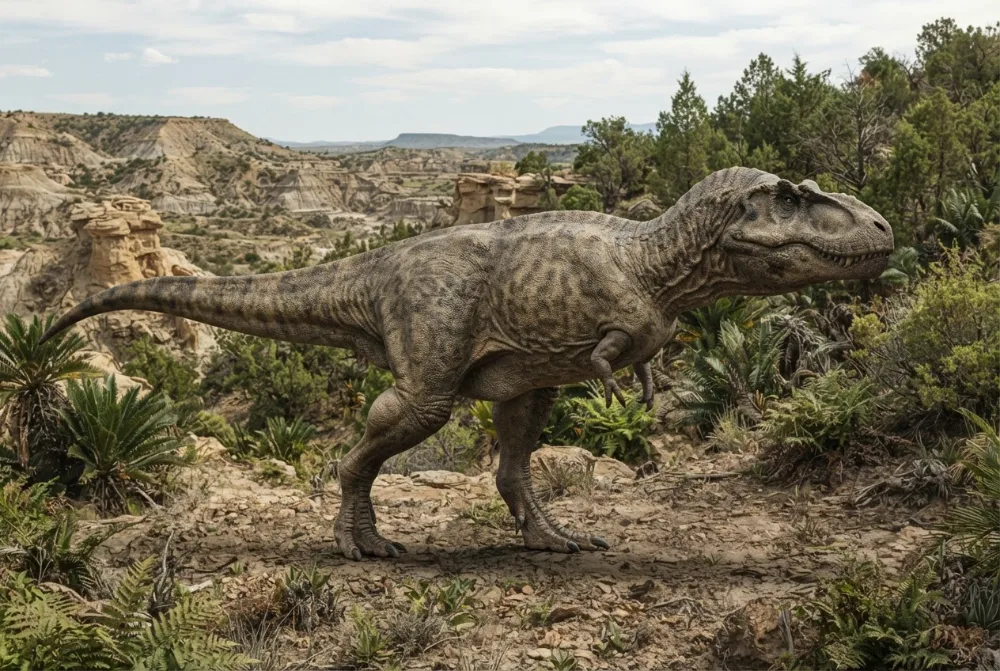
Bistahieversor was a fierce meat-eating dinosaur that lived in what is now New Mexico, USA. It was a close cousin of the famous Tyrannosaurus rex and had a deep, strong snout for biting. Scientists call it the 'Bisti Beast' after the wild area where its bones were found.1
When did it live?
How big was it?
How big was Bistahieversor compared to YOU?
Just maths in your browser. Nothing is saved or sent anywhere.
Fun facts
Bistahieversor had 64 teeth, more than many other tyrannosaurs.1
It had an extra opening above its eye, which scientists think held an air sac that made the skull lighter.1
A keel along its lower jaw helped strengthen its bite.1
Bistahieversor lived about 75.5 to 74.5 million years ago, during the Late Cretaceous.1
The first fossils of Bistahieversor were once mistaken for another dinosaur called Aublysodon.2
Both adult and juvenile skeletons have been found, giving scientists a good look at how it grew.2
Most asked questions about Bistahieversor
?How big was Bistahieversor?
About 8 to 9 metres (26 to 30 feet) long and weighed between 2.5 and 3.3 metric tons (2.75 to 3.6 short tons).13
?Was Bistahieversor bigger than T. rex?
No, Bistahieversor was much smaller than Tyrannosaurus rex. T. rex could be over 12 metres (40 feet) long and weigh more than 8 metric tons.1
?What did Bistahieversor eat?
It was a meat-eater that hunted other dinosaurs. Its deep snout and strong bite helped it catch and eat prey.13
?Where was Bistahieversor found?
Its fossils were found in the Bisti/De-Na-Zin Wilderness Area in New Mexico, USA. That's why it's called the 'Bisti Beast'.13
?When did Bistahieversor live?
It lived about 75.5 to 74.5 million years ago, during the Late Cretaceous Period.1
?Did Bistahieversor have feathers?
Scientists are not sure. No feathers have been found with Bistahieversor fossils, but some of its close relatives may have had simple feathers.1

Ask Rex about Bistahieversor
Rex only answers questions about this page. 3 questions a day.
Rex is an AI and can make mistakes. He runs on servers in the EU and questions are never saved. Never type your name or other personal things.
Myth buster
Myth: Bistahieversor is often called a tyrannosaurid like T. rex.
Truth: Scientists now think Bistahieversor was a close relative of tyrannosaurids, but not a true member of that family. It belongs to a group called Eutyrannosauria.1
For dino experts
- Scientific name
- Bistahieversor
- Named by
- Carr and Williamson 20104
- Group
- Tyrannosaurs
- Family / clade
- Tyrannosauridae4
- Classification
- Theropoda > Tyrannosauroidea > Tyrannosauridae4
- Age of the rocks
- 84 to 72 million years (Campanian)4
- Rock formations
- Fruitland, Kirtland4
- Countries
- USA4
- Fossil records
- 4 in the Paleobiology Database4
- Discovery
- Bistahieversor was named in 2010 by Thomas Carr and Thomas Williamson. The first skeleton was found by Paul Sealey in the Bisti Wilderness Area of New Mexico.2
- Still debated
- Scientists are still debating exactly how Bistahieversor is related to other tyrannosaurs, and whether its deep snout evolved separately from that of T. rex.2
Where the facts come from
- en.wikipedia.org (en.wikipedia.org)
- Full article: Bistahieversor sealeyi, gen. et sp. nov., a new tyrannosauroid from New Mexico and the origin of deep snouts in Tyrannosauroidea (tandfonline.com)
- The Bisti Beast | New Mexico Museum of Natural History & Science (nmnaturalhistory.org)
- Bistahieversor in The Paleobiology Database (CC BY 4.0): age, places, rock formations, classification.
Every fact on this page has a number that points to its source. If we got something wrong, sorry, we are dino fans, not a science journal. Tell us at [email protected] and we will fix it.
Rex is hungry! Dino Wiki is a dad's project for his dino-loving son, free with no ads. Grown-ups can feed Rex a snack to help keep it online.Feed Rex Tarbosaurus
 Albertosaurus
 Daspletosaurus
 Gorgosaurus
 Alectrosaurus
 Triceratops
 Velociraptor
 Spinosaurus
 Ankylosaurus
 Parasaurolophus
 Pteranodon