
Brighstoneus
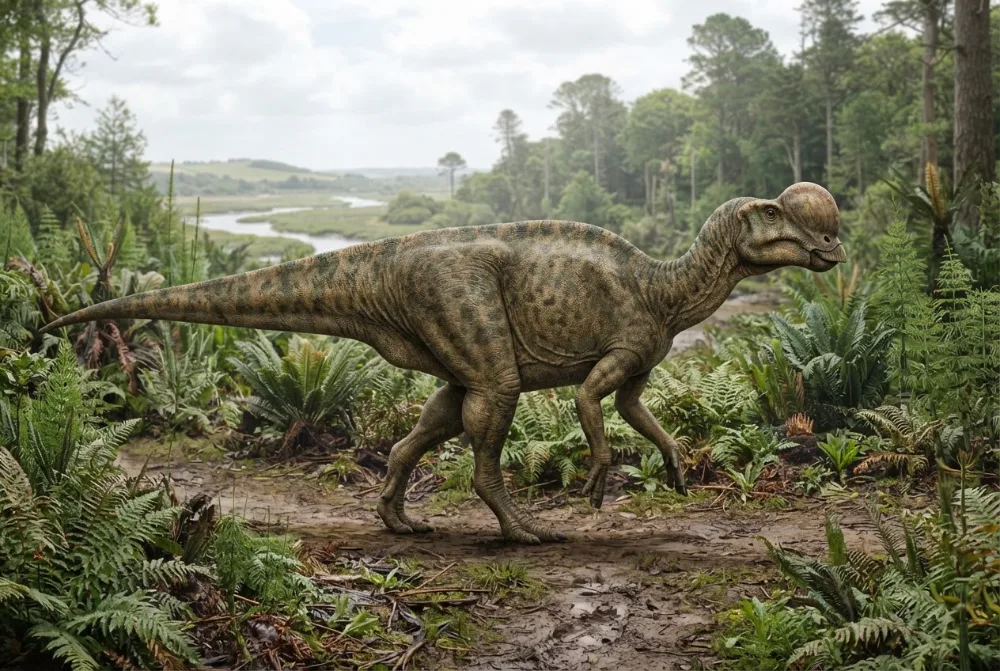
Brighstoneus was a big, plant-eating dinosaur that lived on the Isle of Wight in England about 125 million years ago. It had a strange, bulbous nose that made it look different from its relatives. Scientists think it used its big nose to show off to other dinosaurs or to scare away rivals.12
When did it live?
How big was it?
How long was it?
How heavy was it?
How big was Brighstoneus compared to YOU?
Just maths in your browser. Nothing is saved or sent anywhere.
Fun facts
Brighstoneus had a bulbous bump on its nose, called a nasal bulla, which made its snout look S-shaped from the side.1
Its fossils were found mixed up with the bones of a meat-eating dinosaur called Neovenator after a storm in 1978.1
The dinosaur was named by a retired doctor, Jeremy Lockwood, who spent years studying old bones in museum collections.2
Brighstoneus lived in a floodplain environment that had rivers, lakes, and frequent wildfires.1
Its teeth were different from other similar dinosaurs because they had ridges on both sides.2
The name Brighstoneus honors the village of Brighstone, where a famous Victorian fossil collector named Reverend William Fox once lived.1
Most asked questions about Brighstoneus
?How big was Brighstoneus?
Brighstoneus was probably about 6 metres long and weighed around 1 tonne.1
?What did Brighstoneus eat?
Brighstoneus was a plant-eater. It had a beak and teeth with ridges to chew tough plants.1
?Why did Brighstoneus have a bulbous nose?
Scientists think the bulbous nose, called a nasal bulla, was used to show off to attract mates or scare away rivals.2
?When did Brighstoneus live?
Brighstoneus lived about 125 million years ago, during the Early Cretaceous period.1

Ask Rex about Brighstoneus
Rex only answers questions about this page. 10 questions a month.
Rex is an AI and can make mistakes. He runs on servers in the EU and questions are never saved. Never type your name or other personal things.
Myth buster
Myth: Some people think Brighstoneus was just another Iguanodon.
Truth: Scientists proved it is a separate species because of its unique bulbous nose and different teeth.2
For dino experts
- Scientific name
- Brighstoneus
- Named by
- Lockwood et al. 20213
- Group
- Beaked plant-eaters
- Family / clade
- Hadrosauriformes3
- Classification
- Ornithischia > Ornithopoda > Iguanodontia3
- Age of the rocks
- 126 to 121 million years (Barremian)3
- Rock formations
- Wessex3
- Countries
- United Kingdom3
- Fossil records
- 1 in the Paleobiology Database3
- Discovery
- Brighstoneus was discovered in 1978 after a storm on the Isle of Wight, but it was not named until 2021. Jeremy Lockwood, a retired doctor and PhD student, studied the bones and realized they belonged to a new species.12
- Still debated
- Scientists are not sure exactly what the bulbous nose was used for. It might have been for attracting mates or for fighting rivals.2
Where the facts come from
- Brighstoneus (en.wikipedia.org)
- New bulbous nosed dinosaur discovered (csd.docstore.port.ac.uk)
- Brighstoneus in The Paleobiology Database (CC BY 4.0): age, places, rock formations, classification.
Every fact on this page has a number that points to its source. If we got something wrong, sorry, we are dino fans, not a science journal. Tell us at [email protected] and we will fix it.
 Rex is hungry! Dino Wiki is a dad's project for his dino-loving son, free with no ads. Grown-ups can feed Rex a snack to help keep it online.Feed Rex
 Iguanodon
 Tenontosaurus
 Thescelosaurus
 Zalmoxes
 Camptosaurus
 Rhabdodon
 Stegosaurus
 Archaeopteryx
 Giganotosaurus
 Microraptor
 Deinonychus
 Baryonyx