
Caupedactylus
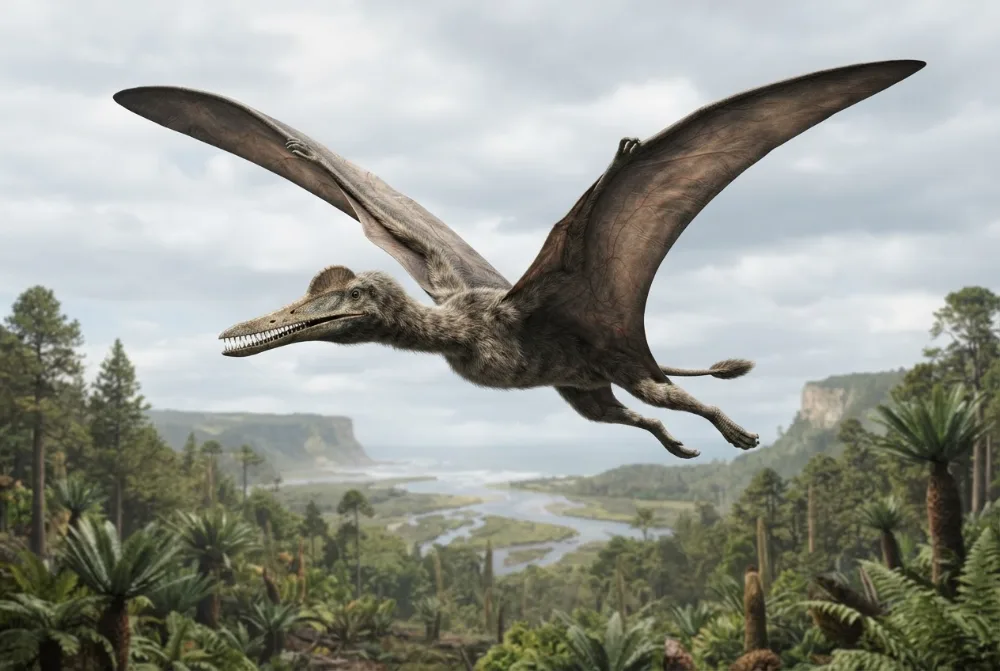
Caupedactylus was a flying reptile with a big, thin crest on its head. It had no teeth and used its beak to eat fruit. It lived about 110 million years ago in what is now Brazil.13
When did it live?
How big was it?
How wide were its wings?
How big was Caupedactylus compared to YOU?
Just maths in your browser. Nothing is saved or sent anywhere.
Fun facts
Caupedactylus had a wingspan of about 3.3 metres (11 feet), making it the largest known tapejarine pterosaur.1
Its skull was about 46 centimetres long and had a large, rounded crest that was only half a millimetre thick at the top.1
The tip of its snout curved downward, and its upper jaw had a slightly concave lower edge.1
The crest on its snout had grooves that may have held blood vessels, possibly helping with temperature control.2
Its lower jaw had a thick, slightly convex surface at the rear, and when closed it fit tightly against the upper jaw with no gap.1
The holotype specimen (MN 4726-V) is an adult, which is rare for pterosaurs from this formation.1
Most asked questions about Caupedactylus
?What did Caupedactylus eat?
It ate fruit. Its beak had no teeth, and the Paleobiology Database lists it as a volant frugivore, meaning a flying fruit-eater.3
?How big was Caupedactylus?
Its wingspan was about 3.3 metres, making it the largest known tapejarine pterosaur. Its skull was about 46 centimetres long.1
?When did Caupedactylus live?
It lived about 110 million years ago, during the Early Cretaceous period (Albian stage).1
?Where was Caupedactylus found?
Its fossils were found in the Romualdo Formation of the Araripe Basin in northeastern Brazil.1

Ask Rex about Caupedactylus
Rex only answers questions about this page. 3 questions a day.
Rex is an AI and can make mistakes. He runs on servers in the EU and questions are never saved. Never type your name or other personal things.
For dino experts
- Scientific name
- Caupedactylus
- Named by
- Kellner 20133
- Group
- Flying reptiles
- Family / clade
- Tapejaridae3
- Classification
- Pterosauria > Pterodactyloidea3
- Age of the rocks
- 120 to 113 million years (Aptian)3
- Rock formations
- Crato3
- Countries
- Brazil3
- Fossil records
- 1 in the Paleobiology Database3
- Discovery
- Caupedactylus was named and described by Alexander Kellner in 2013 based on a partial skeleton found in the Romualdo Formation of Brazil.13
- Still debated
- Scientists are still debating whether the bones in the front of the palate are part of the palatine bones or the maxillae.1
Where the facts come from
- Caupedactylus (en.wikipedia.org)
- A new unusual tapejarid (Pterosauria, Pterodactyloidea) from the Early Cretaceous Romualdo Formation, Araripe Basin, Brazil (cambridge.org)
- Caupedactylus in The Paleobiology Database (CC BY 4.0): age, places, rock formations, classification.
Every fact on this page has a number that points to its source. If we got something wrong, sorry, we are dino fans, not a science journal. Tell us at [email protected] and we will fix it.
 Rex is hungry! Dino Wiki is a dad's project for his dino-loving son, free with no ads. Grown-ups can feed Rex a snack to help keep it online.Feed Rex
 Pteranodon
 Quetzalcoatlus
 Dorygnathus
 Rhamphorhynchus
 Anhanguera
 Pterodactylus
 Stegosaurus
 Iguanodon
 Archaeopteryx
 Giganotosaurus
 Microraptor
 Deinonychus