
Chacaicosaurus
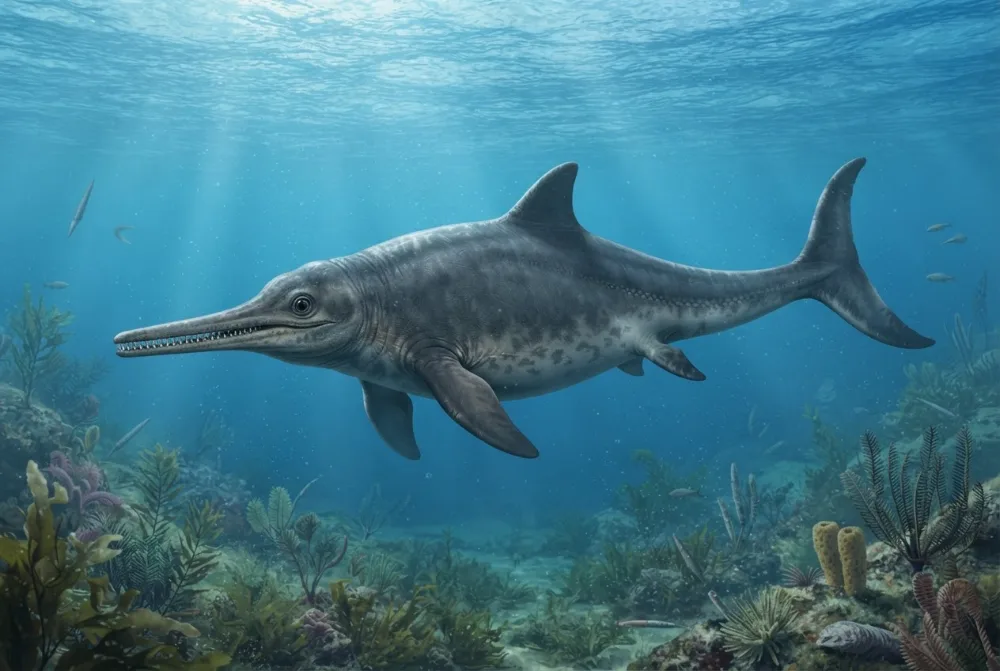
Chacaicosaurus was a fast-swimming marine reptile that lived in the ocean during the Jurassic Period. It had a very long snout and big eyes to spot its prey. Even though it looked like a fish, it was a reptile that breathed air and gave birth to live babies underwater.1
When did it live?
Fun facts
Chacaicosaurus had a very long snout that made up 80% of its skull length.1
It had unique rounded ridges running along each side of its snout, which no other ichthyosaur has.1
Adult Chacaicosaurus may have had very small teeth or even no teeth at all.1
The only known fossil of Chacaicosaurus was found in 1990 by a team led by Zulma Gasparini.1
Chacaicosaurus lived about 170 to 168 million years ago, during the early Bajocian stage of the Jurassic.1
Its name comes from the Chacaico Sur locality and the Greek word for lizard, while the species name cayi honors the Mapuche sea god Cay.1
Chacaicosaurus shared its ocean home with another ichthyosaur called Mollesaurus and a plesiosaur named Maresaurus.1

Ask Rex about Chacaicosaurus
Rex only answers questions about this page. 3 questions a day.
Rex is an AI and can make mistakes. He runs on servers in the EU and questions are never saved. Never type your name or other personal things.
For dino experts
- Scientific name
- Chacaicosaurus
- Named by
- Fernandez 19942
- Group
- Ichthyosaurs
- Family / clade
- Baracromia2
- Classification
- Ichthyosauria > Ichthyosauromorpha2
- Age of the rocks
- 171 to 169 million years (Bajocian)2
- Countries
- Argentina2
- Fossil records
- 1 in the Paleobiology Database2
- Discovery
- Chacaicosaurus was named by paleontologist Marta Fernández in 1994, based on a single partial skeleton found in the Los Molles Formation of Argentina.12
- Still debated
- Scientists are not sure whether Chacaicosaurus belongs in its own genus or should be classified as a species of Stenopterygius.1
Where the facts come from
- Chacaicosaurus (en.wikipedia.org)
- Chacaicosaurus in The Paleobiology Database (CC BY 4.0): age, places, rock formations, classification.
Every fact on this page has a number that points to its source. If we got something wrong, sorry, we are dino fans, not a science journal. Tell us at [email protected] and we will fix it.
 Rex is hungry! Dino Wiki is a dad's project for his dino-loving son, free with no ads. Grown-ups can feed Rex a snack to help keep it online.Feed Rex
 Ichthyosaurus
 Platypterygius
 Stenopterygius
 Khudiakovia
 Ophthalmosaurus
 Chonespondylus
 Pterodactylus
 Peloneustes
 Rhamphocephalus
 Gongbusaurus
 Shunosaurus
 Bishanopliosaurus