
Chaohusaurus
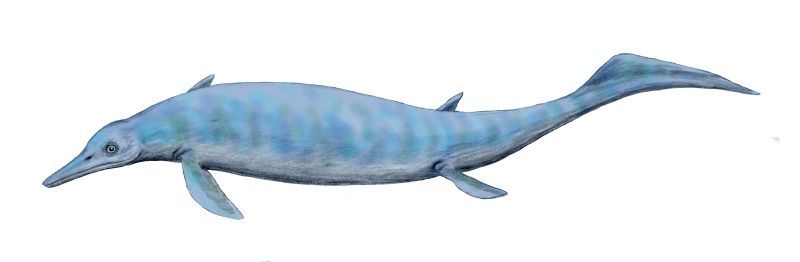
Chaohusaurus was an early marine reptile that lived in the sea, not a dinosaur. It looked a bit like a lizard with flippers and a long tail, and it was one of the smallest ichthyosaurs ever found.1
When did it live?
How big was it?
Fun facts
Chaohusaurus gave birth to live babies in the water, not eggs on land. One fossil shows a mother with two embryos and a newborn inside her.1
Unlike later ichthyosaurs, Chaohusaurus babies were born head-first. This is different from most modern sea reptiles that give birth tail-first.1
Chaohusaurus was very small, only about as long as a yardstick (0.7 to 1 metre). It weighed as little as a bag of sugar (1.3 to 3.1 kg).1
It had different-shaped teeth in its mouth: sharp ones in the front and round, blunt ones in the back for crushing shells.1
Chaohusaurus lived during the Early Triassic period, about 251 to 247 million years ago, when the first dinosaurs were just starting to appear on land.1
Its fossils were first found in 1972 when workers were building a railway in China.1
For dino experts
- Scientific name
- Chaohusaurus
- Named by
- Young and Dong 19723
- Group
- Ichthyosaurs
- Family / clade
- Grippiidae3
- Classification
- Ichthyosauria > Ichthyosauromorpha3
- Age of the rocks
- 251 to 237 million years ()3
- Rock formations
- Nanlinghu3
- Countries
- China3
- Fossil records
- 9 in the Paleobiology Database3
- Also known as
- Anhuisaurus (older names now counted as the same animal)3
- Discovery
- Chaohusaurus was named by Chinese scientists Yang Zhongjian and Dong Zhiming in 1972, based on a partial skeleton found during railway construction near Chaohu Lake, China.1
- Still debated
- Scientists still debate whether Chaohusaurus is the most primitive ichthyosaur or if it belongs just outside the group Ichthyopterygia.1
Where the facts come from
- Chaohusaurus (en.wikipedia.org)
- PBDB Taxon (paleobiodb.org)
- Chaohusaurus in The Paleobiology Database (CC BY 4.0): age, places, rock formations, classification.
Every fact on this page has a number that points to its source. If we got something wrong, sorry, we are dino fans, not a science journal. Tell us at [email protected] and we will fix it.
 Rex is hungry! Dino Wiki is free with no ads. Grown-ups can feed Rex a snack to keep it that way.Feed Rex
 Ichthyosaurus
 Platypterygius
 Stenopterygius
 Khudiakovia
 Ophthalmosaurus
 Chonespondylus
 Placodus
 Lariosaurus
 Cyamodus
 Cymatosaurus
 Proneusticosaurus
 Neusticosaurus