
Placodus
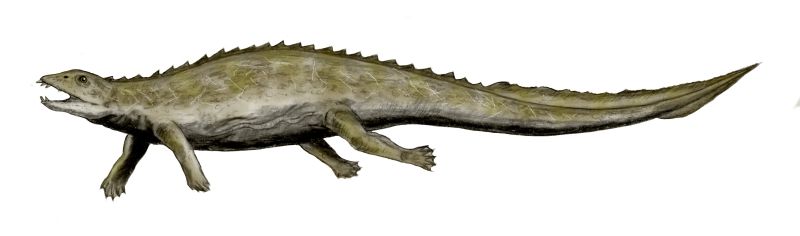
Placodus was a marine reptile that lived about 240 million years ago, during the Middle Triassic. It had a stocky body, a long tail, and a heavy skull with flat teeth for crushing shellfish. It swam in shallow seas and probably spent most of its time on the seafloor looking for food.1
When did it live?
How big was it?
Fun facts
Placodus had a rigid body because the bones in its spine were dovetailed together, making its trunk stiff.1
Its belly was covered with special armor made of bent, right-angled abdominal ribs, and it had a row of bony knobs above its backbone.1
Placodus was negatively buoyant, meaning it was heavy and could easily stay on the seafloor without floating up.1
Before scientists knew what Placodus looked like, its teeth were mistaken for fish teeth.1
Placodus was slow and clumsy on land because of its heavy body armor, so it probably only came ashore to lay eggs.1
Its short legs probably ended in webbed feet, and it used its flattened tail to push through the water.1
For dino experts
- Scientific name
- Placodus
- Named by
- Agassiz 18332
- Group
- Other sea reptiles
- Family / clade
- Placodontidae2
- Classification
- Placodontia > Sauropterygia2
- Age of the rocks
- 251 to 227 million years ()2
- Rock formations
- Jena, Wellenkalk, Vossenveld2
- Countries
- Germany, Israel, Poland, Netherlands, Italy, China2
- Fossil records
- 34 in the Paleobiology Database2
- Also known as
- Anomosaurus, Crurosaurus (older names now counted as the same animal)2
- Discovery
- Placodus was named by the Swiss naturalist Louis Agassiz in 1833. He originally thought the fossils were fish teeth.12
Where the facts come from
- Placodus (en.wikipedia.org)
- Placodus in The Paleobiology Database (CC BY 4.0): age, places, rock formations, classification.
Every fact on this page has a number that points to its source. If we got something wrong, sorry, we are dino fans, not a science journal. Tell us at [email protected] and we will fix it.
 Rex is hungry! Dino Wiki is free with no ads. Grown-ups can feed Rex a snack to keep it that way.Feed Rex
 Nothosaurus
 Lariosaurus
 Cyamodus
 Cymatosaurus
 Proneusticosaurus
 Simosaurus
 Chonespondylus
 Cymbospondylus
 Phalarodon
 Mixosaurus
 Chaohusaurus
 Chensaurus