 Home
 All dinos
 Dino groups
 Explore
 Dinos by country
 Dino vs dino
 How big were they?
 Dinos A to Z
 Who ate what?
 What dino are you? Quiz
 Dino games
 Dino battle
 Dino race
 Dino mini-games
 Sticker album
 Dino TOP lists
 Timeline
 Surprise me!
 Language: English

Colepiocephale
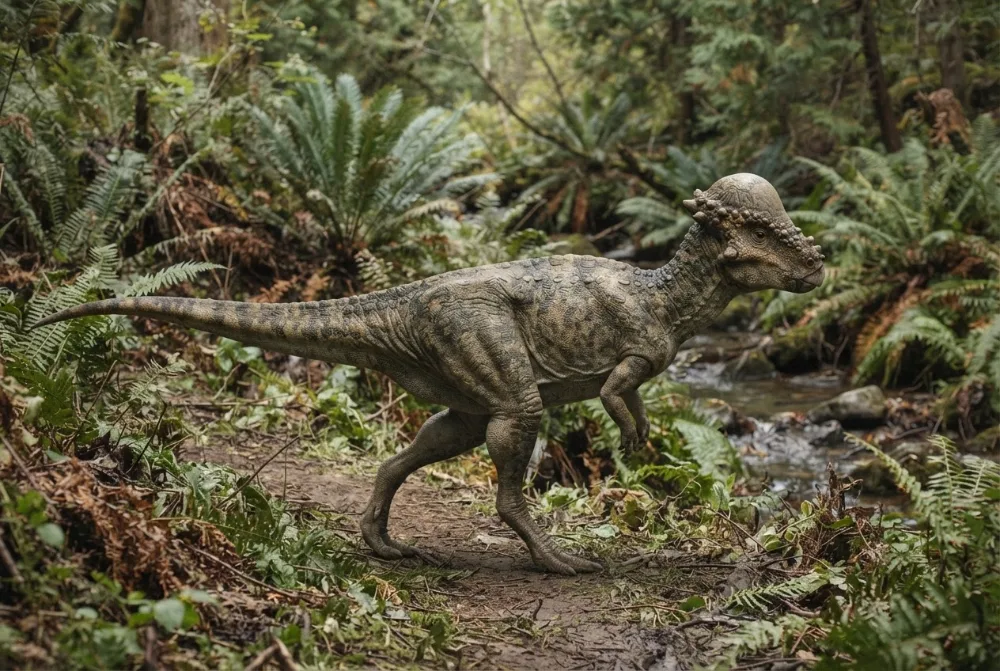
Colepiocephale was a small dome-headed dinosaur that lived in what is now Canada. It had a thick, bony dome on its skull that looked like a knuckle, and it used its head for head-butting fights with other dinosaurs.1
 Canada
When did it live?
Colepiocephale: 84 to 72 million years ago
How big was it?
How long was it?
 as long as 3 dogs nose to tail🍌as long as 17 bananas end to end🏃could run 100 metres in 8.6 seconds (the fastest human needs 9.6)
How big was Colepiocephale compared to YOU?
Just maths in your browser. Nothing is saved or sent anywhere.
How fast was it?


Fun facts
Colepiocephale means 'knucklehead' because its dome looked like a curled-up knuckle.1
It was one of the oldest dome-headed dinosaurs in North America, living about 80 million years ago.1
The first fossil was a partial skull found in 1923 by E.J. Whitaker along the South Saskatchewan River.1
Scientists once thought it was a species of Stegoceras, but later gave it its own name in 2003.1
All the fossils found in the Foremost Formation belong to Colepiocephale, meaning it was the only dome-headed dinosaur there at that time.1
Its dome was made of solid bone, and it may have used it to ram rivals or show off to mates.1
Most asked questions about Colepiocephale
?How big was Colepiocephale?
It was a small dinosaur. The Paleobiology Database estimates its adult length between 1 and 2 metres, but no exact size is known from the fossils.2
?What did Colepiocephale eat?
It was an herbivore, meaning it ate plants.2
?When did Colepiocephale live?
It lived during the Late Cretaceous period, about 80 to 78 million years ago.1
?Where was Colepiocephale found?
Its fossils were found in Alberta, Canada, mostly in the Foremost Formation. One specimen also came from Montana.1
For dino experts
- Scientific name
- Colepiocephale
- Named by
- Sullivan 20032
- Group
- Dome-heads
- Family / clade
- Pachycephalosauridae2
- Classification
- Ornithischia > Pachycephalosauria2
- Age of the rocks
- 84 to 72 million years (Campanian)2
- Rock formations
- Foremost2
- Countries
- Canada2
- Fossil records
- 4 in the Paleobiology Database2
- Discovery
- The first fossil, a partial skull, was collected in 1923 by E.J. Whitaker in Alberta, Canada. It was named Stegoceras lambei in 1945 by Charles Mortram Sternberg, and later renamed Colepiocephale by Robert M. Sullivan in 2003.1
- Still debated
- Scientists are still debating whether some fossils from the Judith River Formation in Montana belong to Colepiocephale or to another dome-headed dinosaur.1
Where the facts come from
- Colepiocephale (en.wikipedia.org)
- Colepiocephale in The Paleobiology Database (CC BY 4.0): age, places, rock formations, classification.
Every fact on this page has a number that points to its source. If we got something wrong, sorry, we are dino fans, not a science journal. Tell us at hello@dinowiki.app and we will fix it.
 Rex is hungry! Dino Wiki is a dad's project for his dino-loving son, free with no ads and no cookies. Grown-ups can feed Rex a snack to help keep it online.Feed Rex
 Pachycephalosaurus
 Stegoceras
 Prenocephale
 Sphaerotholus
 Foraminacephale
 Brontotholus
 Tyrannosaurus
 Triceratops
 Velociraptor
 Spinosaurus
 Ankylosaurus
 Parasaurolophus