
Coloborhynchus
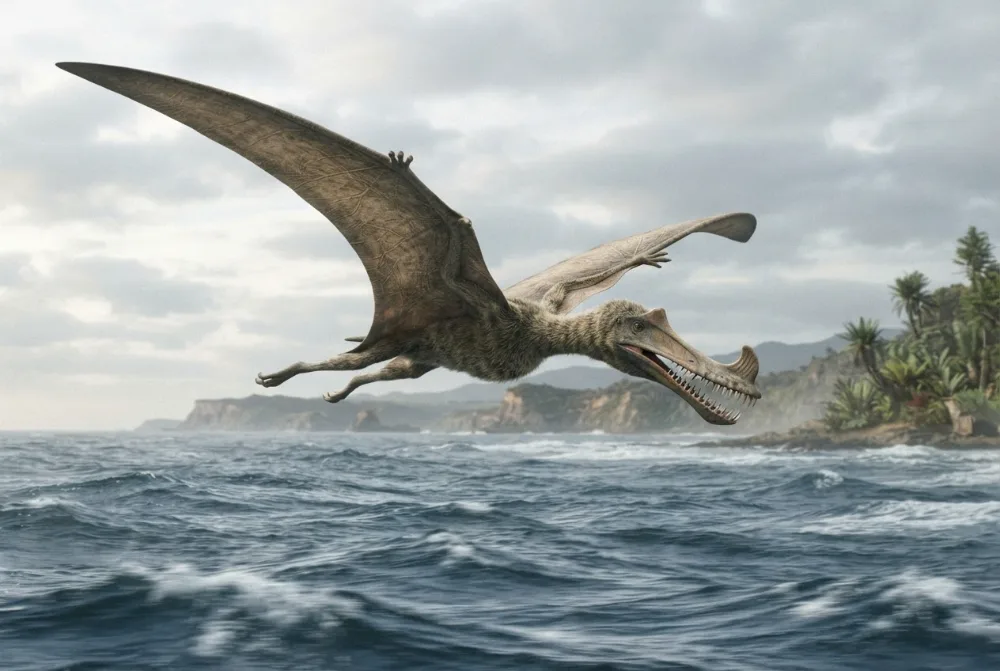
Coloborhynchus was a flying reptile with a long, toothed snout that lived near the sea. It soared over the waves and snatched fish with its sharp teeth. Some scientists think it was one of the biggest toothed pterosaurs ever!1
When did it live?
How big was it?
How wide were its wings?
How big was Coloborhynchus compared to YOU?
Just maths in your browser. Nothing is saved or sent anywhere.
Fun facts
Coloborhynchus lived about 140 to 94 million years ago, during the Cretaceous Period.4
Its name means 'maimed beak' because the first fossil found was a damaged snout.1
The first Coloborhynchus fossil was a piece of the upper jaw with tooth sockets, found in England.12
Coloborhynchus belonged to a group called Anhangueridae, which were fish-eating pterosaurs with crests on their snouts.41
Some scientists now think only one species, Coloborhynchus clavirostris, truly belongs to this genus.2
Fossils of Coloborhynchus have been found in both England and Morocco, showing it lived in different parts of the world.41
Coloborhynchus had a flat, squared-off tip on its upper jaw, which helped it catch fish.2
Most asked questions about Coloborhynchus
?How big was Coloborhynchus?
It could have a wingspan of about 7 metres (23 feet), which is as long as a small boat. The largest toothed pterosaur specimen, Coloborhynchus capito, had a skull up to 75 centimetres long.13
?What did Coloborhynchus eat?
It ate fish, just like many other pterosaurs that lived near the sea. Its sharp teeth and long snout helped it catch them.1
?When did Coloborhynchus live?
It lived during the Early Cretaceous Period, about 140 to 94 million years ago.1
?Why is it called Coloborhynchus?
Its name means 'maimed beak' because the first fossil found was a damaged snout. The name was given by Richard Owen in 1874.1
Ask Rex about Coloborhynchus
Rex only answers questions about this page. 3 questions a day.
Rex is an AI and can make mistakes. He runs on servers in the EU and questions are never saved. Never type your name or other personal things.
Myth buster
Myth: Coloborhynchus was the largest flying animal ever.
Truth: It was once thought to be the largest toothed pterosaur, but a close relative called Tropeognathus is now believed to have had a bigger wingspan.1
For dino experts
- Scientific name
- Coloborhynchus
- Named by
- Owen 18744
- Group
- Flying reptiles
- Family / clade
- Anhangueridae4
- Classification
- Pterosauria > Pterodactyloidea4
- Age of the rocks
- 139 to 94 million years (Berriasian / Cenomanian)4
- Rock formations
- Wessex, Ifezouane4
- Countries
- Morocco, United Kingdom4
- Fossil records
- 5 in the Paleobiology Database4
- Also known as
- Amblydectes (older names now counted as the same animal)4
- Discovery
- Richard Owen named Coloborhynchus in 1874 based on a partial snout from East Sussex, England. The fossil was damaged, so Owen called it 'maimed beak'.14
- Still debated
- Scientists are still debating which species belong to Coloborhynchus and which should be placed in other genera like Nicorhynchus or Uktenadactylus.2
Where the facts come from
- Coloborhynchus (en.wikipedia.org)
- A taxonomic and phylogenetic review of the anhanguerid pterosaur group Coloborhynchinae and the new clade (ddd.uab.cat)
- The world’s largest toothed pterosaur, NHMUK R481, an incomplete rostrum of Coloborhynchus capito (Seeley, 1870) from the Cambridge Greensand of England (sciencedirect.com)
- Coloborhynchus in The Paleobiology Database (CC BY 4.0): age, places, rock formations, classification.
Every fact on this page has a number that points to its source. If we got something wrong, sorry, we are dino fans, not a science journal. Tell us at [email protected] and we will fix it.
 Rex is hungry! Dino Wiki is a dad's project for his dino-loving son, free with no ads. Grown-ups can feed Rex a snack to help keep it online.Feed Rex
 Pteranodon
 Quetzalcoatlus
 Dorygnathus
 Rhamphorhynchus
 Anhanguera
 Pterodactylus
 Stegosaurus
 Iguanodon
 Archaeopteryx
 Giganotosaurus
 Microraptor
 Deinonychus