 Home
 All dinos
 Dino groups
 Explore
 Dinos by country
 Dino vs dino
 How big were they?
 Dinos A to Z
 Who ate what?
 What dino are you? Quiz
 Dino games
 Dino battle
 Dino race
 Dino mini-games
 Sticker album
 Dino TOP lists
 Timeline
 Surprise me!
 Language: English

Cumnoria
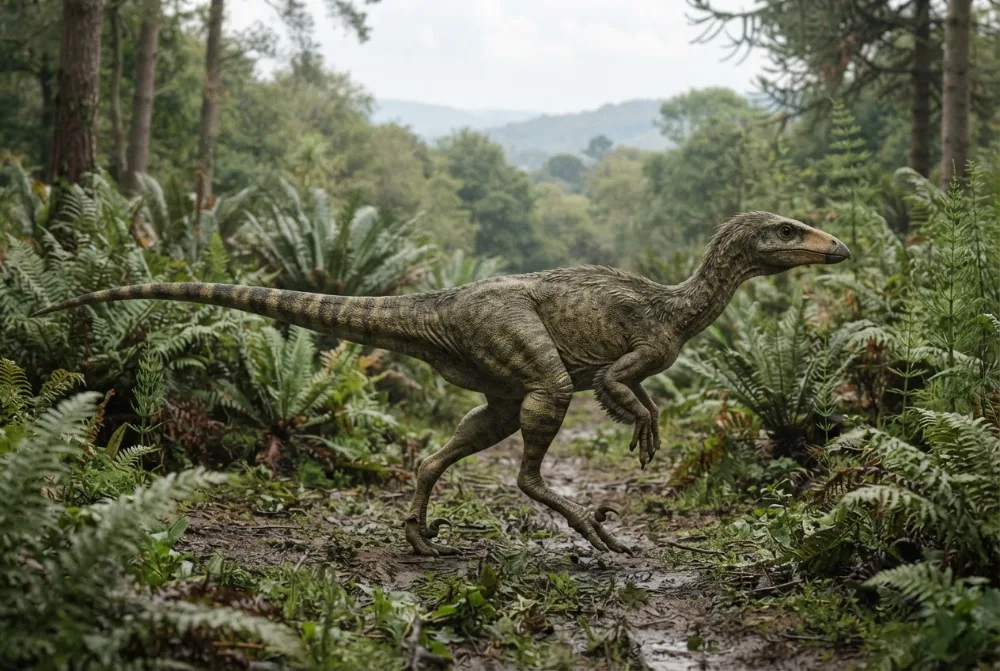
Cumnoria was a small, plant-eating dinosaur that lived in what is now England during the Late Jurassic. It walked on two legs and had a slender build, like a speedy little lizard with a beak.1
 United Kingdom
When did it live?
Cumnoria: 152 to 149 million years ago
How big was it?
How long was it?
 as long as 5 dogs nose to tail🍌as long as 28 bananas end to end🏃could run 100 metres in 8.4 seconds (the fastest human needs 9.6)
How big was Cumnoria compared to YOU?
Just maths in your browser. Nothing is saved or sent anywhere.
How fast was it?


Fun facts
Cumnoria was first thrown on a rubbish heap by brick pit workers before a scientist rescued the bones.1
It was originally thought to be a species of Iguanodon, then Camptosaurus, before being recognized as its own genus.1
Cumnoria may be the oldest known member of a group called Styracosterna, which includes more advanced duck-billed dinosaurs.1
The only known skeleton is a juvenile, because its vertebrae and ribs were not fully fused together.1
Cumnoria had a special ridge on its shoulder bone and an oval muscle scar on its upper arm that are unique among its relatives.1
Most asked questions about Cumnoria
?How big was Cumnoria?
About 3.5 to 5 metres long. That is roughly the length of a small car.1
?What did Cumnoria eat?
It was a plant-eater, or herbivore. It used its beak to bite off leaves and other plants.1
?When did Cumnoria live?
It lived during the Late Jurassic period, about 156 to 151 million years ago.1
?Where was Cumnoria found?
Its fossils were discovered in a brick pit near Cumnor, Oxfordshire, England.1
Myth buster
Myth: Cumnoria is just a young Camptosaurus.
Truth: Scientists now think Cumnoria is a separate genus, not a baby Camptosaurus, based on unique features in its bones.1
For dino experts
- Scientific name
- Cumnoria
- Named by
- Seeley 18882
- Group
- Beaked plant-eaters
- Family / clade
- Styracosterna2
- Classification
- Ornithischia > Ornithopoda > Iguanodontia2
- Age of the rocks
- 152 to 149 million years (Kimmeridgian)2
- Rock formations
- Kimmeridge Clay2
- Countries
- United Kingdom2
- Fossil records
- 1 in the Paleobiology Database2
- Discovery
- Workers at Chawley Brick Pits in 1879 found the bones on a dump heap. They were given to Professor George Rolleston, then to Joseph Prestwich, who reported it as a new Iguanodon. John Whitaker Hulke named it Iguanodon prestwichii in 1880. Harry Govier Seeley gave it the genus Cumnoria in 1888.1
- Still debated
- Scientists still debate whether Cumnoria is a distinct genus or should be lumped back into Camptosaurus.1
Where the facts come from
- Cumnoria (en.wikipedia.org)
- Cumnoria in The Paleobiology Database (CC BY 4.0): age, places, rock formations, classification.
Every fact on this page has a number that points to its source. If we got something wrong, sorry, we are dino fans, not a science journal. Tell us at hello@dinowiki.app and we will fix it.
 Rex is hungry! Dino Wiki is a dad's project for his dino-loving son, free with no ads and no cookies. Grown-ups can feed Rex a snack to help keep it online.Feed Rex
 Iguanodon
 Tenontosaurus
 Thescelosaurus
 Zalmoxes
 Camptosaurus
 Rhabdodon
 Stegosaurus
 Brachiosaurus
 Diplodocus
 Allosaurus
 Brontosaurus
 Compsognathus