
Cycnorhamphus
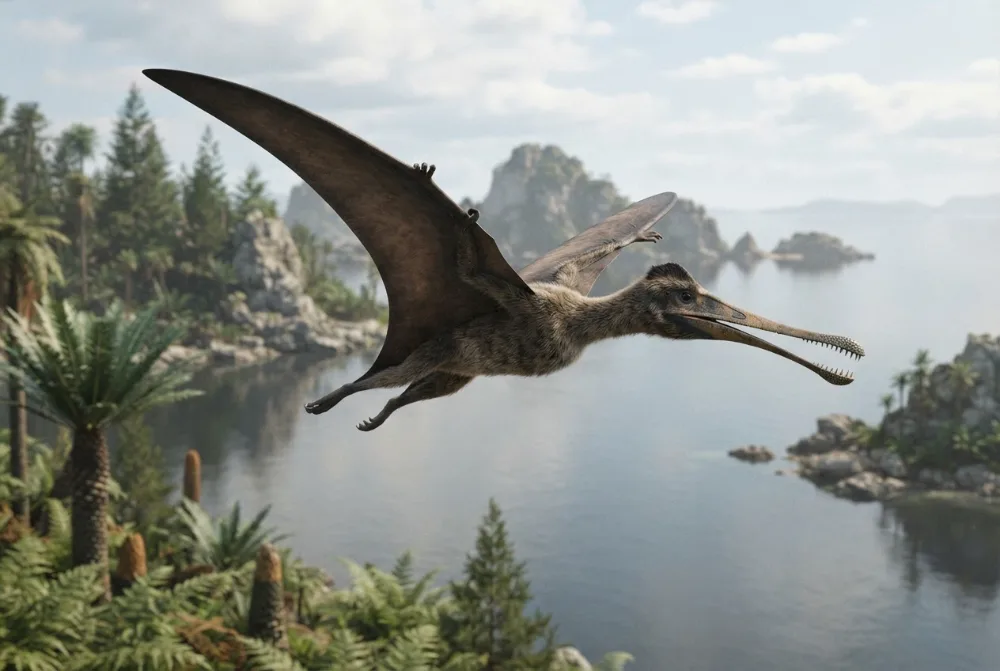
Cycnorhamphus was a pterosaur, a flying reptile that lived during the Late Jurassic. It had a strange beak with peg-like teeth at the tips and curved jaws that left a gap. Scientists think it might have used its beak to crush hard-shelled animals like mollusks.1
When did it live?
How big was it?
How wide were its wings?
How big was Cycnorhamphus compared to YOU?
Just maths in your browser. Nothing is saved or sent anywhere.
How fast was it?
Fun facts
Cycnorhamphus lived about 152 million years ago during the Late Jurassic.1
Its name means 'swan beak' because of the shape of its snout.1
The first fossil was found in Germany in 1855 and named Pterodactylus suevicus by Friedrich August Quenstedt.1
A well-preserved skull nicknamed 'The Painten Pelican' helped scientists understand its unusual jaw.1
Adult Cycnorhamphus had blunter, stouter teeth at the tips of their jaws than juveniles.1
The jaws had a gap behind the teeth, and soft tissue structures filled that gap in the upper jaw.1
Some scientists think Cycnorhamphus used its beak like openbill storks to crush hard invertebrates.1
Most asked questions about Cycnorhamphus
?How big was Cycnorhamphus?
Cycnorhamphus had a wingspan of about 1.5 metres (4.9 feet).4
?What did Cycnorhamphus eat?
Scientists think it probably ate shellfish, using its beak to crush hard invertebrates like mollusks, similar to openbill storks.14
?Why did Cycnorhamphus have a gap in its jaws?
Nobody knows for sure. Ideas include trapping jellyfish, opening seashells, or just for show.4
?Is Cycnorhamphus a dinosaur?
No, Cycnorhamphus is a pterosaur, a flying reptile that lived during the Late Jurassic, not a dinosaur.1
Ask Rex about Cycnorhamphus
Rex only answers questions about this page. 10 questions a month.
Rex is an AI and can make mistakes. He runs on servers in the EU and questions are never saved. Never type your name or other personal things.
Myth buster
Myth: Cycnorhamphus had long jaws with many teeth like other pterosaurs.
Truth: It actually had short, peg-like teeth only at the tips of its jaws, with a curved gap behind them.1
For dino experts
- Scientific name
- Cycnorhamphus
- Named by
- Seeley 18705
- Group
- Flying reptiles
- Family / clade
- Lophocratia5
- Classification
- Pterosauria > Pterodactyloidea5
- Age of the rocks
- 152 to 145 million years (Kimmeridgian / Tithonian)5
- Rock formations
- Nusplingen Limestone, Liegende Bankkalk, Solnhofen5
- Countries
- Germany5
- Fossil records
- 3 in the Paleobiology Database5
- Discovery
- The first fossil was found near Nusplingen in Germany and named Pterodactylus suevicus by Friedrich August Quenstedt in 1855. In 1870, Harry Govier Seeley gave it the new genus name Cycnorhamphus.1
- Still debated
- Scientists are still unsure exactly how Cycnorhamphus used its unusual beak and jaw gap.1
Where the facts come from
- Cycnorhamphus (en.wikipedia.org)
- PBDB Taxon (paleobiodb.org)
- Cycnorhamphus, Pterofiltrus (reptileevolution.com)
- Cycnorhamphus - Thomas Henry Huxley Paleozoological Gardens (hpz.zhejiangopterus.org)
- Cycnorhamphus in The Paleobiology Database (CC BY 4.0): age, places, rock formations, classification.
Every fact on this page has a number that points to its source. If we got something wrong, sorry, we are dino fans, not a science journal. Tell us at [email protected] and we will fix it.
 Rex is hungry! Dino Wiki is a dad's project for his dino-loving son, free with no ads. Grown-ups can feed Rex a snack to help keep it online.Feed Rex
 Pteranodon
 Quetzalcoatlus
 Dorygnathus
 Rhamphorhynchus
 Anhanguera
 Pterodactylus
 Brachiosaurus
 Diplodocus
 Allosaurus
 Brontosaurus
 Compsognathus
 Camarasaurus