
Efraasia
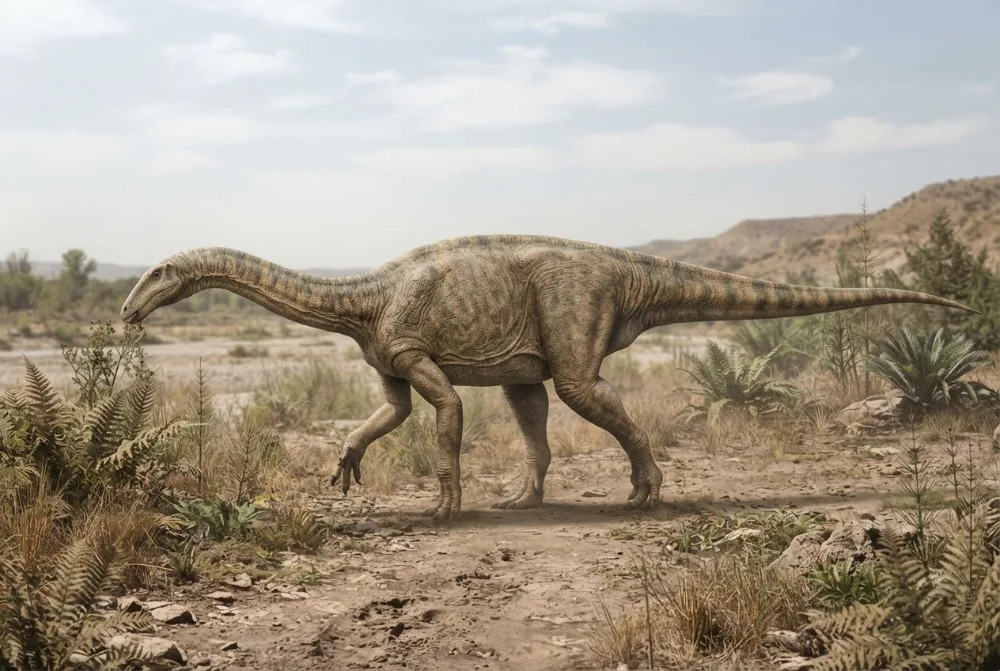
Efraasia was a long-necked plant-eater that lived in what is now Germany about 210 million years ago. It was a medium-sized dinosaur, about 6 to 7 metres long, and could walk on two or four legs. Its name honors the scientist Eberhard Fraas, who collected the first fossils.1
When did it live?
How big was it?
How big was Efraasia compared to YOU?
Just maths in your browser. Nothing is saved or sent anywhere.
Fun facts
Efraasia was once thought to be a small dinosaur only 2 to 3 metres long, but scientists later realized those fossils were from juveniles. Adults grew to about 6.5 metres.1
Its fossils were first mistaken for three different dinosaur species: Teratosaurus minor, Sellosaurus fraasi, and Paleosaurus diagnosticus. In 2003, scientists combined them into one species: Efraasia minor.1
Efraasia had long fingers and a flexible thumb, which it may have used to grasp food. Its wrists were shaped so it could walk on all fours easily.1
The first Efraasia fossils were discovered by a stonemason named Albert Burrer in a quarry near Pfaffenhofen, Germany, between 1906 and 1914.1
Efraasia is a basal sauropodomorph, meaning it is an early relative of the giant long-necked sauropods like Brachiosaurus and Diplodocus.1
Some scientists think Efraasia was an obligate biped, meaning it could only walk on two legs, because its lower arm could not rotate to point its hands downward.1
Most asked questions about Efraasia
?What did Efraasia eat?
Efraasia was a herbivore, meaning it ate plants. It thrived on the lush vegetation of its time.12
?How big was Efraasia?
Efraasia was a medium sized dinosaur, about 6 to 7 metres long. It weighed between 300 and 600 kilograms.12

Ask Rex about Efraasia
Rex only answers questions about this page. 3 questions a day.
Rex is an AI and can make mistakes. He runs on servers in the EU and questions are never saved. Never type your name or other personal things.
Myth buster
Myth: Efraasia was a meat-eating dinosaur.
Truth: Early researchers thought it was a predator, but in 1965 scientists proved it was a plant-eating sauropodomorph.1
For dino experts
- Scientific name
- Efraasia
- Named by
- Galton 19733
- Group
- Long-necks
- Family / clade
- Sauropodomorpha3
- Classification
- Sauropodomorpha3
- Age of the rocks
- 227 to 206 million years (Norian)3
- Rock formations
- Löwenstein3
- Countries
- Germany3
- Fossil records
- 5 in the Paleobiology Database3
- Discovery
- The first fossils were found by Albert Burrer in a quarry near Pfaffenhofen, Germany, starting in 1906. They were later studied by Friedrich von Huene and Eberhard Fraas. The genus Efraasia was named by Peter Galton in 1973 in honor of Fraas.1
- Still debated
- Scientists still debate whether Efraasia walked on two legs or four. Some think its wrists allowed it to walk on all fours, while others argue it was an obligate biped.1
Where the facts come from
- Efraasia (en.wikipedia.org)
- Efraasia | Exploring the Late Triassic Herbivorous Giant (thedinosaurs.org)
- Efraasia in The Paleobiology Database (CC BY 4.0): age, places, rock formations, classification.
Every fact on this page has a number that points to its source. If we got something wrong, sorry, we are dino fans, not a science journal. Tell us at [email protected] and we will fix it.
Rex is hungry! Dino Wiki is a dad's project for his dino-loving son, free with no ads. Grown-ups can feed Rex a snack to help keep it online.Feed Rex Brachiosaurus
 Diplodocus
 Brontosaurus
 Argentinosaurus
 Camarasaurus
 Morosaurus
 Nothosaurus
 Coelophysis
 Podokesaurus
 Simosaurus
 Eudimorphodon
 Herrerasaurus