
Eoazhdarcho
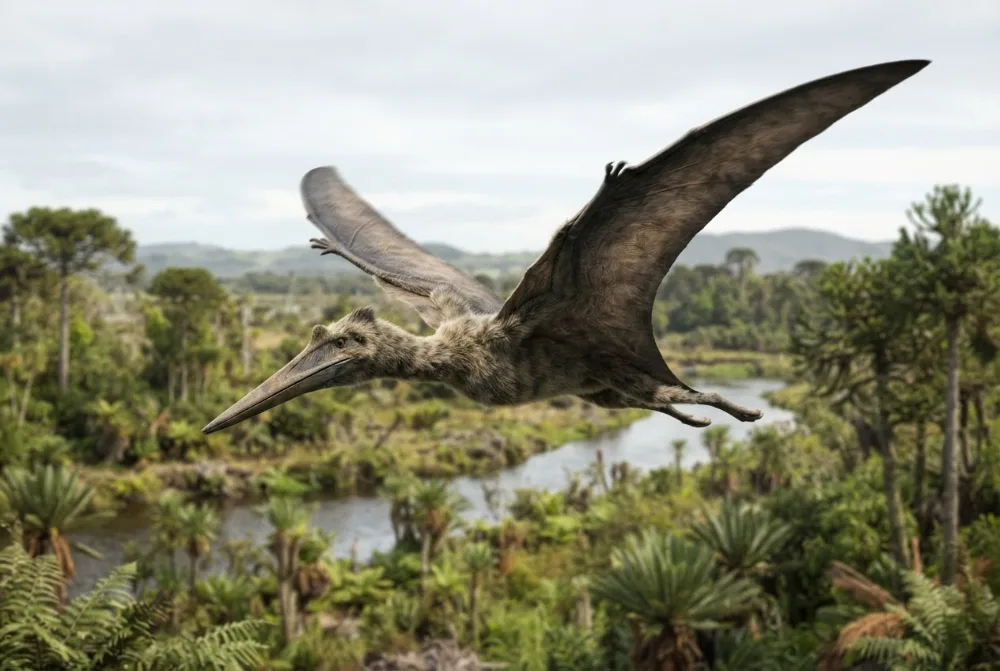
Eoazhdarcho was a small flying reptile that lived in the Early Cretaceous period, about 120 million years ago. It had a wingspan of about 1.6 metres (5.2 feet) and probably ate fish. Its fossils were found in Liaoning, China.13
When did it live?
How big was it?
How wide were its wings?
How big was Eoazhdarcho compared to YOU?
Just maths in your browser. Nothing is saved or sent anywhere.
Fun facts
Eoazhdarcho is known from a partial skeleton and lower jaw, found in the Jiufotang Formation of China.1
Its name means 'dawn Azhdarcho' because it was an early relative of the larger pterosaur Azhdarcho.1
Scientists think Eoazhdarcho belonged to a group called Chaoyangopteridae, which are close cousins of the giant azhdarchids.1
The ratio of its humerus (upper arm bone) to femur (thigh bone) is about 0.96, meaning its arms and legs were almost the same length.2

Ask Rex about Eoazhdarcho
Rex only answers questions about this page. 3 questions a day.
Rex is an AI and can make mistakes. He runs on servers in the EU and questions are never saved. Never type your name or other personal things.
For dino experts
- Scientific name
- Eoazhdarcho
- Named by
- Lü and Ji 20053
- Group
- Flying reptiles
- Family / clade
- Azhdarchidae3
- Classification
- Pterosauria > Pterodactyloidea > Azhdarchidae3
- Age of the rocks
- 121 to 113 million years (Aptian)3
- Rock formations
- Jiufotang3
- Countries
- China3
- Fossil records
- 1 in the Paleobiology Database3
- Discovery
- Eoazhdarcho was named in 2005 by Chinese paleontologists Lü Junchang and Ji Qiang, based on a partial skeleton found in Chaoyang, Liaoning, China.13
- Still debated
- Scientists are not sure whether Eoazhdarcho belongs to the Chaoyangopteridae family or to a different group within the pterosaurs, as different studies have placed it in different positions.1
Where the facts come from
- Eoazhdarcho (en.wikipedia.org)
- New Azhdarchid Pterosaur from the Early Cretaceous of Western Liaoning (semanticscholar.org)
- Eoazhdarcho in The Paleobiology Database (CC BY 4.0): age, places, rock formations, classification.
Every fact on this page has a number that points to its source. If we got something wrong, sorry, we are dino fans, not a science journal. Tell us at [email protected] and we will fix it.
 Rex is hungry! Dino Wiki is a dad's project for his dino-loving son, free with no ads. Grown-ups can feed Rex a snack to help keep it online.Feed Rex
 Pteranodon
 Quetzalcoatlus
 Dorygnathus
 Rhamphorhynchus
 Anhanguera
 Pterodactylus
 Stegosaurus
 Iguanodon
 Archaeopteryx
 Giganotosaurus
 Microraptor
 Deinonychus