
Eolambia
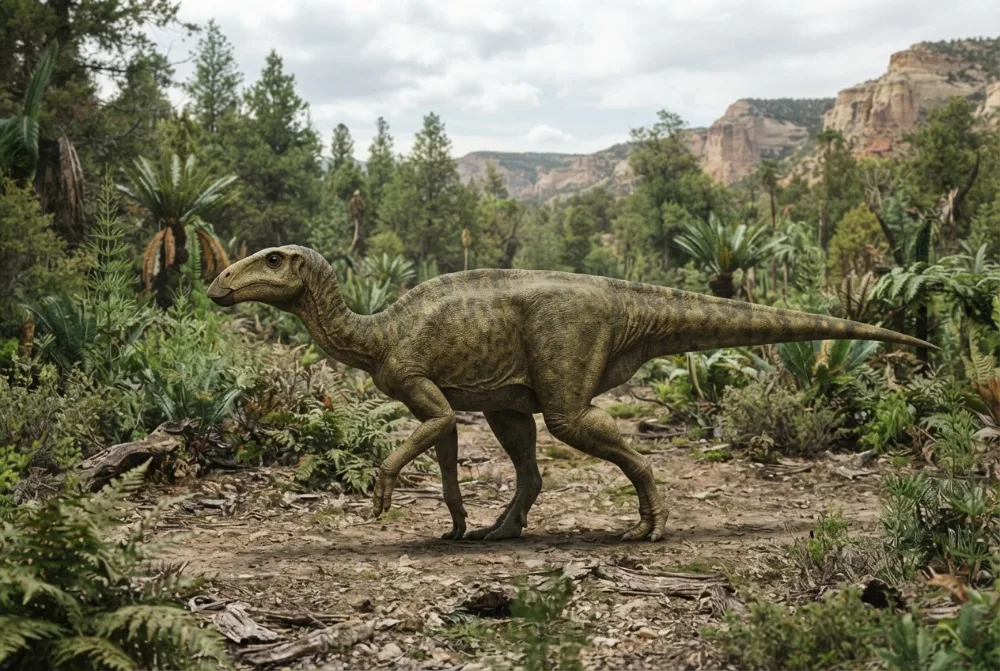
Eolambia was a plant-eating dinosaur that lived in what is now Utah, USA, about 96 million years ago. It had a beak and lots of teeth for chewing tough plants. It was an early cousin of the duck-billed dinosaurs.15
When did it live?
How big was it?
How long was it?
How tall was it?
at the hips
How heavy was it?
How big was Eolambia compared to YOU?
Just maths in your browser. Nothing is saved or sent anywhere.
Fun facts
Eolambia is known from hundreds of bones, including both adults and babies, so scientists have a good picture of its skeleton.1
The first Eolambia fossil was found by Carole and Ramal Jones in 1993, and the species name honors Carole.1
Young Eolambia were hunted by big crocodile-like reptiles that lived in the lakes, but adults were too big for them.1
Grown-up Eolambia, at least eight or nine years old, were hunted by large meat-eating dinosaurs like Siats.1
Eolambia lived in a floodplain with lakes that changed water levels over about 21,000-year cycles.1
The name Eolambia was suggested by paleoartist Michael Skrepnick, replacing an earlier informal name.1
Most asked questions about Eolambia
?How big was Eolambia?
About 6 metres (20 feet) long. That is about as long as a large van.1
?What does the name Eolambia mean?
It means 'dawn lambeosaurine', because scientists first thought it was an early member of the lambeosaurine group.1
?Was Eolambia a hadrosaur?
No, it is a hadrosauroid, an early cousin of the true duck-billed dinosaurs (hadrosaurs).1
?How old could Eolambia get?
Scientists estimate it lived at least 8 to 9 years, based on a subadult specimen.4
Ask Rex about Eolambia
Rex only answers questions about this page. 3 questions a day.
Rex is an AI and can make mistakes. He runs on servers in the EU and questions are never saved. Never type your name or other personal things.
Myth buster
Myth: Eolambia was a duck-billed dinosaur like later hadrosaurs.
Truth: Eolambia was an early relative of hadrosaurs, but it was not a true hadrosaurid. Scientists place it outside the hadrosaurid family.2
For dino experts
- Scientific name
- Eolambia
- Named by
- Kirkland 19985
- Group
- Beaked plant-eaters
- Family / clade
- Hadrosauroidea5
- Classification
- Ornithischia > Ornithopoda > Iguanodontia5
- Age of the rocks
- 121 to 94 million years (Aptian / Cenomanian)5
- Rock formations
- Cedar Mountain5
- Countries
- USA5
- Fossil records
- 12 in the Paleobiology Database5
- Discovery
- The first Eolambia fossils were found in 1993 by Carole and Ramal Jones in Utah. Paleontologist James Kirkland named it Eolambia caroljonesa in 1998.1
- Still debated
- Scientists debate exactly where Eolambia sits on the family tree, with some originally thinking it was a lambeosaurine hadrosaurid, but later studies place it as a more basal hadrosauroid.2
Where the facts come from
- Eolambia (en.wikipedia.org)
- Osteology of the Basal Hadrosauroid Eolambia caroljonesa (Dinosauria: Ornithopoda) from the Cedar Mountain Formation of Utah | PLOS One (journals.plos.org)
- Eolambia caroljonesa | Dinosaur Database by DinoAnimals.com (dinoanimals.com)
- Anatomy, taphonomy, and phylogenetic implications of a new specimen of Eolambia caroljonesa (Dinosauria: Ornithopoda) from the Cedar Mountain Formation, Utah, USA (pmc.ncbi.nlm.nih.gov)
- Eolambia in The Paleobiology Database (CC BY 4.0): age, places, rock formations, classification.
Every fact on this page has a number that points to its source. If we got something wrong, sorry, we are dino fans, not a science journal. Tell us at [email protected] and we will fix it.
 Rex is hungry! Dino Wiki is a dad's project for his dino-loving son, free with no ads. Grown-ups can feed Rex a snack to help keep it online.Feed Rex
 Iguanodon
 Tenontosaurus
 Thescelosaurus
 Zalmoxes
 Camptosaurus
 Rhabdodon
 Stegosaurus
 Archaeopteryx
 Giganotosaurus
 Microraptor
 Deinonychus
 Baryonyx