When did it live?

How big was it?
How long was it?
How tall was it?
estimate
How heavy was it?
 as long as 5 dogs nose to tail🍌as long as 28 bananas end to end🍉as heavy as 63 watermelons🧸as heavy as 17 kindergarten kids🎒as heavy as 10 school kids🏃could run 100 metres in 7.7 seconds (the fastest human needs 9.6)
How big was Erectopus compared to YOU?
Just maths in your browser. Nothing is saved or sent anywhere.
How fast was it?


Fun facts
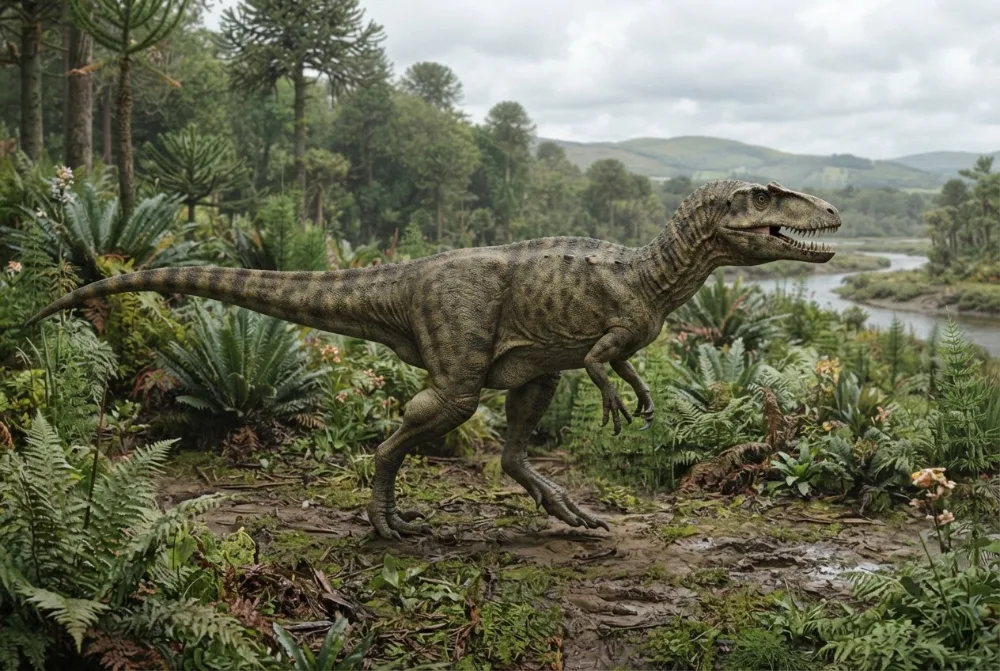
Erectopus was first thought to be a species of Megalosaurus, but later got its own name.1
Its fossils were found in phosphate mines in France, alongside plesiosaurs and crocodiles.1
Scientists think Erectopus weighed about 200 to 315 kilograms, as heavy as a large bear.1
Erectopus lived around 125 to 94 million years ago, during the Early Cretaceous.2
The name Erectopus means 'upright foot' because of the shape of its foot bones.1
Some teeth found in Romania were thought to belong to Erectopus, but they probably came from a different dinosaur.1
Most asked questions about Erectopus

Ask Rex about Erectopus
Rex only answers questions about this page. 10 questions a month.
Rex is an AI and can make mistakes. He runs on servers in the EU and questions are never saved. Never type your name or other personal things.
For dino experts
- Scientific name
- Erectopus
- Named by
- Huene 19232
- Group
- Meat-eating dinos
- Family / clade
- Metriacanthosauridae2
- Classification
- Theropoda > Allosauroidea2
- Age of the rocks
- 126 to 94 million years (Barremian / Cenomanian)2
- Rock formations
- Baharîje, La Penthiève Beds, Papo Seco2
- Countries
- France, Egypt, Portugal2
- Fossil records
- 8 in the Paleobiology Database2
- Discovery
- Erectopus was named by Friedrich von Huene in 1923, based on fossils found in the 1870s in France. The first bones were described by Charles Barrois in 1875.1
- Still debated
- Scientists are not sure whether Erectopus belongs to the family Metriacanthosauridae or another group of allosauroids.12
Where the facts come from
- Erectopus (en.wikipedia.org)
- Erectopus in The Paleobiology Database (CC BY 4.0): age, places, rock formations, classification.
Every fact on this page has a number that points to its source. If we got something wrong, sorry, we are dino fans, not a science journal. Tell us at [email protected] and we will fix it.
 Rex is hungry! Dino Wiki is a dad's project for his dino-loving son, free with no ads. Grown-ups can feed Rex a snack to help keep it online.Feed Rex
 Allosaurus
 Carnotaurus
 Dilophosaurus
 Giganotosaurus
 Compsognathus
 Paronychodon
 Stegosaurus
 Iguanodon
 Archaeopteryx
 Microraptor
 Deinonychus
 Baryonyx