
Foskeia
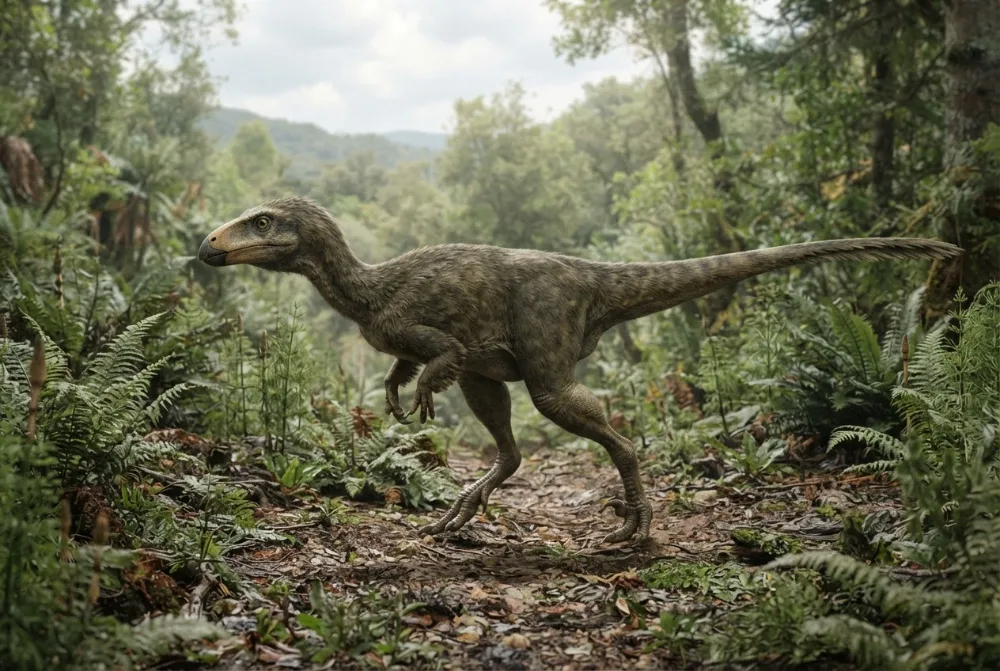
Foskeia was a small, two-legged plant-eater that lived in what is now Spain. It had a beak and a very special skull, and it was one of the earliest members of its dinosaur group.1
When did it live?
How big was it?
How long was it?
How big was Foskeia compared to YOU?
Just maths in your browser. Nothing is saved or sent anywhere.
Fun facts
Foskeia had a beak made of fused premaxillae bones, which is very unusual for an ornithopod dinosaur.1
Its front teeth stuck out forward (procumbent) and the crowns extended beyond the edge of the beak.1
The first tooth in its lower jaw was shaped like a thin thread (filiform), which is a unique feature.1
Foskeia had a very high jaw joint, which helped it bite with extra force.1
Scientists used CT scans to see inside the skull fossils and build a 3D model of the head.1
Foskeia lived about 125 to 119 million years ago, during the Early Cretaceous period.2
This dinosaur is the earliest known member of a group called Rhabdodontia, which lived only in Europe.1
Most asked questions about Foskeia
?How big was Foskeia?
Foskeia was very small, about 0.5 metres (1.6 feet) long, making it one of the smallest ornithopods known.31
?What did Foskeia eat?
Foskeia was a plant-eater (herbivore). Its name means 'light forager', referring to its small size and presumed herbivorous habits.3
?Could Foskeia walk on two legs?
Yes, adults were bipedal. Juveniles started out walking on all fours, but switched to two legs early in life.3
?Why did Foskeia have a beak?
Foskeia had a beak made of fused premaxillae bones, which is unusual for an ornithopod. It likely used it to bite off plant material.3
?When did Foskeia live?
Foskeia lived during the Early Cretaceous, about 125 to 119 million years ago, in what is now Spain.3

Ask Rex about Foskeia
Rex only answers questions about this page. 3 questions a day.
Rex is an AI and can make mistakes. He runs on servers in the EU and questions are never saved. Never type your name or other personal things.
For dino experts
- Scientific name
- Foskeia
- Named by
- Dieudonné et al. 20264
- Group
- Beaked plant-eaters
- Family / clade
- Rhabdodontia4
- Classification
- Ornithischia > Ornithopoda > Iguanodontia4
- Age of the rocks
- 126 to 120 million years (Barremian / Aptian)4
- Rock formations
- Castrillo de la Reina4
- Countries
- Spain4
- Fossil records
- 1 in the Paleobiology Database4
- Discovery
- Foskeia was named in 2026 by a team of scientists led by Dieudonné, based on fossils found at the Vegagete site in Burgos, Spain. The remains were first thought to belong to a different dinosaur, but new skull bones showed it was a new species.12
- Still debated
- Scientists are not sure exactly how big Foskeia grew, because only a few bones have been found so far.1
Where the facts come from
- Foskeia pelendonum, a new rhabdodontomorph from the Lower Cretaceous of Salas de los Infantes (Burgos Province, Spain), and a new phylogeny of ornithischian dinosaurs (riull.ull.es)
- PBDB Taxon (paleobiodb.org)
- Foskeia (en.wikipedia.org)
- Foskeia in The Paleobiology Database (CC BY 4.0): age, places, rock formations, classification.
Every fact on this page has a number that points to its source. If we got something wrong, sorry, we are dino fans, not a science journal. Tell us at [email protected] and we will fix it.
 Rex is hungry! Dino Wiki is a dad's project for his dino-loving son, free with no ads. Grown-ups can feed Rex a snack to help keep it online.Feed Rex
 Iguanodon
 Tenontosaurus
 Thescelosaurus
 Zalmoxes
 Camptosaurus
 Rhabdodon
 Stegosaurus
 Archaeopteryx
 Giganotosaurus
 Microraptor
 Deinonychus
 Baryonyx