
Fukuivenator
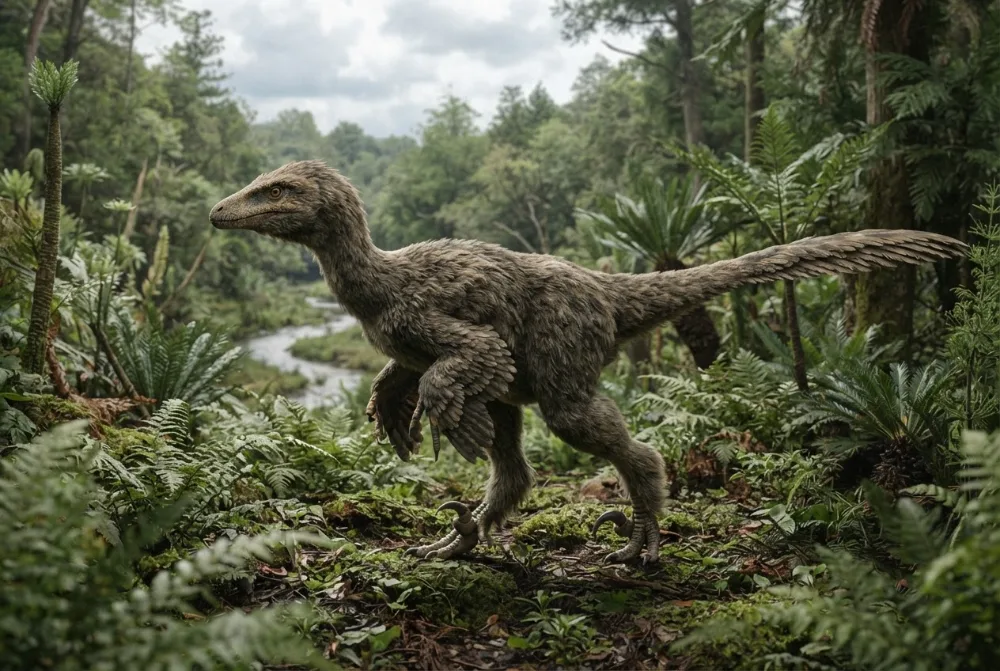
Fukuivenator was a small, fast dinosaur that lived in what is now Japan. It had a strange mix of features from different dinosaur groups, making it a real puzzle for scientists. This dinosaur might have eaten both plants and meat, like a modern raccoon.12
When did it live?
Fun facts
Fukuivenator is known from a nearly complete skeleton, making it the most complete non-bird dinosaur ever found in Japan.12
Its inner ear was shaped like a mix between those of birds and other dinosaurs, showing a step in the evolution of bird hearing.12
Fukuivenator had a very large nostril opening, almost as tall as another hole in its skull called the antorbital fenestra.1
This dinosaur had different kinds of teeth in its mouth, a feature called heterodonty. Some teeth were small and spatula-shaped, while others were large and curved.1
Most asked questions about Fukuivenator
?How big was Fukuivenator?
Fukuivenator was about 2.45 metres (8.0 feet) long and weighed around 25 kilograms (55 pounds).41
?What did Fukuivenator eat?
Fukuivenator probably ate both plants and meat, like a modern raccoon. Its teeth and long neck suggest it was at least omnivorous, maybe even mostly herbivorous.41
?Where was Fukuivenator found?
Fukuivenator was found in 2007 in a quarry near the Sugiyama River in Katsuyama, Japan. The skeleton is the most complete non-bird dinosaur fossil ever found in Japan.41
?When did Fukuivenator live?
Fukuivenator lived during the Early Cretaceous, about 127 to 115 million years ago. That's based on radiometric dating of nearby rocks.4

Ask Rex about Fukuivenator
Rex only answers questions about this page. 3 questions a day.
Rex is an AI and can make mistakes. He runs on servers in the EU and questions are never saved. Never type your name or other personal things.
For dino experts
- Scientific name
- Fukuivenator
- Named by
- Azuma et al. 20165
- Group
- Odd feathered dinos
- Family / clade
- Therizinosauria5
- Classification
- Theropoda > Therizinosauria5
- Age of the rocks
- 121 to 113 million years (Aptian)5
- Rock formations
- Kitadani5
- Countries
- Japan5
- Fossil records
- 1 in the Paleobiology Database5
- Discovery
- Fukuivenator was named in 2016 by a team led by Yoichi Azuma. The fossil was found in the summer of 2007 in the Kitadani Dinosaur Quarry in Fukui, Japan. It was a nearly complete skeleton, the most complete non-bird dinosaur from Japan.13
- Still debated
- Scientists are not sure which dinosaur group Fukuivenator belongs to. It has features of dromaeosaurids, therizinosaurs, and other groups, but its exact family tree is still debated.12
Where the facts come from
- A bizarre theropod from the Early Cretaceous of Japan highlighting mosaic evolution among coelurosaurians | Scientific Reports (nature.com)
- A bizarre theropod from the Early Cretaceous of Japan highlighting mosaic evolution among coelurosaurians (pmc.ncbi.nlm.nih.gov)
- PBDB Taxon (paleobiodb.org)
- Fukuivenator (en.wikipedia.org)
- Fukuivenator in The Paleobiology Database (CC BY 4.0): age, places, rock formations, classification.
Every fact on this page has a number that points to its source. If we got something wrong, sorry, we are dino fans, not a science journal. Tell us at [email protected] and we will fix it.
Rex is hungry! Dino Wiki is a dad's project for his dino-loving son, free with no ads. Grown-ups can feed Rex a snack to help keep it online.Feed Rex Therizinosaurus
 Oviraptor
 Chirostenotes
 Citipes
 Leptorhynchos
 Avimimus
 Stegosaurus
 Iguanodon
 Archaeopteryx
 Giganotosaurus
 Microraptor
 Deinonychus