

Chirostenotes
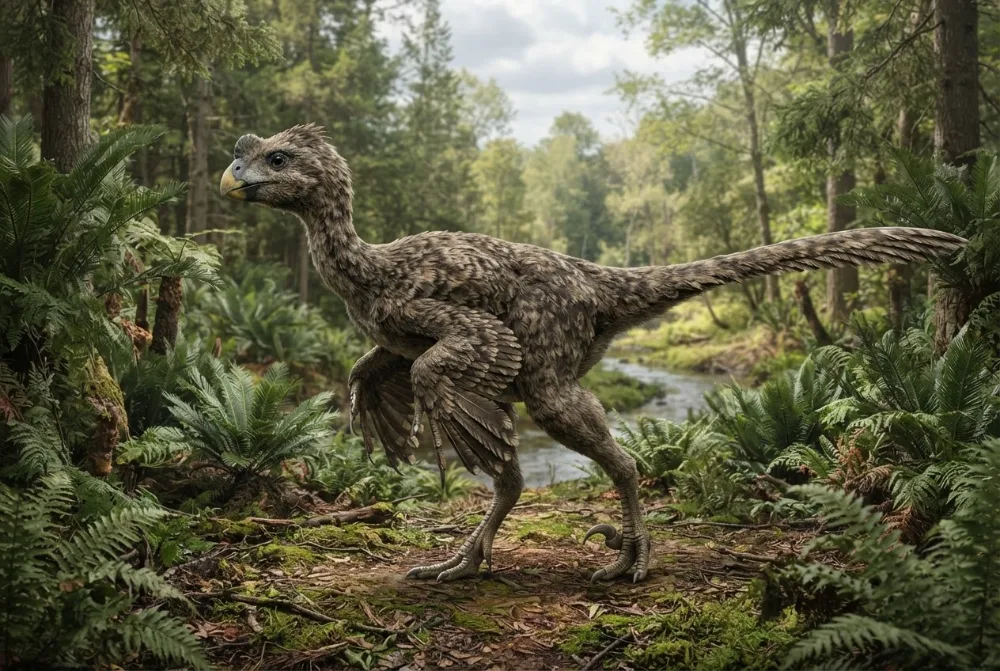
Chirostenotes was a small, bird-like dinosaur that lived in North America during the Late Cretaceous. It had long, slender fingers and a beak without teeth, and scientists think it ate both plants and small animals.12
When did it live?
How big was it?
How long was it?
How big was Chirostenotes compared to YOU?
Just maths in your browser. Nothing is saved or sent anywhere.
Fun facts
Chirostenotes belongs to a group called caenagnathids, which are oviraptorosaurs. These dinosaurs are known for their toothless beaks and often had crests on their heads.42
Its name means 'narrow-handed' because its hand bones were long and slender, with three fingers that ended in sharp claws.1
Chirostenotes lived between about 79 and 67 million years ago, during the Late Cretaceous period.1
Fossils of Chirostenotes have been found in the Dinosaur Park Formation in Alberta, Canada, and the Hell Creek Formation in Montana, USA.4
Scientists once thought Chirostenotes was a different dinosaur called Macrophalangia, which means 'big toes'. Now they know it's the same animal.4
A study of a well-preserved jaw showed that Chirostenotes had a strong, shearing bite, like some plant-eating animals today. This supports the idea that it ate tough plants.2
Most asked questions about Chirostenotes
?How big was Chirostenotes?
About 2.5 metres (8.2 ft) long and weighed around 100 kg (220 lbs).3
?What did Chirostenotes eat?
It was an omnivore, eating both plants and small animals like grubs, amphibians, reptiles and mammals.32
?Did Chirostenotes have feathers?
Yes, it was a feathered theropod, and related oviraptorosaurs like Caudipteryx had large primary feathers on their hands.3
?When did Chirostenotes live?
It lived during the Late Cretaceous period, about 79 to 67 million years ago.1
?Why is it called Chirostenotes?
Its name means 'narrow-handed' because its hand bones were long and slender.1

Ask Rex about Chirostenotes
Rex only answers questions about this page. 3 questions a day.
Rex is an AI and can make mistakes. He runs on servers in the EU and questions are never saved. Never type your name or other personal things.
Myth buster
Myth: Some people think Chirostenotes was a meat-eater like many other theropods.
Truth: Chirostenotes was actually an omnivore, eating both plants and small animals. Its toothless beak and jaw shape are better suited for slicing plants than for catching large prey.2
For dino experts
- Scientific name
- Chirostenotes
- Named by
- Gilmore 19244
- Group
- Odd feathered dinos
- Family / clade
- Caenagnathidae4
- Classification
- Theropoda > Oviraptorosauria4
- Age of the rocks
- 84 to 66 million years (Campanian / Maastrichtian)4
- Rock formations
- Hell Creek, Dinosaur Park, Aguja4
- Countries
- USA, Canada4
- Fossil records
- 28 in the Paleobiology Database4
- Also known as
- Macrophalangia (older names now counted as the same animal)4
- Discovery
- Chirostenotes was named in 1924 by paleontologist Charles W. Gilmore, based on a pair of hands found in Alberta, Canada. Later, more complete fossils showed it was a caenagnathid.41
- Still debated
- Scientists are still debating exactly what Chirostenotes ate. Some think it was mostly a plant-eater, while others believe it ate a mix of plants and small animals.2
Where the facts come from
- Chirostenotes | Natural History Museum (nhm.ac.uk)
- A previously undescribed caenagnathid mandible from the late Campanian of Alberta, and insights into the diet of Chirostenotes pergracilis (Dinosauria: Oviraptorosauria) (cdnsciencepub.com)
- Chirostenotes (Wikipedia) (Wikipedia)
- Chirostenotes in The Paleobiology Database (CC BY 4.0): age, places, rock formations, classification.
Every fact on this page has a number that points to its source. If we got something wrong, sorry, we are dino fans, not a science journal. Tell us at [email protected] and we will fix it.
Rex is hungry! Dino Wiki is a dad's project for his dino-loving son, free with no ads. Grown-ups can feed Rex a snack to help keep it online.Feed Rex Therizinosaurus
 Oviraptor
 Citipes
 Leptorhynchos
 Avimimus
 Caenagnathus
 Triceratops
 Velociraptor
 Spinosaurus
 Ankylosaurus
 Parasaurolophus