
Geminiraptor
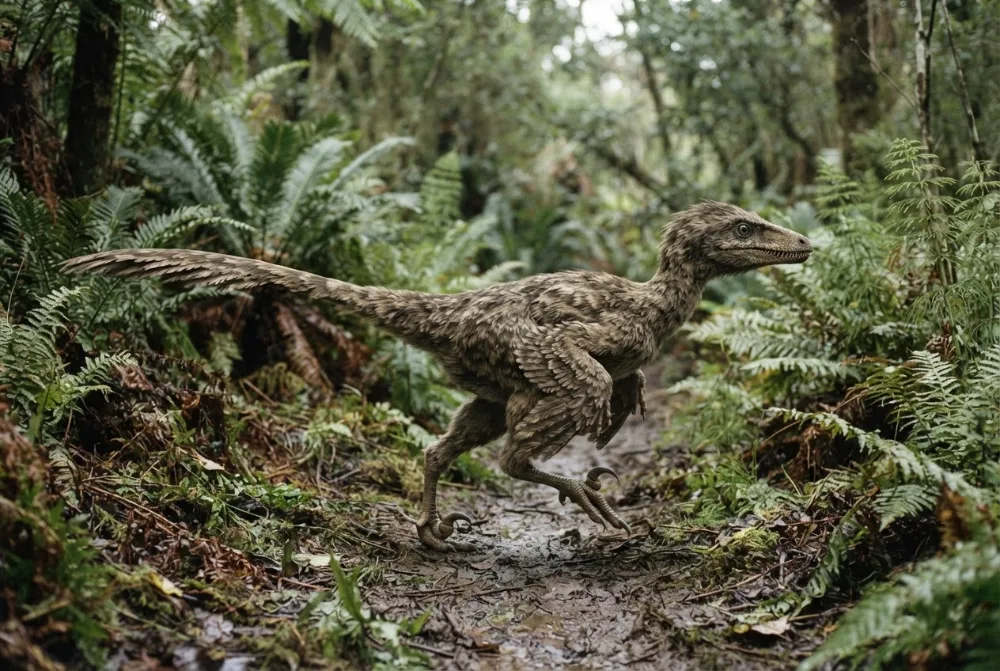
Geminiraptor was a small, fast, meat-eating dinosaur with lots of sharp teeth. It lived in what is now Utah, USA, about 139 to 134 million years ago. This dinosaur was a troodontid, a group known for being brainy and bird-like.1
When did it live?
How big was it?
How long was it?
How tall was it?
head height
How heavy was it?
How big was Geminiraptor compared to YOU?
Just maths in your browser. Nothing is saved or sent anywhere.
Fun facts
Geminiraptor is named after twin geologists Marina and Celina Suarez, who discovered the fossil site. The name means 'twin seizer'.1
Only one piece of the skull, an upper jaw bone called a maxilla, has been found. Scientists think the whole dinosaur was about 1.5 meters (5 feet) long.1
Its upper jaw had at least 19 teeth, and the sockets were square-shaped, which is unusual. This feature is only known in one other troodontid, Sinovenator.1
Geminiraptor's upper jaw had a big air pocket inside, giving it a triangular shape when cut across. This helped make the skull lighter.1
It lived alongside other dinosaurs such as the theropods Falcarius and Yurgovuchia, the sauropod Mierasaurus, and the large plant-eater Iguanacolossus.1
Most asked questions about Geminiraptor
?How big was Geminiraptor?
It was a small dinosaur, about 1.5 metres (5 feet) long and weighed roughly 2.3 to 9 kilograms (5 to 20 pounds).1
?What did Geminiraptor eat?
It was a meat-eater, a carnivore that likely hunted small animals. Its many sharp teeth helped it catch and eat prey.14
?When did Geminiraptor live?
It lived during the Early Cretaceous period, about 139 to 134 million years ago.1
?Where was Geminiraptor found?
Its only fossil, an upper jaw bone, was found in Utah, USA, in the Cedar Mountain Formation.14
?Is Geminiraptor a dinosaur?
Yes, it is a dinosaur. It belongs to the group Troodontidae, which are small, bird-like theropod dinosaurs.1
?Why is it called Geminiraptor?
Its name means 'twin seizer' in Latin, after the twin geologists Marina and Celina Suarez who found the fossil site.1
Ask Rex about Geminiraptor
Rex only answers questions about this page. 3 questions a day.
Rex is an AI and can make mistakes. He runs on servers in the EU and questions are never saved. Never type your name or other personal things.
For dino experts
- Scientific name
- Geminiraptor
- Named by
- Senter et al. 20104
- Group
- Raptors
- Family / clade
- Troodontidae4
- Classification
- Theropoda > Troodontidae4
- Age of the rocks
- 137 to 133 million years (Valanginian)4
- Rock formations
- Cedar Mountain4
- Countries
- USA4
- Fossil records
- 1 in the Paleobiology Database4
- Discovery
- Geminiraptor was named by Phil Senter, James I. Kirkland, John Bird, and Jeff A. Bartlett in 2010. It was described from a single upper jaw bone found in Utah, USA.1
- Still debated
- Scientists are not sure exactly where Geminiraptor fits in the troodontid family tree. It might be closely related to Sinovenator because both have bony walls between their tooth sockets.1
Where the facts come from
- Geminiraptor (en.wikipedia.org)
- S-EPMC3002269 - A new troodontid theropod dinosaur from the lower Cretaceous of Utah. - OmicsDI (omicsdi.org)
- Falcarius (Wikipedia) (Wikipedia)
- Geminiraptor in The Paleobiology Database (CC BY 4.0): age, places, rock formations, classification.
Every fact on this page has a number that points to its source. If we got something wrong, sorry, we are dino fans, not a science journal. Tell us at [email protected] and we will fix it.
 Rex is hungry! Dino Wiki is a dad's project for his dino-loving son, free with no ads. Grown-ups can feed Rex a snack to help keep it online.Feed Rex
 Velociraptor
 Microraptor
 Deinonychus
 Asiamericana
 Richardoestesia
 Saurornitholestes
 Stegosaurus
 Iguanodon
 Archaeopteryx
 Giganotosaurus
 Baryonyx
 Paronychodon