
Guemesia
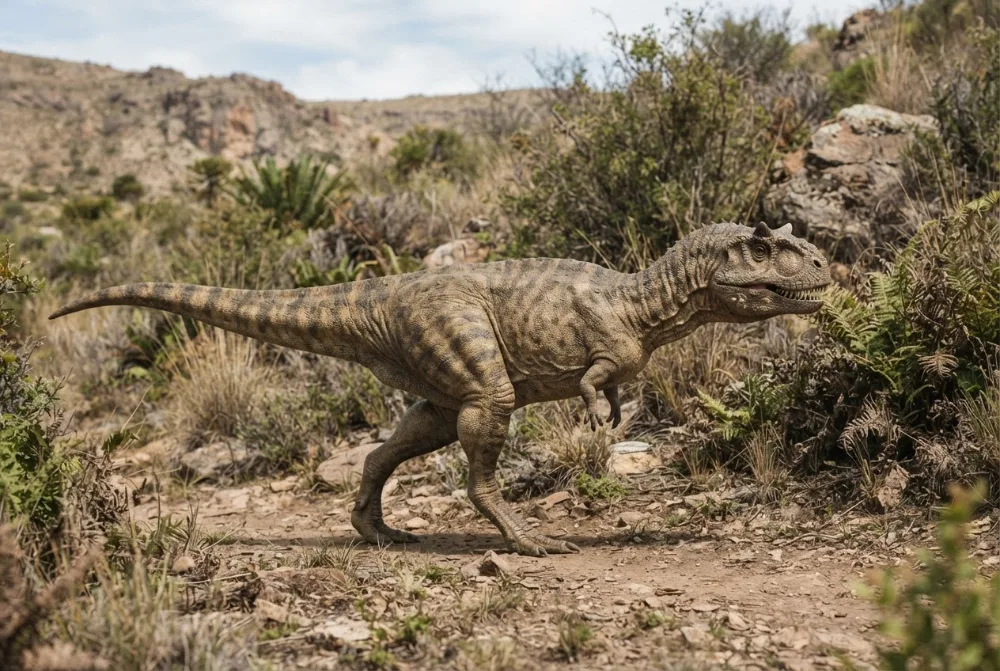
Guemesia was a small, meat-eating dinosaur that lived in what is now Argentina. It is one of the smallest abelisaurids ever found, about the size of a large dog. Its nearly complete braincase helped scientists learn a lot about this little predator.12
When did it live?
Fun facts
Guemesia is known from only a single, nearly complete braincase, which is very rare for abelisaurids.12
It is one of the smallest abelisaurids ever discovered, much smaller than relatives like Carnotaurus.12
Unlike many other abelisaurids, Guemesia had no horns or bumps on its skull.2
Its skull roof was thin, and its parietal eminence was low and narrow, at the same level as the sagittal crest.2
Guemesia lived during the Late Cretaceous period, about 72 million years ago.1
It is the first definitive abelisaurid dinosaur found in northwestern Argentina.2
Guemesia belongs to the group Brachyrostra, which includes many other South American abelisaurids.1
Most asked questions about Guemesia
?How big was Guemesia?
About the size of a large dog, making it one of the smallest abelisaurids known.13
?Did Guemesia have horns?
No. Unlike many other abelisaurids, Guemesia had no horns or bumps on its skull.12
?What did Guemesia eat?
It was a meat-eater, likely feeding on large dinosaurs like titanosaurs, using its powerful head and jaws instead of its tiny arms.3

Ask Rex about Guemesia
Rex only answers questions about this page. 3 questions a day.
Rex is an AI and can make mistakes. He runs on servers in the EU and questions are never saved. Never type your name or other personal things.
For dino experts
- Scientific name
- Guemesia
- Named by
- Agnolín et al. 20214
- Group
- Meat-eating dinos
- Family / clade
- Abelisauridae4
- Classification
- Theropoda > Ceratosauria > Abelisauridae4
- Age of the rocks
- 84 to 66 million years (Campanian / Maastrichtian)4
- Rock formations
- Los Blanquitos4
- Countries
- Argentina4
- Fossil records
- 1 in the Paleobiology Database4
- Discovery
- Guemesia was named in 2022 by paleontologist Federico Agnolín and colleagues. The fossil, a nearly complete braincase, was found in the Los Blanquitos Formation in Salta Province, Argentina.12
- Still debated
- Scientists are not sure exactly how big Guemesia was, because only its braincase has been found. Its small size might mean it was a juvenile or a particularly small species.12
Where the facts come from
- Guemesia (en.wikipedia.org)
- First definitive abelisaurid theropod from the Late Cretaceous of Northwestern Argentina: Journal of Vertebrate Paleontology: Vol 41 , No 4 - Get Access (tandfonline.com)
- New armless abelisaur dinosaur species discovered in Argentina | Natural History Museum (nhm.ac.uk)
- Guemesia in The Paleobiology Database (CC BY 4.0): age, places, rock formations, classification.
Every fact on this page has a number that points to its source. If we got something wrong, sorry, we are dino fans, not a science journal. Tell us at [email protected] and we will fix it.
 Rex is hungry! Dino Wiki is a dad's project for his dino-loving son, free with no ads. Grown-ups can feed Rex a snack to help keep it online.Feed Rex
 Allosaurus
 Carnotaurus
 Dilophosaurus
 Giganotosaurus
 Compsognathus
 Paronychodon
 Tyrannosaurus
 Triceratops
 Velociraptor
 Spinosaurus
 Ankylosaurus
 Parasaurolophus