
Iberomesornis
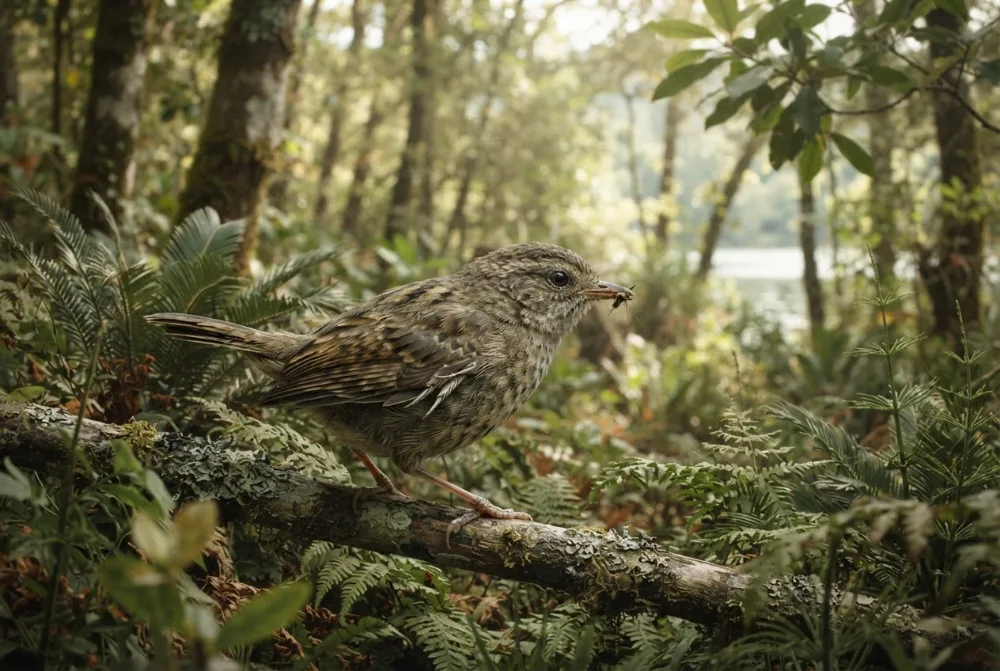
Iberomesornis was a tiny bird that lived about 125 million years ago in what is now Spain. It was no bigger than a sparrow and fluttered through warm forests near lakes, snatching insects. It was an early bird, but not a dinosaur like T. rex, it was a type of bird called an enantiornithine.1
When did it live?
How big was it?
How long was it?
How heavy was it?
How big was Iberomesornis compared to YOU?
Just maths in your browser. Nothing is saved or sent anywhere.
Fun facts
Iberomesornis had a single claw on each wing, which is unusual for modern birds.1
Its tail was short and ended in a pygostyle, a fused bone that supports tail feathers, making it more advanced than Archaeopteryx.1
It had strong, clawed feet for perching on branches, with long curved toes and a special toe that helped it grip.1
The fossil was found in rocks that were once a forest around a lake, with a warm climate and a dry season.1
Its ribcage did not have bony uncinate processes, but scientists think it had cartilage there instead.1
Iberomesornis is one of the earliest known enantiornithine birds, a group that lived alongside dinosaurs.1
Most asked questions about Iberomesornis
?How big was Iberomesornis?
It was tiny, no bigger than a large modern sparrow. Its wingspan was about 20 centimetres (8 inches) and it weighed 15 to 20 grams (0.5 to 0.7 ounces).1
?What did Iberomesornis eat?
Nobody knows for sure because its skull has not been found. It probably hunted insects and other small animals, catching them in the air or from the ground.1
?Could Iberomesornis fly?
Yes, it could flap its wings and fly. A 2025 study found that it had strong muscles for flapping flight, even though it lacked a bony keel on its breastbone.2
?When did Iberomesornis live?
It lived about 125 million years ago, during the Early Cretaceous period. Its fossils were found in Spain.1

Ask Rex about Iberomesornis
Rex only answers questions about this page. 3 questions a day.
Rex is an AI and can make mistakes. He runs on servers in the EU and questions are never saved. Never type your name or other personal things.
Myth buster
Myth: Some people think Iberomesornis was a dinosaur like Velociraptor.
Truth: It was a bird, specifically an enantiornithine, which is a type of bird that lived in the Cretaceous. Birds are related to dinosaurs, but they are not the same as non-avian dinosaurs.1
For dino experts
- Scientific name
- Iberomesornis
- Named by
- Sanz et al. 19903
- Group
- Early birds
- Family / clade
- Enantiornithes3
- Classification
- Theropoda > Avialae3
- Age of the rocks
- 126 to 121 million years (Barremian)3
- Rock formations
- La Huérguina3
- Countries
- Spain3
- Fossil records
- 2 in the Paleobiology Database3
- Discovery
- The fossil was found in 1985 by Armando Díaz Romeral in Spain. It was named Iberomesornis romerali in 1992 by José Luis Sanz and José Fernando Bonaparte.1
- Still debated
- Scientists are not sure what Iberomesornis ate because its skull has not been found, so they guess it ate insects and small animals.1
Where the facts come from
- Iberomesornis (en.wikipedia.org)
- Micro-CT reconstruction reveals new information about the phylogenetic position and locomotion of the Early Cretaceous bird Iberomesornis romerali (dinosaurier-info.de)
- Iberomesornis in The Paleobiology Database (CC BY 4.0): age, places, rock formations, classification.
Every fact on this page has a number that points to its source. If we got something wrong, sorry, we are dino fans, not a science journal. Tell us at [email protected] and we will fix it.
 Rex is hungry! Dino Wiki is a dad's project for his dino-loving son, free with no ads. Grown-ups can feed Rex a snack to help keep it online.Feed Rex
 Archaeopteryx
 Hesperornis
 Ichthyornis
 Baptornis
 Jurapteryx
 Gobipteryx
 Stegosaurus
 Iguanodon
 Giganotosaurus
 Microraptor
 Deinonychus
 Baryonyx