 Home
 All dinos
 Dino groups
 Explore
 Dinos by country
 Dino vs dino
 How big were they?
 Dinos A to Z
 Who ate what?
 What dino are you? Quiz
 Dino games
 Dino battle
 Dino race
 Dino mini-games
 Sticker album
 Dino TOP lists
 Timeline
 Surprise me!
 Language: English

Igai
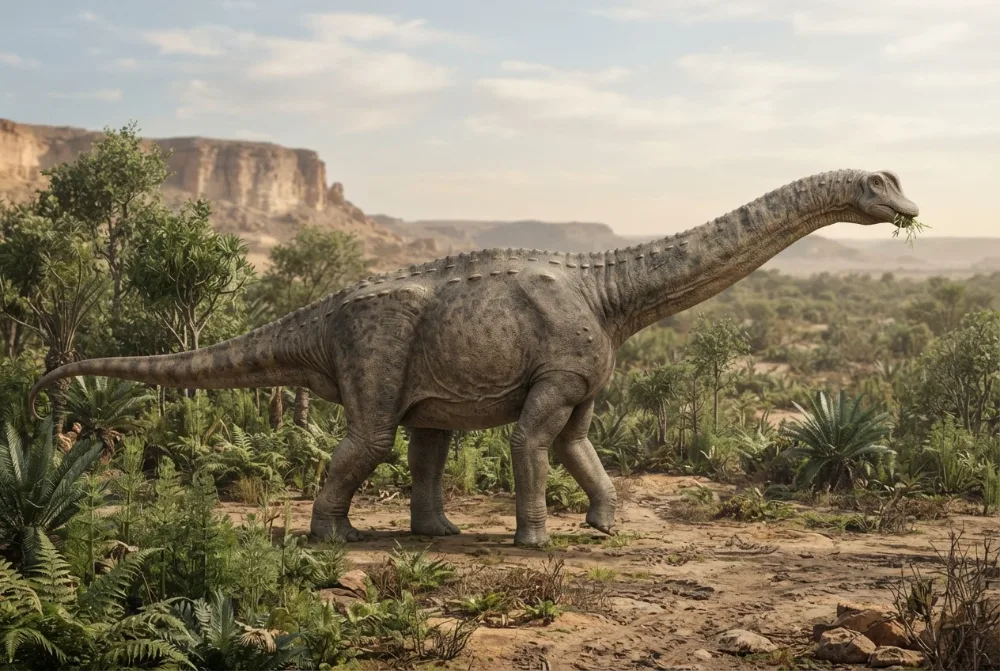
Igai was a giant, long-necked plant-eater that stomped through what is now Egypt about 74 million years ago. It was a titanosaur, a group of sauropods known for their huge bodies and small heads. Even though it was big, it was actually one of the smaller titanosaurs!12
 Egypt
When did it live?
Igai: 84 to 72 million years ago
How big was it?
How long was it?
How tall was it?
estimate
 as long as 3 cars parked in a row🍌as long as 83 bananas end to end🏃could run 100 metres in 22 seconds (the fastest human needs 9.6)
How big was Igai compared to YOU?
Just maths in your browser. Nothing is saved or sent anywhere.
How fast was it?


Fun facts
Igai had air sacs inside its backbone bones, making them light and spongy, which helped it grow so large.2
Its fifth metacarpal (a bone in the hand) had two unique bumps on the inner side that no other titanosaur has.2
Igai was more slender than many other titanosaurs, with leg bones that were relatively thin and graceful.2
The first and second metatarsals (foot bones) had deep grooves on their upper surfaces, a feature not seen in other titanosaurs.2
Igai lived about 74 million years ago, during the Campanian stage of the Late Cretaceous.2
Igai was probably bigger than its close relative Mansourasaurus, which was about 8 to 10 metres long.2
Most asked questions about Igai
Myth buster
Myth: Igai was a giant, slow-moving beast like other sauropods.
Truth: Igai was actually relatively small and slender for a titanosaur, with fairly thin, graceful limb bones.2
For dino experts
- Scientific name
- Igai
- Named by
- Gorscak et al. 20234
- Group
- Long-necks
- Family / clade
- Saltasauridae4
- Classification
- Sauropodomorpha > Sauropoda > Titanosauria > Macronaria4
- Age of the rocks
- 84 to 72 million years (Campanian)4
- Rock formations
- Quseir4
- Countries
- Egypt4
- Fossil records
- 1 in the Paleobiology Database4
- Discovery
- Fossils of Igai were first found in 1977 by German scientists in the Kharga Oasis, Egypt. It was named and described in 2023 by Gorscak and colleagues.23
- Still debated
- Scientists are still debating whether Igai was fully grown when it died, because some bones suggest it might not have been completely mature.1
Where the facts come from
- tandfonline.com (tandfonline.com)
- Igai (en.wikipedia.org)
- PBDB Taxon (paleobiodb.org)
- Igai in The Paleobiology Database (CC BY 4.0): age, places, rock formations, classification.
Every fact on this page has a number that points to its source. If we got something wrong, sorry, we are dino fans, not a science journal. Tell us at hello@dinowiki.app and we will fix it.
 Rex is hungry! Dino Wiki is a dad's project for his dino-loving son, free with no ads and no cookies. Grown-ups can feed Rex a snack to help keep it online.Feed Rex
 Brachiosaurus
 Diplodocus
 Brontosaurus
 Argentinosaurus
 Camarasaurus
 Morosaurus
 Tyrannosaurus
 Triceratops
 Velociraptor
 Spinosaurus
 Ankylosaurus
 Parasaurolophus