
Istiorachis
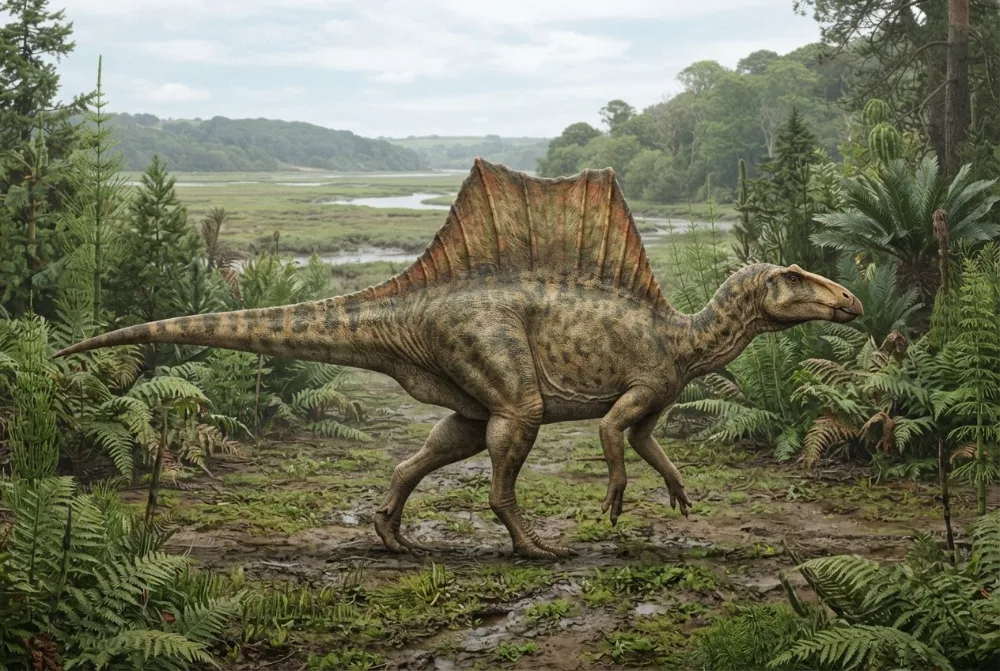
Istiorachis was a plant-eating dinosaur that lived on the Isle of Wight over 120 million years ago. It had a tall sail on its back made of long spines, which might have helped it show off to other dinosaurs. It was about the size of an American bison and weighed as much as a small car.2
When did it live?
How big was it?
How tall was it?
How heavy was it?
How big was Istiorachis compared to YOU?
Just maths in your browser. Nothing is saved or sent anywhere.
Fun facts
Istiorachis had very long spines on its back and tail bones, making a sail-like structure that was probably used for showing off to mates or scaring predators.1
Its name honors Dame Ellen MacArthur, a famous sailor from the Isle of Wight who sailed solo around the world.1
The only known fossil of Istiorachis was found in a plant debris bed near Grange Chine on the Isle of Wight.1
Some of the skeleton was stolen by poachers before scientists could collect it.1
Istiorachis belonged to a group of dinosaurs called iguanodontians, which were common in the Early Cretaceous.2
The sail of Istiorachis was made of neural spines that were over four times taller than the main part of the backbone.1
Most asked questions about Istiorachis
?How big was Istiorachis?
It was about the size of an American bison, stood around two metres tall, and weighed about one tonne (1,000 kilograms).2
?What did Istiorachis eat?
It was a plant-eating dinosaur, so it ate plants like ferns, cycads and conifers that grew in its warm, forested environment.3

Ask Rex about Istiorachis
Rex only answers questions about this page. 3 questions a day.
Rex is an AI and can make mistakes. He runs on servers in the EU and questions are never saved. Never type your name or other personal things.
For dino experts
- Scientific name
- Istiorachis
- Named by
- Lockwood et al. 20254
- Group
- Beaked plant-eaters
- Family / clade
- Styracosterna4
- Classification
- Ornithischia > Ornithopoda > Iguanodontia4
- Age of the rocks
- 133 to 121 million years (Hauterivian / Barremian)4
- Rock formations
- Wessex4
- Countries
- United Kingdom4
- Fossil records
- 1 in the Paleobiology Database4
- Discovery
- Istiorachis was named in 2025 by Jeremy Lockwood, David Martill, and Susannah Maidment. The fossil was dug up by Nicholas Chase from the Wessex Formation on the Isle of Wight.1
- Still debated
- Scientists are not sure exactly what the sail was used for. It might have helped with walking on four legs, or it might have been for showing off to other dinosaurs.1
Where the facts come from
- The origins of neural spine elongation in iguanodontian dinosaurs and the osteology of a new sail-back styracosternan (Dinosauria, Ornithischia) from the Lower Cretaceous Wealden Group of England (onlinelibrary.wiley.com)
- New sail-backed dinosaur species unearthed on the Isle of Wight | Natural History Museum (nhm.ac.uk)
- Istiorachis (en.wikipedia.org)
- Istiorachis in The Paleobiology Database (CC BY 4.0): age, places, rock formations, classification.
Every fact on this page has a number that points to its source. If we got something wrong, sorry, we are dino fans, not a science journal. Tell us at [email protected] and we will fix it.
 Rex is hungry! Dino Wiki is a dad's project for his dino-loving son, free with no ads. Grown-ups can feed Rex a snack to help keep it online.Feed Rex
 Iguanodon
 Tenontosaurus
 Thescelosaurus
 Zalmoxes
 Camptosaurus
 Rhabdodon
 Stegosaurus
 Archaeopteryx
 Giganotosaurus
 Microraptor
 Deinonychus
 Baryonyx