When did it live?

Fun facts
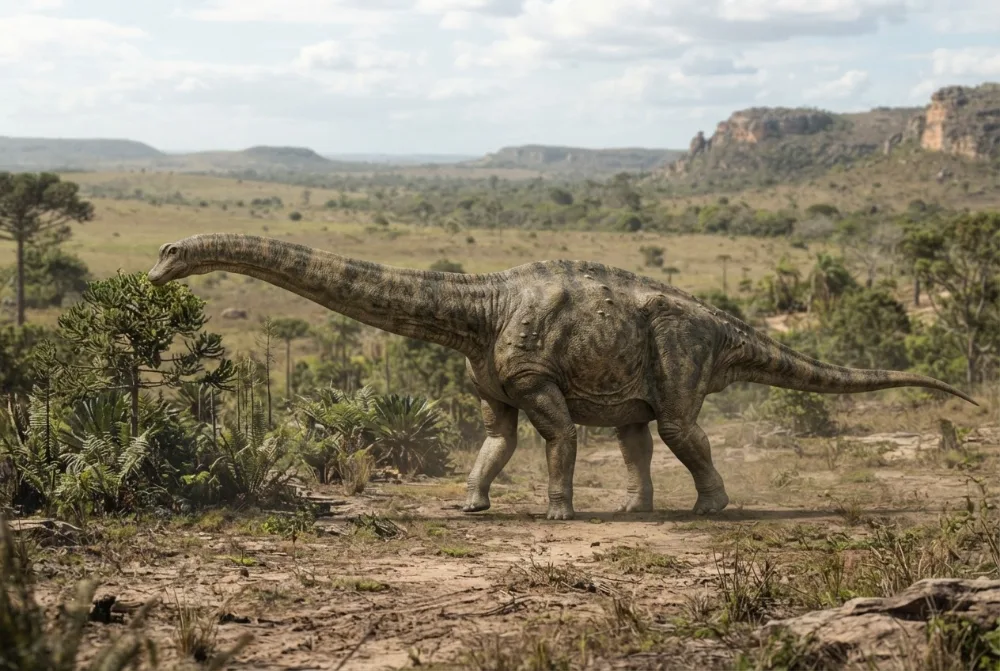
Itapeuasaurus is the most complete diplodocoid dinosaur from the Cenomanian age found in South America.1
Its backbone had deep pits called fossae that made the bones lighter, like a bird's bones.2
The largest vertebra found was 40 centimeters (16 inches) long.1
Itapeuasaurus belongs to a group of sauropods called rebbachisaurids, which had tall neural spines on their vertebrae.2
The fossils were discovered by a fisherman named Carlos Wagner Silva in November 2014.1
Because the bones were found on a beach in the tidal zone, scientists could only dig for about four hours each day.1
Most asked questions about Itapeuasaurus

Ask Rex about Itapeuasaurus
Rex only answers questions about this page. 3 questions a day.
Rex is an AI and can make mistakes. He runs on servers in the EU and questions are never saved. Never type your name or other personal things.
For dino experts
- Scientific name
- Itapeuasaurus
- Named by
- Lindoso et al. 20193
- Group
- Long-necks
- Family / clade
- Rebbachisauridae3
- Classification
- Sauropodomorpha > Sauropoda > Diplodocoidea3
- Age of the rocks
- 100 to 94 million years (Cenomanian)3
- Rock formations
- Alcântara3
- Countries
- Brazil3
- Fossil records
- 1 in the Paleobiology Database3
- Discovery
- Itapeuasaurus was named in 2019 by Lindoso and colleagues. The fossils were found on Itapeua beach in Brazil, first spotted by a fisherman in 2014.31
Where the facts come from
- Itapeuasaurus (en.wikipedia.org)
- Diplodocoidea) from the middle Cretaceous of northern Brazil (igeo.ufrj.br)
- Itapeuasaurus in The Paleobiology Database (CC BY 4.0): age, places, rock formations, classification.
Every fact on this page has a number that points to its source. If we got something wrong, sorry, we are dino fans, not a science journal. Tell us at [email protected] and we will fix it.
Rex is hungry! Dino Wiki is a dad's project for his dino-loving son, free with no ads. Grown-ups can feed Rex a snack to help keep it online.Feed Rex Brachiosaurus
 Diplodocus
 Brontosaurus
 Argentinosaurus
 Camarasaurus
 Morosaurus
 Triceratops
 Velociraptor
 Spinosaurus
 Ankylosaurus
 Parasaurolophus