
Jinchuanloong
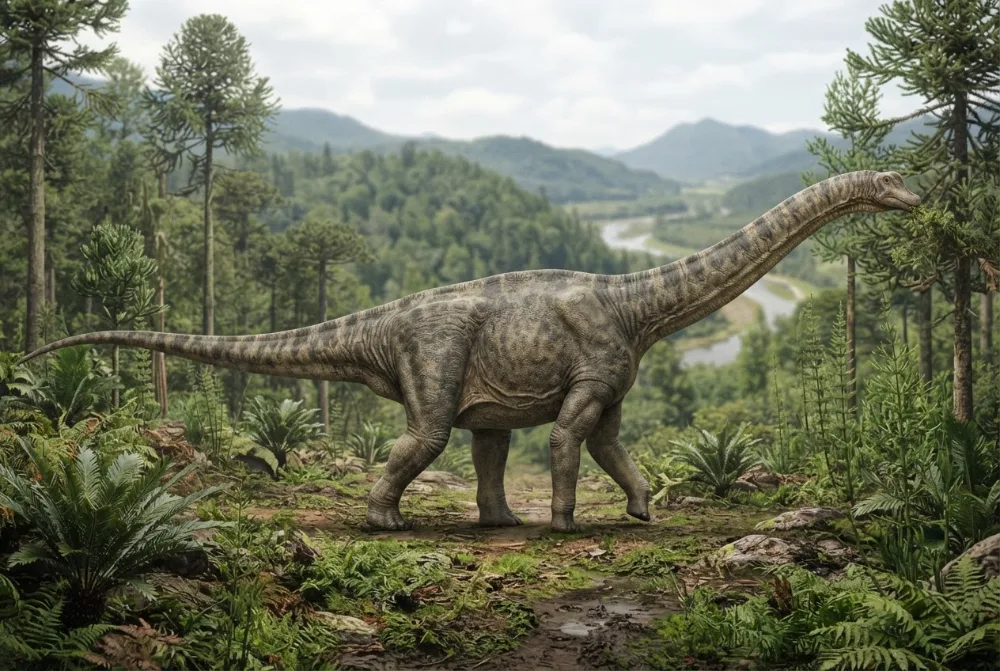
Jinchuanloong was a long-necked, plant-eating dinosaur that lived about 168 million years ago. It walked on four sturdy legs and had a very long tail. Scientists found its skull, neck bones, and tail bones in China.12
When did it live?
How big was it?
How big was Jinchuanloong compared to YOU?
Just maths in your browser. Nothing is saved or sent anywhere.
Fun facts
Its name 'niedu' comes from the Mandarin words for 'nickel' and 'city', because Jinchuan is famous for its nickel mines.12
The fossil includes the first five neck bones still attached to the skull, and 29 tail bones that were still in a row.12
Scientists think the holotype was not fully grown because some of its skull bones were not fused together.1

Ask Rex about Jinchuanloong
Rex only answers questions about this page. 3 questions a day.
Rex is an AI and can make mistakes. He runs on servers in the EU and questions are never saved. Never type your name or other personal things.
For dino experts
- Scientific name
- Jinchuanloong
- Named by
- Li et al. 20254
- Group
- Long-necks
- Family / clade
- Eusauropoda4
- Classification
- Sauropodomorpha > Sauropoda4
- Age of the rocks
- 168 to 165 million years (Bathonian)4
- Rock formations
- Xinhe4
- Countries
- China4
- Fossil records
- 1 in the Paleobiology Database4
- Discovery
- The fossil was found in 2017 by Dr. Li Daqing during fieldwork in Gansu Province, China. It was named and described by Li and colleagues in 2025.12
- Still debated
- Scientists are not sure if the holotype was a juvenile or a subadult, because some bones were unfused but it was already about 10 metres long.1
Where the facts come from
- Jinchuanloong (en.wikipedia.org)
- A new eusauropod (Dinosauria, Sauropodomorpha) from the Middle Jurassic of Gansu, China | Scientific Reports (preview-www.nature.com)
- PBDB Taxon (paleobiodb.org)
- Jinchuanloong in The Paleobiology Database (CC BY 4.0): age, places, rock formations, classification.
Every fact on this page has a number that points to its source. If we got something wrong, sorry, we are dino fans, not a science journal. Tell us at [email protected] and we will fix it.
Rex is hungry! Dino Wiki is a dad's project for his dino-loving son, free with no ads. Grown-ups can feed Rex a snack to help keep it online.Feed Rex Brachiosaurus
 Diplodocus
 Brontosaurus
 Argentinosaurus
 Camarasaurus
 Morosaurus
 Ichthyosaurus
 Khudiakovia
 Ophthalmosaurus
 Pterodactylus
 Peloneustes
 Rhamphocephalus