 Home
 All dinos
 Dino groups
 Explore
 Dinos by country
 Dino vs dino
 How big were they?
 Dinos A to Z
 Who ate what?
 What dino are you? Quiz
 Dino games
 Dino battle
 Dino race
 Dino mini-games
 Sticker album
 Dino TOP lists
 Timeline
 Surprise me!
 Language: English

Linlongopterus
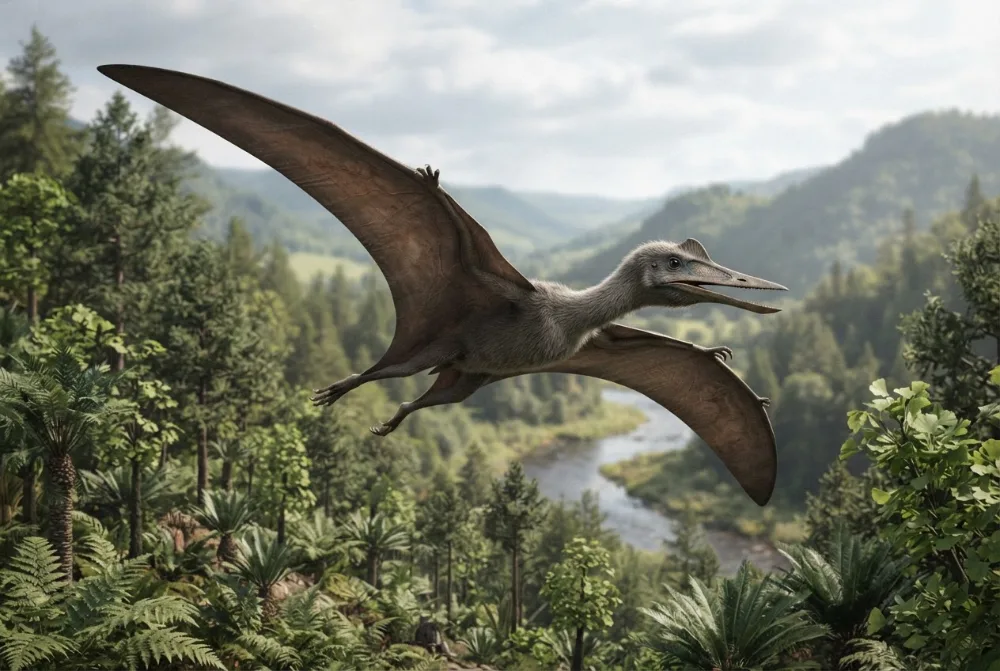
Linlongopterus was a flying reptile that soared over ancient China about 120 million years ago. It had a long skull full of sharp, cone-shaped teeth for catching fish. This pterosaur was not a dinosaur, but a close cousin that ruled the skies.13
 China
When did it live?
Linlongopterus: 121 to 113 million years ago
How fast was it?


Fun facts
Linlongopterus is known from only one partial skull and jaw, found in two pieces that had to be glued back together.1
Its eye socket was positioned lower on the skull than in most other pteranodontoid pterosaurs, a unique feature.1
The bones of its skull were not fully fused, suggesting this individual was not fully grown when it died.1
Linlongopterus had no crest on its snout, unlike many of its relatives such as anhanguerids.1
Its teeth were cone-shaped and gently curved, similar to those of Mimodactylus and Haopterus, but without a cingulum (a shelf-like structure).1
Scientists are not sure exactly where Linlongopterus fits on the pterosaur family tree, but most agree it belongs to the group Pteranodontoidea.1
Most asked questions about Linlongopterus
For dino experts
- Scientific name
- Linlongopterus
- Named by
- Rodrigues et al. 20153
- Group
- Flying reptiles
- Family / clade
- Pteranodontoidea3
- Classification
- Pterosauria > Pterodactyloidea3
- Age of the rocks
- 121 to 113 million years (Aptian)3
- Rock formations
- Jiufotang3
- Countries
- China3
- Fossil records
- 1 in the Paleobiology Database3
- Discovery
- Linlongopterus was named in 2015 by a team led by Taissa Rodrigues, based on a partial skull found in the Jiufotang Formation of Liaoning, China. The species name jennyae honors Elfriede Kellner, mother of co-author Alexander Kellner.13
- Still debated
- Scientists still debate whether Linlongopterus belongs to the family Mimodactylidae or is a more primitive member of Ornithocheiriformes.1
Where the facts come from
- Linlongopterus (en.wikipedia.org)
- PBDB Taxon (paleobiodb.org)
- Linlongopterus in The Paleobiology Database (CC BY 4.0): age, places, rock formations, classification.
Every fact on this page has a number that points to its source. If we got something wrong, sorry, we are dino fans, not a science journal. Tell us at hello@dinowiki.app and we will fix it.
 Rex is hungry! Dino Wiki is a dad's project for his dino-loving son, free with no ads and no cookies. Grown-ups can feed Rex a snack to help keep it online.Feed Rex
 Pteranodon
 Quetzalcoatlus
 Dorygnathus
 Rhamphorhynchus
 Anhanguera
 Pterodactylus
 Iguanodon
 Archaeopteryx
 Giganotosaurus
 Microraptor
 Deinonychus
 Baryonyx