
Lycorhinus
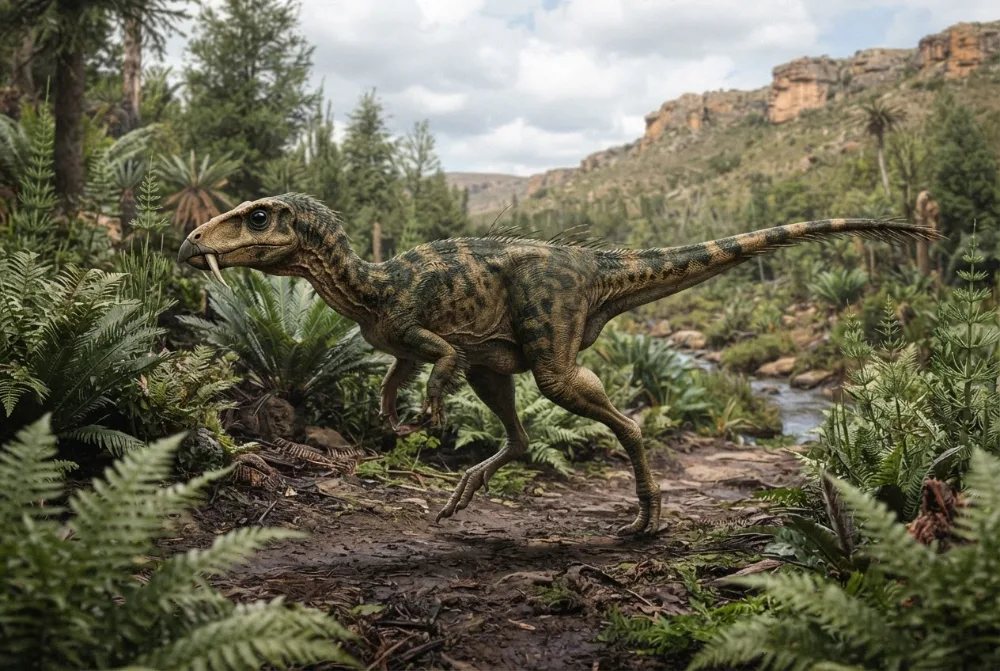
Lycorhinus was a small, plant-eating dinosaur with a beak and long, sharp canine teeth. It lived in what is now South Africa and Lesotho during the Early Jurassic period, about 200 million years ago.13
When did it live?
How big was it?
How long was it?
How big was Lycorhinus compared to YOU?
Just maths in your browser. Nothing is saved or sent anywhere.
Fun facts
Lycorhinus was first thought to be a mammal-like reptile called a cynodont, not a dinosaur, when it was named in 1924.1
It had a beak at the front of its mouth, like a parrot, but also had long, fang-like canine teeth.1
Lycorhinus was only about 1.2 metres (4 feet) long, about the size of a large dog.1
Scientists once thought a different dinosaur called Lanasaurus was a separate species, but now they think it was the same as Lycorhinus.13
Its fossils were found in the Upper Elliot Formation, which is made of red mudstone from ancient rivers and deserts.1
Lycorhinus lived alongside the long-necked dinosaur Massospondylus and the early crocodile relative Protosuchus.1
Most asked questions about Lycorhinus
?What did Lycorhinus eat?
Lycorhinus was a plant-eater. Its teeth show wear from chewing tough plants, and scientists think it may have also eaten fruits, roots, and nuts, like modern peccaries do.1
?How big was Lycorhinus?
Lycorhinus was about 1.2 metres (4 feet) long, which is about the size of a large dog.12

Ask Rex about Lycorhinus
Rex only answers questions about this page. 3 questions a day.
Rex is an AI and can make mistakes. He runs on servers in the EU and questions are never saved. Never type your name or other personal things.
Myth buster
Myth: Because Lycorhinus had long canine teeth, some people think it was a meat-eater.
Truth: Lycorhinus was actually a plant-eater. Its teeth show wear from chewing plants, and its beak helped it crop vegetation.1
For dino experts
- Scientific name
- Lycorhinus
- Named by
- Haughton 19243
- Group
- Beaked plant-eaters
- Family / clade
- Heterodontosauridae3
- Classification
- Ornithischia > Heterodontosauridae3
- Age of the rocks
- 201 to 184 million years (Hettangian / Pliensbachian)3
- Rock formations
- Elliot, Clarens3
- Countries
- South Africa, Lesotho3
- Fossil records
- 5 in the Paleobiology Database3
- Also known as
- Lanasaurus (older names now counted as the same animal)3
- Discovery
- Lycorhinus was named in 1924 by South African paleontologist Sidney H. Haughton, based on a partial jaw found in the Upper Elliot Formation of South Africa.13
- Still debated
- Scientists are not sure exactly how Lycorhinus used its long canine teeth, whether for defense, digging, or eating tough plants.1
Where the facts come from
- Lycorhinus (en.wikipedia.org)
- Lycorhinus | Natural History Museum (nhm.ac.uk)
- Lycorhinus in The Paleobiology Database (CC BY 4.0): age, places, rock formations, classification.
Every fact on this page has a number that points to its source. If we got something wrong, sorry, we are dino fans, not a science journal. Tell us at [email protected] and we will fix it.
 Rex is hungry! Dino Wiki is a dad's project for his dino-loving son, free with no ads. Grown-ups can feed Rex a snack to help keep it online.Feed Rex
 Iguanodon
 Tenontosaurus
 Thescelosaurus
 Zalmoxes
 Camptosaurus
 Rhabdodon
 Dilophosaurus
 Stenopterygius
 Dorygnathus
 Lufengosaurus
 Scutellosaurus
 Yunnanosaurus