
Mantellisaurus
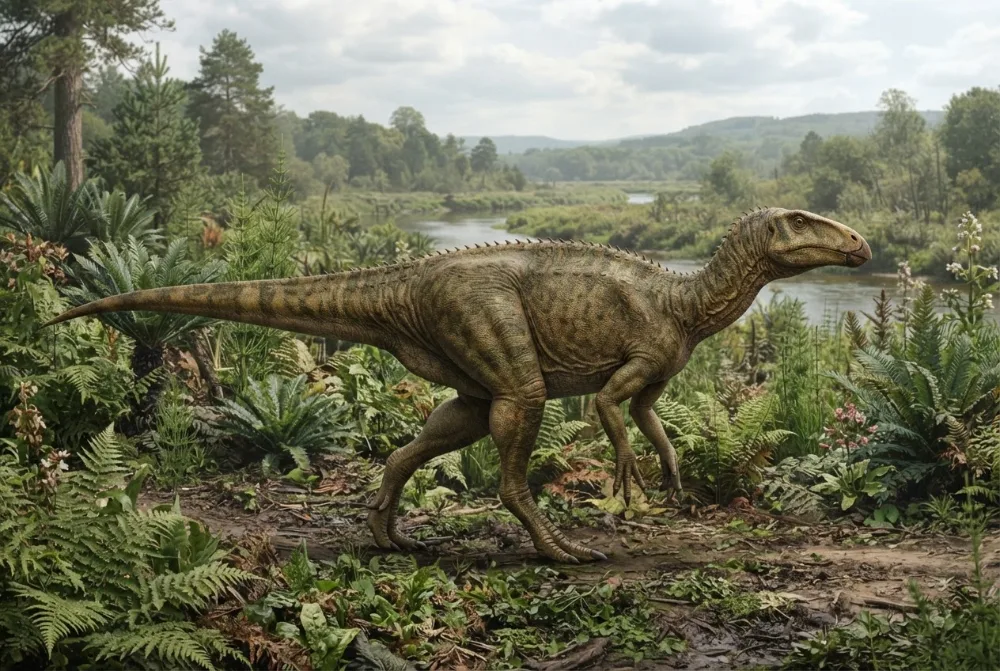
Mantellisaurus was a medium-sized, plant-eating dinosaur that lived in Europe during the Early Cretaceous. It had a light build and could walk on two legs or all fours. Its name honors Gideon Mantell, who discovered the first Iguanodon fossils.1
When did it live?
How big was it?
How long was it?
How heavy was it?
How big was Mantellisaurus compared to YOU?
Just maths in your browser. Nothing is saved or sent anywhere.
Fun facts
Mantellisaurus was once thought to be a species of Iguanodon, but scientists gave it its own genus in 2007.1
Its forelimbs were only about half the length of its hindlimbs, so it probably walked on two legs most of the time.1
A nearly complete skeleton was found in a quarry in Nehden, Germany, in 1971, along with bones of Iguanodon and crocodiles.1
The first fossil of Mantellisaurus was discovered on the Isle of Wight, England, in 1914 and named Iguanodon atherfieldensis.1
Some scientists think the Belgian specimen IRSNB 1551 belongs to a separate genus called Dollodon, but others disagree.1
Mantellisaurus weighed about 750 kilograms (1,650 pounds), as heavy as a small car.1
Most asked questions about Mantellisaurus
?How big was Mantellisaurus?
Mantellisaurus was about 7 metres (23 feet) long and weighed around 750 kilograms (1,650 pounds), as heavy as a small car.1
?What did Mantellisaurus eat?
Mantellisaurus was a plant-eating dinosaur. It ate plants like ferns and cycads.1
?Did Mantellisaurus walk on two legs or four?
It mostly walked on two legs because its forelimbs were only half the length of its hindlimbs. It could go on all fours when standing still or moving slowly.1
?Where did Mantellisaurus live?
It lived in Europe during the Early Cretaceous. Fossils have been found in Belgium, England, Spain and Germany.1
?Is Mantellisaurus a dinosaur?
Yes, it is a dinosaur. It is an iguanodontian dinosaur, a type of plant-eating ornithischian.1
?When did Mantellisaurus live?
It lived during the Barremian and early Aptian ages of the Early Cretaceous Period, about 125 to 120 million years ago.1

Ask Rex about Mantellisaurus
Rex only answers questions about this page. 3 questions a day.
Rex is an AI and can make mistakes. He runs on servers in the EU and questions are never saved. Never type your name or other personal things.
Myth buster
Myth: Mantellisaurus was a slow, clumsy quadruped like a giant iguana.
Truth: Mantellisaurus was lightly built and probably walked mostly on two legs, only going on all fours when standing still or moving slowly.1
For dino experts
- Scientific name
- Mantellisaurus
- Named by
- Paul 20073
- Group
- Beaked plant-eaters
- Family / clade
- Iguanodontia3
- Classification
- Ornithischia > Ornithopoda > Iguanodontia3
- Age of the rocks
- 143 to 120 million years (Berriasian / Aptian)3
- Rock formations
- Wessex, Arcillas de Morella, Vectis3
- Countries
- United Kingdom, Spain, Germany, France, Belgium, Portugal3
- Fossil records
- 17 in the Paleobiology Database3
- Also known as
- Dollodon, Mantellodon (older names now counted as the same animal)3
- Discovery
- The first fossil was found by Reginald Walter Hooley in 1914 on the Isle of Wight, England. He named it Iguanodon atherfieldensis in 1925. In 2007, Gregory Paul gave it its own genus, Mantellisaurus, honoring Gideon Mantell.1
- Still debated
- Scientists still debate whether the Belgian specimen IRSNB 1551 belongs to Mantellisaurus or to a separate genus called Dollodon.1
Where the facts come from
- Mantellisaurus (en.wikipedia.org)
- Mantellisaurus, an Isle of Wight Iguanodontid - DinoWight (dinowight.org.uk)
- Mantellisaurus in The Paleobiology Database (CC BY 4.0): age, places, rock formations, classification.
Every fact on this page has a number that points to its source. If we got something wrong, sorry, we are dino fans, not a science journal. Tell us at [email protected] and we will fix it.
 Rex is hungry! Dino Wiki is a dad's project for his dino-loving son, free with no ads. Grown-ups can feed Rex a snack to help keep it online.Feed Rex
 Iguanodon
 Tenontosaurus
 Thescelosaurus
 Zalmoxes
 Camptosaurus
 Rhabdodon
 Stegosaurus
 Archaeopteryx
 Giganotosaurus
 Microraptor
 Deinonychus
 Baryonyx