
Musankwa
Musankwa was a long-necked plant-eater that lived in what is now Zimbabwe during the Late Triassic. It walked on two legs and weighed about as much as a large bear. Only one leg bone fossil has been found, but it tells scientists a lot about this dinosaur.41
When did it live?
How big was it?
How tall was it?
at the hips
How heavy was it?
How big was Musankwa compared to YOU?
Just maths in your browser. Nothing is saved or sent anywhere.
Fun facts
Musankwa was named in 2024, making it one of the newest dinosaur discoveries from Africa.1
The fossil was found by a team living on a houseboat called Musankwa, which means 'boy close to marriage' in the Tonga language.1
Musankwa is only the fourth dinosaur ever named from Zimbabwe, after Vulcanodon and Mbiresaurus.1
The Musankwa specimen includes a right leg bone, the femur, tibia, and ankle bone, all still connected.1
Scientists think Musankwa was about 386 kilograms, or 851 pounds, which is as heavy as a large moose.1
Musankwa lived during the Norian stage of the Late Triassic, about 227 to 205 million years ago.4
The Pebbly Arkose Formation where Musankwa was found is made of ancient river sand and pebbles.1
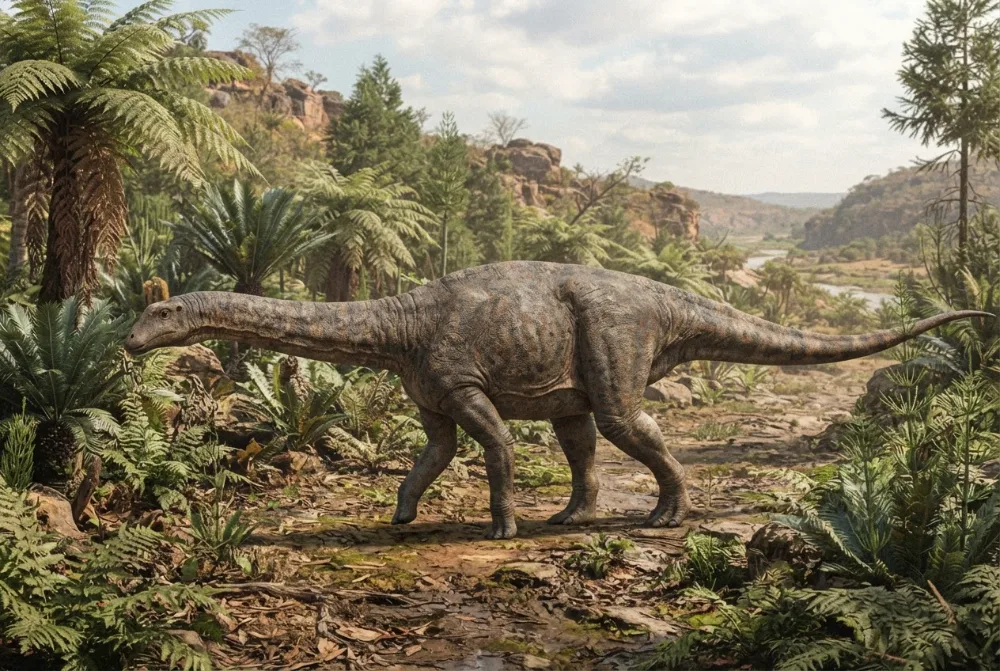
Most asked questions about Musankwa
?How big was Musankwa?
Musankwa weighed about 386 kilograms (851 pounds), which is as heavy as a large moose or a horse. It stood about 1.5 metres (5 feet) tall at the hip.12
?What did Musankwa eat?
Musankwa was a plant-eater. It was a sauropodomorph, a group of long-necked dinosaurs that ate plants.3

Ask Rex about Musankwa
Rex only answers questions about this page. 3 questions a day.
Rex is an AI and can make mistakes. He runs on servers in the EU and questions are never saved. Never type your name or other personal things.
Myth buster
Myth: Some people think only giant long-necked dinosaurs like Brachiosaurus lived in Africa.
Truth: Musankwa was a smaller relative of those giants, showing that early sauropodomorphs came in many sizes and lived across the supercontinent Pangaea.1
For dino experts
- Scientific name
- Musankwa
- Named by
- Barrett et al. 20244
- Group
- Long-necks
- Family / clade
- Massopoda4
- Classification
- Sauropodomorpha4
- Age of the rocks
- 237 to 206 million years (Carnian / Norian)4
- Rock formations
- Pebbly Arkose4
- Countries
- Zimbabwe4
- Fossil records
- 1 in the Paleobiology Database4
- Discovery
- Musankwa was discovered in March 2018 by paleontologist Paul Barrett on Spurwing Island, Lake Kariba, Zimbabwe. It was officially named in 2024 by Barrett and his team.1
- Still debated
- Scientists are still debating whether Musankwa was a member of the Massopoda group or more closely related to the Unaysauridae dinosaurs.1
Where the facts come from
- Musankwa (en.wikipedia.org)
- New dinosaur species from Zimbabwe found and described by Museum expert | Natural History Museum (nhm.ac.uk)
- 2024-05 - Musankwa sanyatiensis, a new dinosaur from Zimbabwe - Wits University (wits.ac.za)
- Musankwa in The Paleobiology Database (CC BY 4.0): age, places, rock formations, classification.
Every fact on this page has a number that points to its source. If we got something wrong, sorry, we are dino fans, not a science journal. Tell us at [email protected] and we will fix it.
 Rex is hungry! Dino Wiki is a dad's project for his dino-loving son, free with no ads. Grown-ups can feed Rex a snack to help keep it online.Feed Rex
 Brachiosaurus
 Diplodocus
 Brontosaurus
 Argentinosaurus
 Camarasaurus
 Morosaurus
 Nothosaurus
 Coelophysis
 Podokesaurus
 Simosaurus
 Eudimorphodon
 Herrerasaurus