
Muyelensaurus
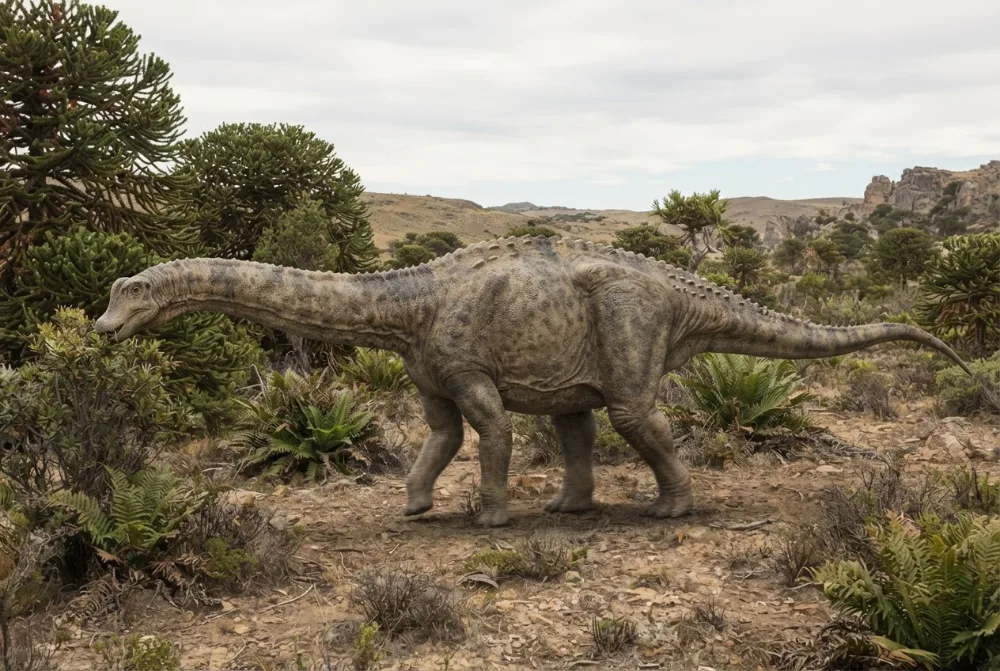
Muyelensaurus was a long-necked, plant-eating dinosaur that lived in what is now Argentina. It was a titanosaur, a group of sauropods known for their huge size, but Muyelensaurus was more slender than its relatives.1
When did it live?
How big was it?
How long was it?
How heavy was it?
How big was Muyelensaurus compared to YOU?
Just maths in your browser. Nothing is saved or sent anywhere.
Fun facts
Muyelensaurus lived about 86 to 85 million years ago, during the Late Cretaceous.1
Its fossils were first thought to be from the Portezuelo Formation, but later scientists realized they came from the Plottier Formation.1
The name Muyelensaurus comes from 'Muyelen', an indigenous name for the Colorado River in Argentina.1
Muyelensaurus was more slender than other titanosaurs, meaning it had a lighter build.1
The only known species is Muyelensaurus pecheni.1
Most asked questions about Muyelensaurus

Ask Rex about Muyelensaurus
Rex only answers questions about this page. 3 questions a day.
Rex is an AI and can make mistakes. He runs on servers in the EU and questions are never saved. Never type your name or other personal things.
For dino experts
- Scientific name
- Muyelensaurus
- Named by
- Calvo et al. 20074
- Group
- Long-necks
- Family / clade
- Rinconsauria4
- Classification
- Sauropodomorpha > Sauropoda > Titanosauria > Macronaria4
- Age of the rocks
- 90 to 84 million years (Coniacian / Santonian)4
- Rock formations
- Plottier4
- Countries
- Argentina4
- Fossil records
- 1 in the Paleobiology Database4
- Discovery
- Muyelensaurus was named in 2007 by paleontologists Jorge Calvo, Bernardo González Riga, and Juan Porfiri. The fossils were found in the Neuquén province of Patagonia, Argentina.1
Where the facts come from
- Muyelensaurus (en.wikipedia.org)
- Muyelensaurus pecheni | Dinosaur Database by DinoAnimals.com (dinoanimals.com)
- A new titanosaur sauropod from the Late Cretaceous of Neuquén, Patagonia, Argentina (researchgate.net)
- Muyelensaurus in The Paleobiology Database (CC BY 4.0): age, places, rock formations, classification.
Every fact on this page has a number that points to its source. If we got something wrong, sorry, we are dino fans, not a science journal. Tell us at [email protected] and we will fix it.
 Rex is hungry! Dino Wiki is a dad's project for his dino-loving son, free with no ads. Grown-ups can feed Rex a snack to help keep it online.Feed Rex
 Brachiosaurus
 Diplodocus
 Brontosaurus
 Argentinosaurus
 Camarasaurus
 Morosaurus
 Tyrannosaurus
 Triceratops
 Velociraptor
 Spinosaurus
 Ankylosaurus
 Parasaurolophus