
Mythunga
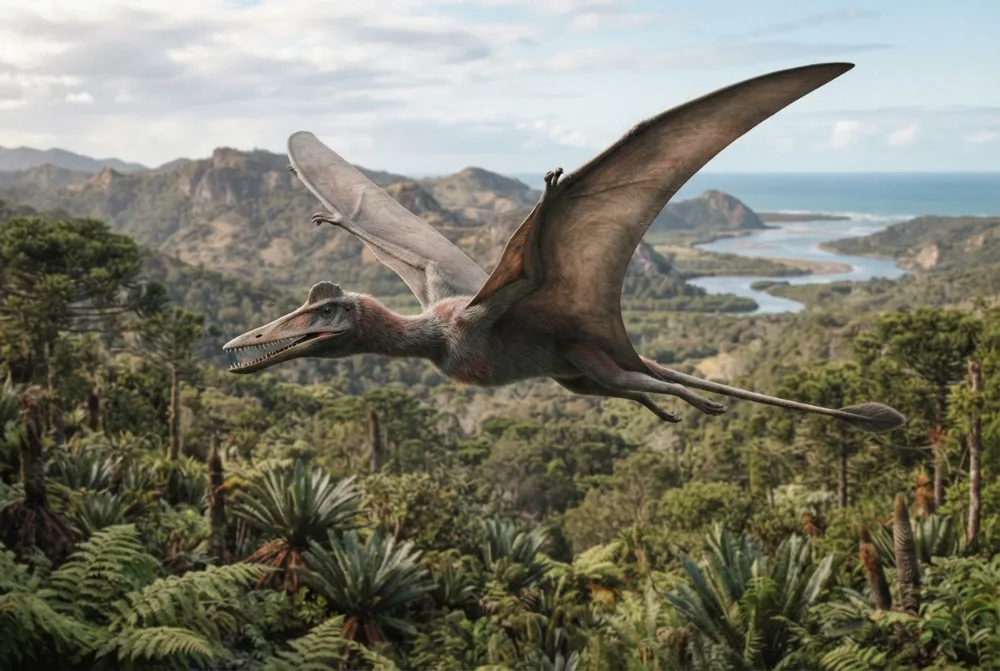
Mythunga was a big flying reptile that soared over an ancient sea in Australia. It had a long, hollow snout and sharp teeth for catching fish. It was one of the largest pterosaurs from its region!1
When did it live?
How big was it?
How big was Mythunga compared to YOU?
Just maths in your browser. Nothing is saved or sent anywhere.
Fun facts
Mythunga is the most complete pterosaur skull known from Australasia, even though only part of the skull and jaws are preserved.1
Its snout was hollow and box-like inside, with thin-walled chambers separated by struts, which made the skull light for flying.1
Mythunga had only three teeth between the last enlarged tooth and the opening in its snout, and these teeth were spaced widely apart.1
The fossil was found in 1991 by Philip Gilmore, and it may be from a young animal, so adults could have been even larger.1
Mythunga lived near the coast of the Eromanga Sea, a shallow inland sea that covered central Australia during the Early Cretaceous.1
Its teeth interlocked in a way typical of fish-eating pterosaurs, and the wide spacing may have helped it catch large fish.1
Most asked questions about Mythunga
?How big was Mythunga?
Its wingspan was between 4 and 6 metres (13 to 20 ft). Its skull was about 80 centimetres to 1 metre (2.6 to 3.3 ft) long.21
?What did Mythunga eat?
It ate fish. Its interlocking teeth were typical of fish-eating pterosaurs, and the wide spacing may have helped it catch large fish.1

Ask Rex about Mythunga
Rex only answers questions about this page. 3 questions a day.
Rex is an AI and can make mistakes. He runs on servers in the EU and questions are never saved. Never type your name or other personal things.
Myth buster
Myth: Some people think Mythunga was a dinosaur.
Truth: Mythunga was a pterosaur, a flying reptile that is not a dinosaur. Pterosaurs are a separate group of reptiles that evolved flight independently.1
For dino experts
- Scientific name
- Mythunga
- Named by
- Molnar and Thulborn 20073
- Group
- Flying reptiles
- Family / clade
- Anhangueridae3
- Classification
- Pterosauria > Pterodactyloidea3
- Age of the rocks
- 106 to 100 million years (Albian)3
- Rock formations
- Toolebuc3
- Countries
- Australia3
- Fossil records
- 1 in the Paleobiology Database3
- Discovery
- The partial skull was discovered in 1991 by Philip Gilmore on Dunluce Station in Queensland, Australia. It was named by Molnar and Thulborn in 2007.13
- Still debated
- Scientists are not sure if Mythunga had a crest on its head, because the top of the snout is missing from the fossil.1
Where the facts come from
- Mythunga camara - The Australian Museum (australian.museum)
- Mythunga (en.wikipedia.org)
- Mythunga in The Paleobiology Database (CC BY 4.0): age, places, rock formations, classification.
Every fact on this page has a number that points to its source. If we got something wrong, sorry, we are dino fans, not a science journal. Tell us at [email protected] and we will fix it.
Rex is hungry! Dino Wiki is a dad's project for his dino-loving son, free with no ads. Grown-ups can feed Rex a snack to help keep it online.Feed Rex Pteranodon
 Quetzalcoatlus
 Dorygnathus
 Rhamphorhynchus
 Anhanguera
 Pterodactylus
 Stegosaurus
 Iguanodon
 Archaeopteryx
 Giganotosaurus
 Microraptor
 Deinonychus