
Ningchengopterus
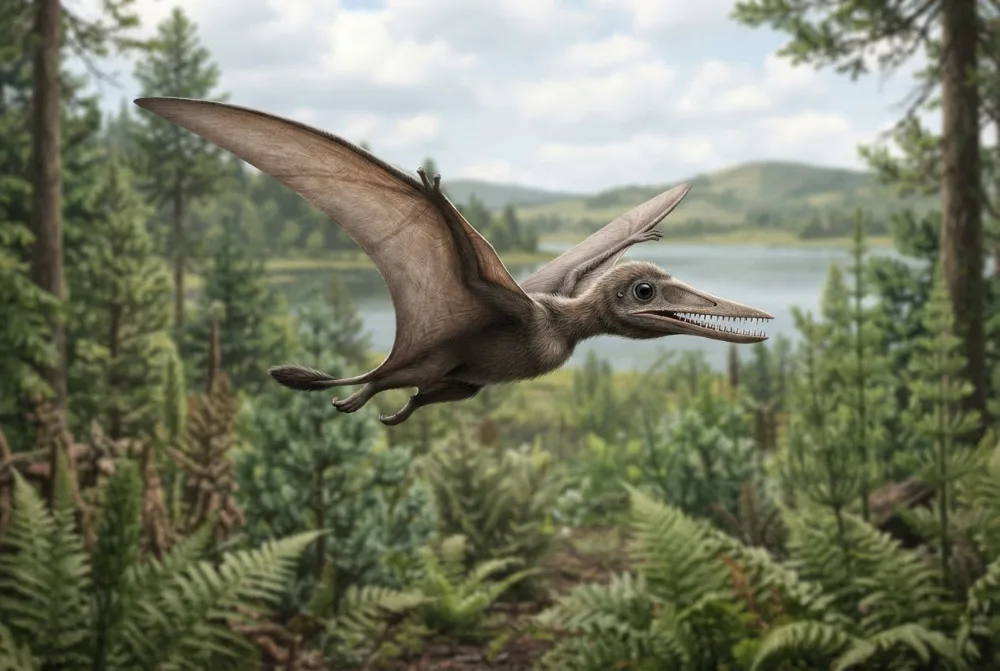
Ningchengopterus was a tiny flying reptile that lived in what is now China. It had about 50 sharp teeth and a long, pointy snout. Even as a baby, it could fly right after hatching!1
When did it live?
How big was it?
How wide were its wings?
How big was Ningchengopterus compared to YOU?
Just maths in your browser. Nothing is saved or sent anywhere.
Fun facts
Ningchengopterus had 50 teeth: 12 in each upper jaw and 13 in each lower jaw.1
Its skull was only 38 millimetres long, about the size of a large grape.1
The fossil shows soft parts like the flight membrane and pycnofibres, which are fuzzy hair-like coverings.1
It was the first small toothed pterodactyloid pterosaur ever found in China.1
Scientists think Ningchengopterus could fly right after hatching, with little help from its parents.1
The fossil was collected by Ms Liu Jingyi, who donated it to science.1

Ask Rex about Ningchengopterus
Rex only answers questions about this page. 3 questions a day.
Rex is an AI and can make mistakes. He runs on servers in the EU and questions are never saved. Never type your name or other personal things.
For dino experts
- Scientific name
- Ningchengopterus
- Named by
- Lü 20093
- Group
- Flying reptiles
- Family / clade
- Pterodactyloidea3
- Classification
- Pterosauria > Pterodactyloidea3
- Age of the rocks
- 126 to 120 million years (Barremian / Aptian)3
- Rock formations
- Yixian3
- Countries
- China3
- Fossil records
- 1 in the Paleobiology Database3
- Discovery
- Ningchengopterus was named and described by Chinese paleontologist Lü Junchang in 2009. The only fossil is a nearly complete skeleton of a hatchling, found in the Yixian Formation of Inner Mongolia.13
- Still debated
- Scientists are not sure which group of pterosaurs Ningchengopterus belongs to. It might be related to the ctenochasmatids, but the evidence is not strong enough.1
Where the facts come from
- Ningchengopterus (en.wikipedia.org)
- Ningchengopterus liuae | Pterosaur Database by DinoAnimals.com (dinoanimals.com)
- Ningchengopterus in The Paleobiology Database (CC BY 4.0): age, places, rock formations, classification.
Every fact on this page has a number that points to its source. If we got something wrong, sorry, we are dino fans, not a science journal. Tell us at [email protected] and we will fix it.
 Rex is hungry! Dino Wiki is a dad's project for his dino-loving son, free with no ads. Grown-ups can feed Rex a snack to help keep it online.Feed Rex
 Pteranodon
 Quetzalcoatlus
 Dorygnathus
 Rhamphorhynchus
 Anhanguera
 Pterodactylus
 Stegosaurus
 Iguanodon
 Archaeopteryx
 Giganotosaurus
 Microraptor
 Deinonychus