
Parahongshanornis
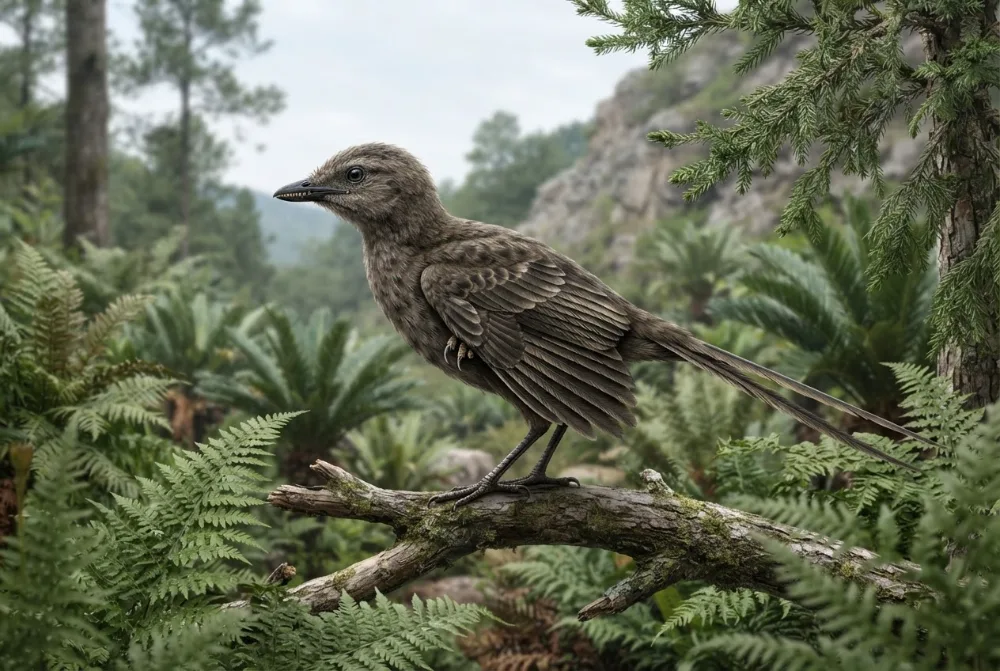
Parahongshanornis was a tiny, feathered bird that lived about 120 million years ago in what is now China. It could probably fly, but its legs were longer than its wings, so it might have spent a lot of time running or wading.12
When did it live?
Fun facts
Parahongshanornis had a U-shaped furcula (wishbone) that was much longer than it was wide, which is a special feature of its family.2
Its legs were longer than its wings, which is unusual for a bird and suggests it was a good runner or wader.2
The fossil includes soft parts like feathers, even though the skull is missing.1
It lived about 120 million years ago, during the Aptian stage of the Early Cretaceous.1
Its thigh bone (femur) was only 24 millimetres long, making it a very small bird.1
The sternum (breastbone) had a keel along its whole length and two pairs of deep notches at the back edge.1

Ask Rex about Parahongshanornis
Rex only answers questions about this page. 3 questions a day.
Rex is an AI and can make mistakes. He runs on servers in the EU and questions are never saved. Never type your name or other personal things.
For dino experts
- Scientific name
- Parahongshanornis
- Named by
- Li et al. 20113
- Group
- Early birds
- Family / clade
- Hongshanornithidae3
- Classification
- Theropoda > Avialae3
- Age of the rocks
- 121 to 113 million years (Aptian)3
- Rock formations
- Jiufotang3
- Countries
- China3
- Fossil records
- 1 in the Paleobiology Database3
- Discovery
- Parahongshanornis was named by Li Li, Wang Jingqi, and Hou Shilin in 2011, based on a nearly complete skeleton found near Yuanjiawa, Chaoyang, China.12
- Still debated
- Scientists are not sure exactly how Parahongshanornis is related to other early birds, because it was assigned to its family based on anatomy rather than a computer analysis.1
Where the facts come from
- Parahongshanornis (en.wikipedia.org)
- A NEW ORNITHURINE BIRD (HONGSHANORNITHIDAE) FROM THE JIUFOTANG FORMATION OF CHAOYANG, LIAONING, CHINA (vertpala.ac.cn)
- Parahongshanornis in The Paleobiology Database (CC BY 4.0): age, places, rock formations, classification.
Every fact on this page has a number that points to its source. If we got something wrong, sorry, we are dino fans, not a science journal. Tell us at [email protected] and we will fix it.
Rex is hungry! Dino Wiki is a dad's project for his dino-loving son, free with no ads. Grown-ups can feed Rex a snack to help keep it online.Feed Rex Archaeopteryx
 Hesperornis
 Ichthyornis
 Baptornis
 Jurapteryx
 Gobipteryx
 Stegosaurus
 Iguanodon
 Giganotosaurus
 Microraptor
 Deinonychus
 Baryonyx