When did it live?

Fun facts
Penelopognathus lived about 121 to 113 million years ago, during the Aptian stage of the Early Cretaceous.2
Scientists think Penelopognathus was a relative of later duck-billed dinosaurs like Edmontosaurus.1
The name Penelopognathus comes from Greek words meaning 'wild duck jaw'.1
This dinosaur was named after David Weishampel, a famous expert on duck-billed dinosaurs.1
Most asked questions about Penelopognathus
?What did Penelopognathus eat?
Penelopognathus was an herbivore, meaning it ate plants. Its teeth were adapted for chewing plant material.3
?How big was Penelopognathus?
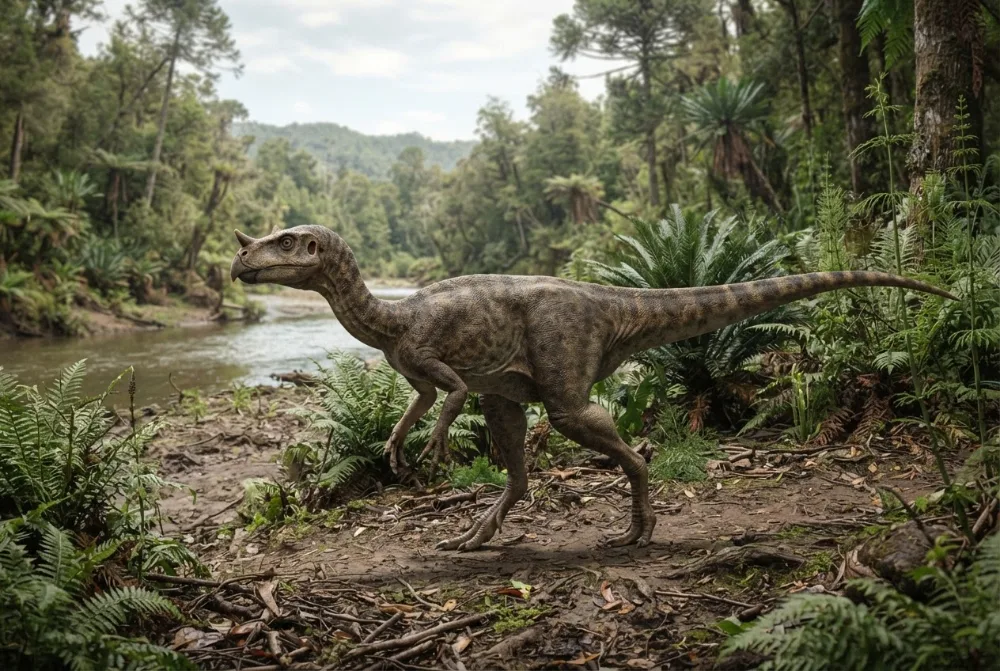
Penelopognathus grew up to about 5 metres (16 ft) long and around 2 metres (6.6 ft) tall when fully grown.1
?When did Penelopognathus live?
Penelopognathus lived during the Early Cretaceous, about 121 to 113 million years ago, in the Aptian stage.3

Ask Rex about Penelopognathus
Rex only answers questions about this page. 3 questions a day.
Rex is an AI and can make mistakes. He runs on servers in the EU and questions are never saved. Never type your name or other personal things.
For dino experts
- Scientific name
- Penelopognathus
- Named by
- Godefroit et al. 20053
- Group
- Beaked plant-eaters
- Family / clade
- Hadrosauroidea3
- Classification
- Ornithischia > Ornithopoda > Iguanodontia3
- Age of the rocks
- 121 to 113 million years (Aptian)3
- Rock formations
- Bayangobi3
- Countries
- China3
- Fossil records
- 1 in the Paleobiology Database3
- Discovery
- Penelopognathus was named in 2005 by paleontologists Pascal Godefroit, Li, and Shang, based on a jaw fossil found in the Bayan Gobi Formation of Inner Mongolia, China.1
- Still debated
- Scientists are not sure exactly how Penelopognathus is related to other duck-billed dinosaurs. Some studies place it close to Telmatosaurus, while others suggest different relationships.1
Where the facts come from
- Penelopognathus (en.wikipedia.org)
- PBDB Taxon (paleobiodb.org)
- Penelopognathus in The Paleobiology Database (CC BY 4.0): age, places, rock formations, classification.
Every fact on this page has a number that points to its source. If we got something wrong, sorry, we are dino fans, not a science journal. Tell us at [email protected] and we will fix it.
Rex is hungry! Dino Wiki is a dad's project for his dino-loving son, free with no ads. Grown-ups can feed Rex a snack to help keep it online.Feed Rex Iguanodon
 Tenontosaurus
 Thescelosaurus
 Zalmoxes
 Camptosaurus
 Rhabdodon
 Stegosaurus
 Archaeopteryx
 Giganotosaurus
 Microraptor
 Deinonychus
 Baryonyx