
Phalarodon
Phalarodon was a fast-swimming marine reptile that lived in the Triassic seas, not a dinosaur. It had a long body and a skull full of strong teeth for catching fish and squid.1
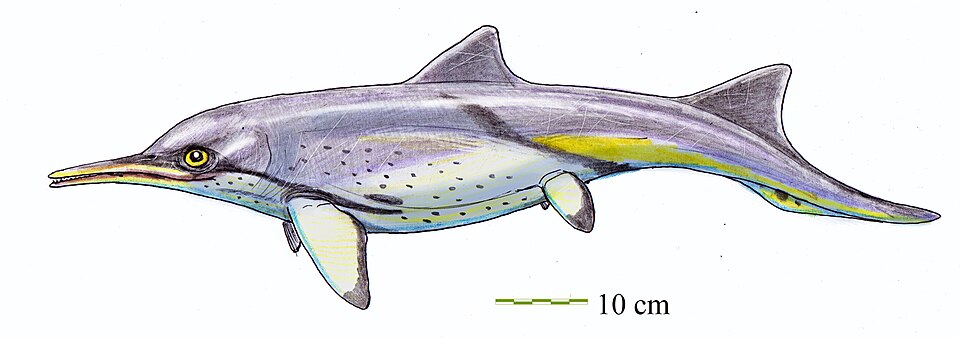
When did it live?
How big was it?
Fun facts
Phalarodon's name means 'boss tooth' because its teeth look like the boss on a helmet cheek-plate.1
It lived during the Middle Triassic, about 247 to 242 million years ago, when the supercontinent Pangaea was still together.1
Phalarodon could swim across the Tethys Ocean, as shown by fossils found in both Germany and China, which were on opposite sides of that ancient sea.1
Its skull had a high ridge on top called a sagittal crest, which helped anchor strong jaw muscles for a powerful bite.1
Some scientists think Phalarodon atavus had a skull up to 80 centimetres (2.6 feet) long, making it a large mixosaurid, but others say the fossils are too broken to be sure.1
Phalarodon shared its home with other marine reptiles like Cymbospondylus and Omphalosaurus in the Fossil Hill Member of Nevada.1
The teeth of Phalarodon were blunt and slightly flattened, perfect for crushing hard-shelled prey like ammonites.1
For dino experts
- Scientific name
- Phalarodon
- Named by
- Merriam 19102
- Group
- Ichthyosaurs
- Family / clade
- Mixosauridae2
- Classification
- Ichthyosauria > Ichthyosauromorpha2
- Age of the rocks
- 251 to 237 million years ()2
- Rock formations
- Sulphur Mountain, Guanling, Jena2
- Countries
- Canada, Germany, USA, China, Svalbard2
- Fossil records
- 14 in the Paleobiology Database2
- Discovery
- Phalarodon was named by John Campbell Merriam in 1910, based on a skull and jaw fragments found in the West Humboldt Range of Nevada, USA.1
- Still debated
- Scientists still debate whether Phalarodon was a small mixosaurid about 1 metre long or a larger one reaching up to 5 metres, because many fossils are just skull pieces.1
Where the facts come from
- Phalarodon (en.wikipedia.org)
- Phalarodon in The Paleobiology Database (CC BY 4.0): age, places, rock formations, classification.
Every fact on this page has a number that points to its source. If we got something wrong, sorry, we are dino fans, not a science journal. Tell us at [email protected] and we will fix it.
 Rex is hungry! Dino Wiki is free with no ads. Grown-ups can feed Rex a snack to keep it that way.Feed Rex
 Ichthyosaurus
 Platypterygius
 Stenopterygius
 Khudiakovia
 Ophthalmosaurus
 Chonespondylus
 Placodus
 Lariosaurus
 Cyamodus
 Cymatosaurus
 Proneusticosaurus
 Neusticosaurus