
Plataleorhynchus
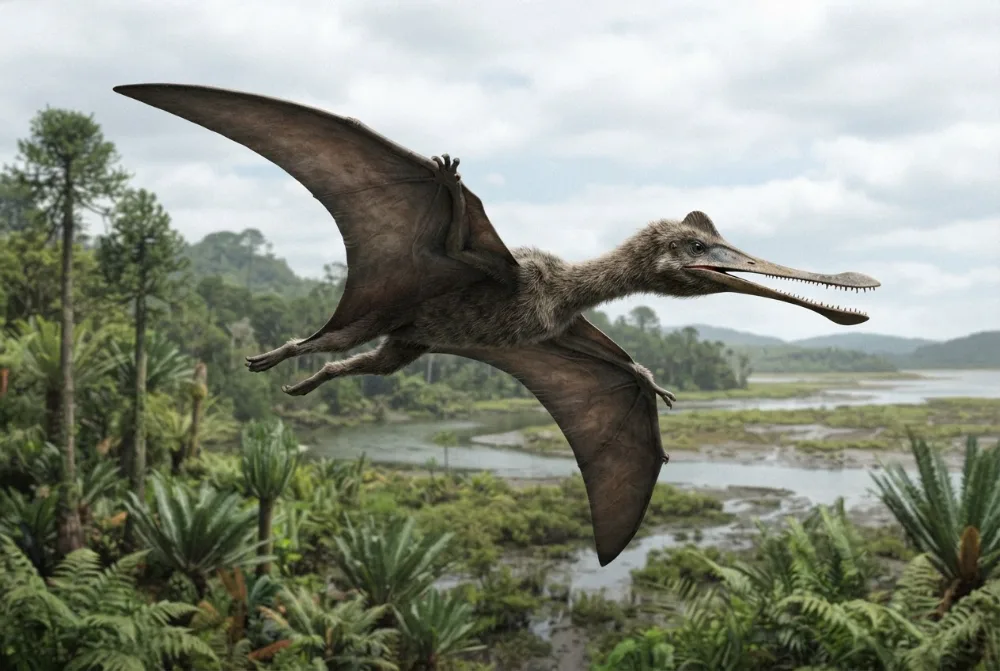
Plataleorhynchus was a flying reptile that lived near the coast of what is now England. It had a long, spoon-shaped snout filled with many thin teeth. It used its special beak to scoop up small water animals for dinner.12
When did it live?
Fun facts
The front of its snout was shaped like a spoon or spatula, and it held 22 narrow teeth that pointed sideways.1
Scientists think its upper jaw had about 76 teeth in total, counting the ones in the preserved part and the missing ones.1
Its skull was at least 40 centimeters (15.75 inches) long, which is about the length of a big ruler.1
It had a horn-covered pad on the roof of its mouth, which may have helped it crush or handle its food.1
Plataleorhynchus lived during the Late Jurassic to Early Cretaceous periods, about 143 to 137 million years ago.12
The only known fossil of this pterosaur is an incomplete upper jaw, which was found in a chalkstone quarry.1
Its name comes from the spoonbill bird, because its snout looks like a spoonbill's beak.1

Ask Rex about Plataleorhynchus
Rex only answers questions about this page. 3 questions a day.
Rex is an AI and can make mistakes. He runs on servers in the EU and questions are never saved. Never type your name or other personal things.
For dino experts
- Scientific name
- Plataleorhynchus
- Named by
- Howse and Milner 19952
- Group
- Flying reptiles
- Family / clade
- Lophocratia2
- Classification
- Pterosauria > Pterodactyloidea2
- Age of the rocks
- 143 to 137 million years (Berriasian)2
- Countries
- United Kingdom2
- Fossil records
- 1 in the Paleobiology Database2
- Discovery
- The fossil was found in a quarry near Langton Matravers, England, and was bought by the Natural History Museum in 1958. Scientists Stafford Howse and Andrew Milner named it Plataleorhynchus in 1995.12
- Still debated
- Scientists are not sure exactly how Plataleorhynchus used its spoon-shaped snout and small teeth, because it is different from other similar pterosaurs.1
Where the facts come from
- Plataleorhynchus (en.wikipedia.org)
- Plataleorhynchus in The Paleobiology Database (CC BY 4.0): age, places, rock formations, classification.
Every fact on this page has a number that points to its source. If we got something wrong, sorry, we are dino fans, not a science journal. Tell us at [email protected] and we will fix it.
Rex is hungry! Dino Wiki is a dad's project for his dino-loving son, free with no ads. Grown-ups can feed Rex a snack to help keep it online.Feed Rex Pteranodon
 Quetzalcoatlus
 Dorygnathus
 Rhamphorhynchus
 Anhanguera
 Pterodactylus
 Stegosaurus
 Iguanodon
 Archaeopteryx
 Giganotosaurus
 Microraptor
 Deinonychus