
Proa
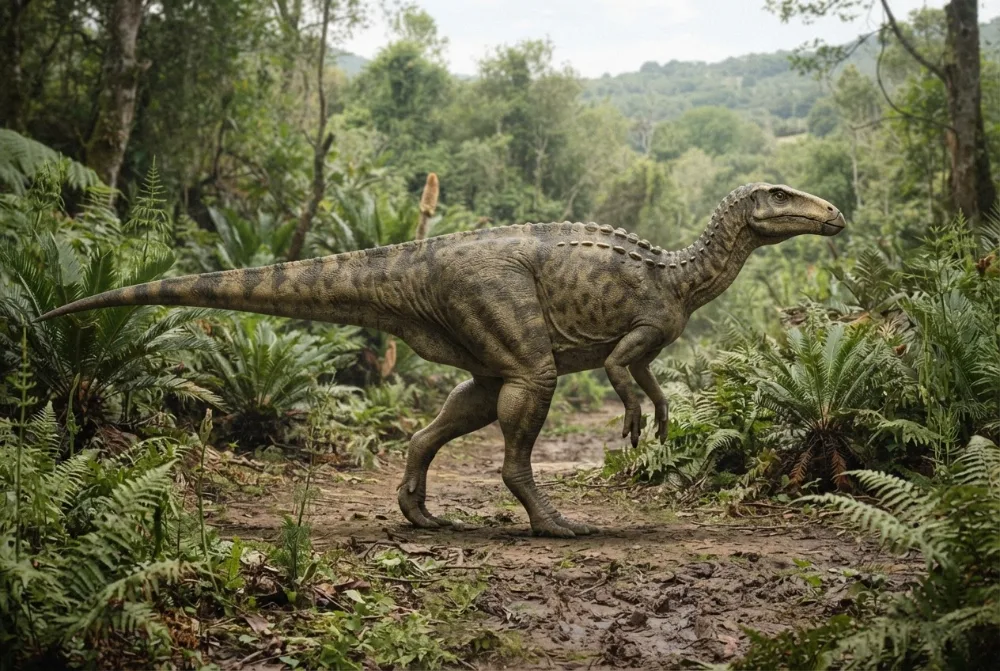
Proa was a plant-eating dinosaur that lived about 112 million years ago in what is now Spain. It had a pointed beak and walked on two legs, but could probably also drop to all fours. It was a relative of the bigger duck-billed dinosaurs.12
When did it live?
How big was it?
How long was it?
How tall was it?
hip height estimate
How heavy was it?
How big was Proa compared to YOU?
Just maths in your browser. Nothing is saved or sent anywhere.
Fun facts
Proa's beak bone had a pointed tip with side prongs that stuck out, which is unique among its relatives.1
It lived during the Early Cretaceous, about 112 million years ago, which was a time when many new dinosaur groups were appearing.1
Proa is known from at least three partial skeletons and several skull pieces, so scientists have a good idea of what it looked like.1
It was a basal iguanodont, meaning it was an early relative of the bigger iguanodons and duck-billed dinosaurs.3
Proa helps fill a gap in the fossil record of European iguanodonts, which was missing for millions of years.3

Ask Rex about Proa
Rex only answers questions about this page. 3 questions a day.
Rex is an AI and can make mistakes. He runs on servers in the EU and questions are never saved. Never type your name or other personal things.
For dino experts
- Scientific name
- Proa
- Named by
- McDonald et al. 20124
- Group
- Beaked plant-eaters
- Family / clade
- Hadrosauriformes4
- Classification
- Ornithischia > Ornithopoda > Iguanodontia4
- Age of the rocks
- 113 to 110 million years (Albian)4
- Rock formations
- Escucha4
- Countries
- Spain4
- Fossil records
- 1 in the Paleobiology Database4
- Discovery
- Proa was named by Andrew T. McDonald and colleagues in 2012, based on fossils from coal mines near Val de Ariño in Spain.1
- Still debated
- Scientists are still debating exactly where Proa sits on the dinosaur family tree, with some placing it close to Iguanodon and others with Asian relatives.1
Where the facts come from
- Proa valdearinnoensis (en.wikipedia.org)
- PBDB Taxon (paleobiodb.org)
- An unusual new basal iguanodont (Dinosauria: Ornithopoda) from the Lower Cretaceous of Teruel, Spain | Zootaxa (mapress.com)
- Proa in The Paleobiology Database (CC BY 4.0): age, places, rock formations, classification.
Every fact on this page has a number that points to its source. If we got something wrong, sorry, we are dino fans, not a science journal. Tell us at [email protected] and we will fix it.
 Rex is hungry! Dino Wiki is a dad's project for his dino-loving son, free with no ads. Grown-ups can feed Rex a snack to help keep it online.Feed Rex
 Iguanodon
 Tenontosaurus
 Thescelosaurus
 Zalmoxes
 Camptosaurus
 Rhabdodon
 Stegosaurus
 Archaeopteryx
 Giganotosaurus
 Microraptor
 Deinonychus
 Baryonyx