
Prognathodon
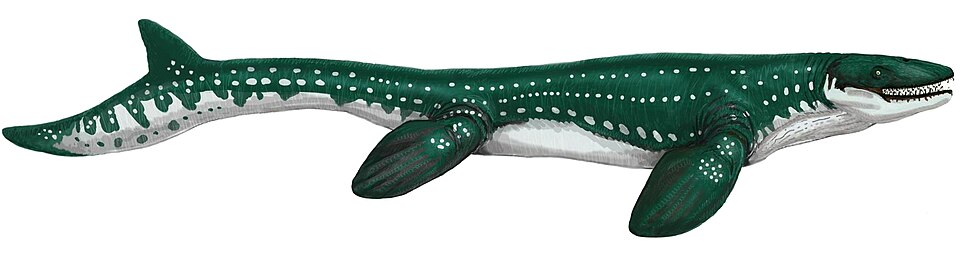
Prognathodon was a giant marine lizard that lived in the oceans at the same time as the dinosaurs. It had a huge, powerful skull and strong teeth that could crush the shells of sea turtles. This mosasaur was an apex predator, meaning it was at the top of the food chain.1
When did it live?
How big was it?
Fun facts
The name Prognathodon means 'forejaw tooth' because its front teeth were especially big and strong.1
One fossil of Prognathodon saturator, nicknamed 'Bèr', was found in a limestone quarry in the Netherlands and is about 12 metres long.1
Prognathodon had teeth with fine, wavy ridges near the tip that helped strengthen them for crushing hard prey like sea turtles.1
Gut contents from a Canadian specimen show that Prognathodon ate a very large fish (1.6 metres long), a smaller fish, a sea turtle, and possibly a squid-like cephalopod.1
Unlike many other mosasaurs, Prognathodon had blunt, rounded tooth tips instead of sharp cutting edges, suggesting it was a crusher of hard-shelled animals.1
The pterygoid teeth on the roof of its mouth were unusually large and showed no wear, so scientists think they were used to grip prey before swallowing it whole.1
Prognathodon fossils have been found on every continent except Antarctica, showing it lived in warm seas worldwide.2
Scientists still argue about which species belong in Prognathodon, because many fossils are incomplete and look different from each other.1
Myth buster
Myth: Some people think Prognathodon was a dinosaur.
Truth: Prognathodon was not a dinosaur. It was a mosasaur, a type of marine lizard that lived in the sea.1
For dino experts
- Scientific name
- Prognathodon
- Named by
- Dollo 18892
- Group
- Mosasaurs
- Family / clade
- Mosasauridae2
- Classification
- Mosasauroidea2
- Age of the rocks
- 100 to 62 million years (Cenomanian to Danian)2
- Rock formations
- Bearpaw Shale, Torme, Gulpen2
- Countries
- USA, Morocco, Spain, Sweden, France, Belgium2
- Fossil records
- 94 in the Paleobiology Database2
- Discovery
- Prognathodon was first named by Belgian paleontologist Louis Dollo in 1889, based on fossils found in Belgium. There was some confusion because Dollo first called it 'Prognathodon' but later used the name 'Prognathosaurus' in his papers.1
- Still debated
- Scientists are still debating which species truly belong to Prognathodon, because many fossils are incomplete and show different features.1
Where the facts come from
- Prognathodon (en.wikipedia.org)
- Prognathodon in The Paleobiology Database (CC BY 4.0): age, places, rock formations, classification.
Every fact on this page has a number that points to its source. If we got something wrong, sorry, we are dino fans, not a science journal. Tell us at [email protected] and we will fix it.
 Rex is hungry! Dino Wiki is free with no ads. Grown-ups can feed Rex a snack to keep it that way.Feed Rex
 Mosasaurus
 Tylosaurus
 Platecarpus
 Clidastes
 Globidens
 Halisaurus
 Triceratops
 Velociraptor
 Spinosaurus
 Ankylosaurus
 Parasaurolophus