
Psittacosaurus
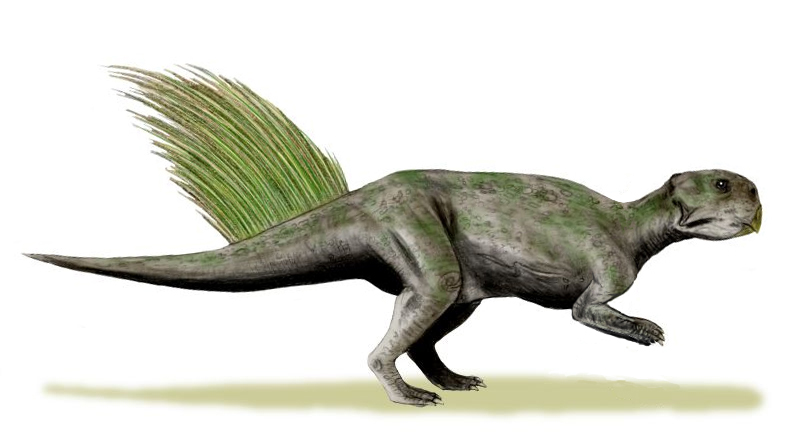
Psittacosaurus was a small, fast dinosaur that looked a bit like a parrot. It had a strong beak for snipping plants and lived in Asia during the Early Cretaceous. Some fossils even show long bristles on its tail!1
When did it live?
How big was it?
Fun facts
Psittacosaurus is the non-avian dinosaur genus with the most known species, up to 13 different ones.1
One fossil of Psittacosaurus was found with long, bristle-like filaments on its tail, similar to those of the dinosaur Tianyulong.1
Psittacosaurus had a brain that was fairly large for its size, suggesting it may have had complex behaviors and good senses of smell and sight.1
Unlike later horned dinosaurs like Triceratops, Psittacosaurus walked on two legs as an adult and did not have a frill or large horns.1
Psittacosaurus swallowed gastroliths (stomach stones) to help break down tough plant material, sometimes more than 50 stones in one animal.1
The first Psittacosaurus fossil was discovered in Mongolia in 1922 by a chauffeur named Wong during an expedition led by Henry Fairfield Osborn.1
Psittacosaurus could slide its lower jaw forward and backward, which may have helped it crack nuts or seeds.1
Myth buster
Myth: Some people think Psittacosaurus was a type of parrot dinosaur that could fly.
Truth: Psittacosaurus was a dinosaur that walked on two legs and could not fly. Its name means 'parrot lizard' because of its beak, not because it had wings.1
For dino experts
- Scientific name
- Psittacosaurus
- Named by
- Osborn 19232
- Group
- Horned dinos
- Family / clade
- Ceratopsia2
- Classification
- Ornithischia > Ceratopsia2
- Age of the rocks
- 137 to 100 million years (Valanginian to Albian)2
- Rock formations
- Yixian, Ilek, Öösh2
- Countries
- China, Mongolia, Russia, Thailand2
- Fossil records
- 70 in the Paleobiology Database2
- Also known as
- Hongshanosaurus, Protiguanodon (older names now counted as the same animal)2
- Discovery
- Psittacosaurus was named in 1923 by American paleontologist Henry Fairfield Osborn after a nearly complete skull and skeleton were found in Mongolia by a chauffeur named Wong. Osborn gave it the name because its beak looked like a parrot's.1
- Still debated
- Scientists still debate whether the species Psittacosaurus lujiatunensis and Psittacosaurus houi are actually the same dinosaur or two different species.1
Where the facts come from
- Psittacosaurus (en.wikipedia.org)
- Psittacosaurus in The Paleobiology Database (CC BY 4.0): age, places, rock formations, classification.
Every fact on this page has a number that points to its source. If we got something wrong, sorry, we are dino fans, not a science journal. Tell us at [email protected] and we will fix it.
 Rex is hungry! Dino Wiki is free with no ads. Grown-ups can feed Rex a snack to keep it that way.Feed Rex
 Triceratops
 Protoceratops
 Ojoceratops
 Tatankaceratops
 Centrosaurus
 Chasmosaurus
 Stegosaurus
 Iguanodon
 Archaeopteryx
 Giganotosaurus
 Microraptor
 Deinonychus