 Home
 All dinos
 Dino groups
 Explore
 Dinos by country
 Dino vs dino
 How big were they?
 Dinos A to Z
 Who ate what?
 What dino are you? Quiz
 Dino games
 Dino battle
 Dino race
 Dino mini-games
 Sticker album
 Dino TOP lists
 Timeline
 Surprise me!
 Language: English

Ratchasimasaurus
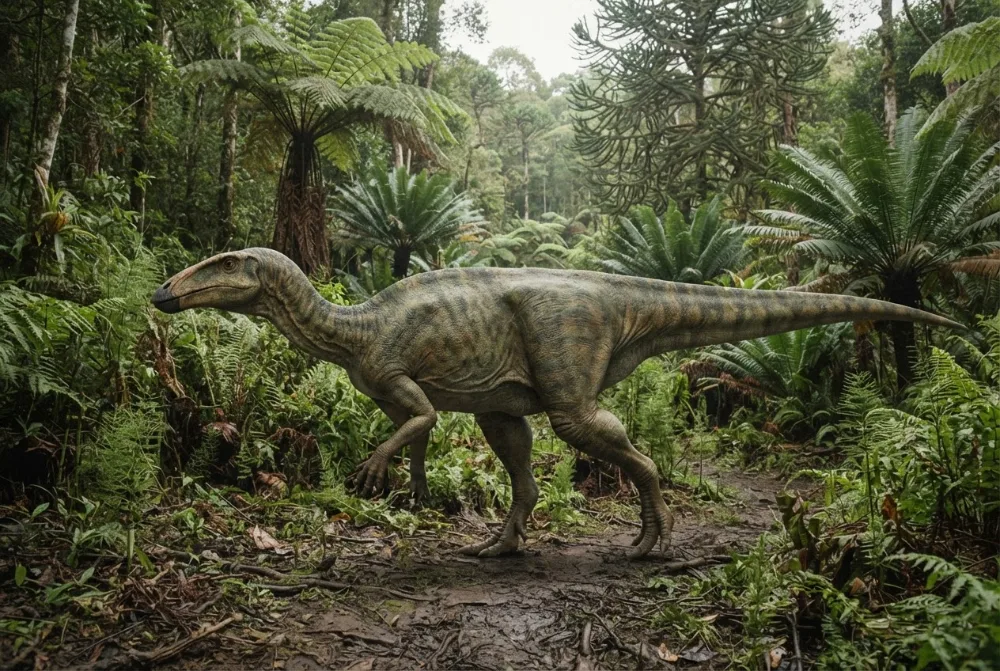
Ratchasimasaurus was a plant-eating dinosaur that lived in what is now Thailand. It had a long, flat jawbone that helped it chew tough plants. This dinosaur was about the size of a small car.12
 Thailand
When did it live?
Ratchasimasaurus: 121 to 113 million years ago
How fast was it?


Fun facts
Ratchasimasaurus is only known from a single left lower jawbone, called a dentary, which is 198.1 millimetres (7.80 inches) long.1
Its jawbone was long and flat, a unique feature that helps scientists tell it apart from other dinosaurs.12
This dinosaur lived during the Early Cretaceous period, about 121 to 113 million years ago.3
Ratchasimasaurus had both primitive and advanced features, like a backward-slanting coronoid process and a shelf between its teeth and jaw joint.12
The fossil was found by a local farmer near a pond in Thailand, likely between 2002 and 2004.1
Its species name, suranareae, honors Thao Suranari, a 19th-century war heroine from Thailand.1
Most asked questions about Ratchasimasaurus
?What did Ratchasimasaurus eat?
Ratchasimasaurus was a plant-eating dinosaur, as shown by its beaked mouth and jaw features for chewing tough plants. Its diet is listed as herbivore in the Paleobiology Database.3
?How big was Ratchasimasaurus?
The only known fossil is a jawbone, so its full size is uncertain. The dentary is 198.1 millimetres (7.80 inches) long, and the dinosaur was about the size of a small car, based on the page's intro.1
?When did Ratchasimasaurus live?
It lived during the Early Cretaceous period, about 121 to 113 million years ago (Aptian stage). This is based on the age range given in the Paleobiology Database.3
For dino experts
- Scientific name
- Ratchasimasaurus
- Named by
- Shibata et al. 20113
- Group
- Beaked plant-eaters
- Family / clade
- Hadrosauroidea3
- Classification
- Ornithischia > Ornithopoda > Iguanodontia3
- Age of the rocks
- 121 to 113 million years (Aptian)3
- Rock formations
- Khok Kruat3
- Countries
- Thailand3
- Fossil records
- 1 in the Paleobiology Database3
- Discovery
- Ratchasimasaurus was named in 2011 by Masateru Shibata, Pratueng Jintasakul, and Yoichi Azuma based on a jawbone found in the Khok Kruat Formation of Thailand.31
- Still debated
- Some scientists think Ratchasimasaurus might be a nomen dubium, meaning its fossils are too incomplete to be sure it is a distinct species.1
Where the facts come from
- Ratchasimasaurus (en.wikipedia.org)
- A New Iguanodontian Dinosaur from the Lower Cretaceous Khok Kruat Formation, Nakhon Ratchasima in Northeastern Thailand (onlinelibrary.wiley.com)
- Ratchasimasaurus in The Paleobiology Database (CC BY 4.0): age, places, rock formations, classification.
Every fact on this page has a number that points to its source. If we got something wrong, sorry, we are dino fans, not a science journal. Tell us at hello@dinowiki.app and we will fix it.
 Rex is hungry! Dino Wiki is a dad's project for his dino-loving son, free with no ads and no cookies. Grown-ups can feed Rex a snack to help keep it online.Feed Rex
 Iguanodon
 Tenontosaurus
 Thescelosaurus
 Zalmoxes
 Camptosaurus
 Rhabdodon
 Archaeopteryx
 Giganotosaurus
 Microraptor
 Deinonychus
 Baryonyx
 Asiamericana