
Riojasaurus
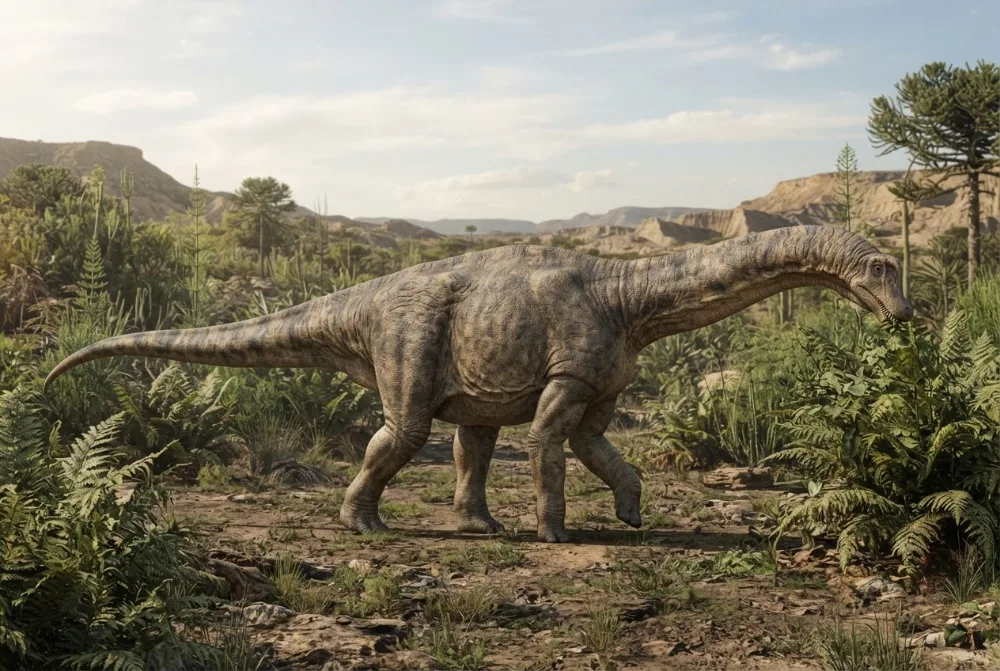
Riojasaurus was a huge, plant-eating dinosaur with a long neck and a heavy body. It lived during the Late Triassic period in what is now Argentina. It probably walked slowly on all four legs, munching on leaves with its leaf-shaped teeth.1
When did it live?
How big was it?
How big was Riojasaurus compared to YOU?
Just maths in your browser. Nothing is saved or sent anywhere.
Fun facts
Riojasaurus had very dense and massive leg bones, making it heavy and sturdy for an early sauropodomorph.1
Unlike most early relatives, Riojasaurus had four sacral vertebrae in its hip area instead of three, which helped support its weight.1
Its neck bones were longer than those of other sauropodomorphs found in the same formation, making its neck especially long.1
The first Riojasaurus skeleton found had no skull. A well-preserved skull was later discovered in 1987 and described in 1995.1
Some scientists think Riojasaurus may have been active at short intervals throughout the day and night, based on the shape of its eye bones (scleral rings).1
Riojasaurus is the only known riojasaurid dinosaur from South America, and it may be closely related to Melanorosaurus from southern Africa.1
Its front and hind limbs were nearly the same length, which is a clue that it walked on all fours and could not rear up on its back legs.1
Most asked questions about Riojasaurus
?How big was Riojasaurus?
Riojasaurus was about 6.6 metres (21.7 feet) long and weighed around 800 kilograms (1,764 pounds). Some large individuals may have reached 10 metres (32.8 feet) long and weighed 3 metric tons (3.3 short tons).1
?What did Riojasaurus eat?
Riojasaurus was a herbivore that ate plants. Its leaf-shaped, serrated teeth were used for grazing on soft vegetation like gymnosperms, and it may have swallowed stones (gastroliths) to help grind food in its stomach.13
?Could Riojasaurus walk on two legs?
No, Riojasaurus probably walked on all four legs. Its front and hind limbs were nearly the same length, and its leg bones were dense and massive, suggesting it moved slowly on all fours and could not rear up on its back legs.1
?When did Riojasaurus live?
Riojasaurus lived during the Late Triassic Period, about 225 to 213 million years ago. Its fossils have been found in the Los Colorados Formation in Argentina.1
?Is Riojasaurus a dinosaur?
Yes, Riojasaurus is a dinosaur. It is a herbivorous sauropodomorph dinosaur from the Late Triassic of Argentina.1
?Did Riojasaurus have feathers?
No, there is no evidence that Riojasaurus had feathers. Its fossils show only scales and bones, and it is not known to have any feather-like structures.1

Ask Rex about Riojasaurus
Rex only answers questions about this page. 3 questions a day.
Rex is an AI and can make mistakes. He runs on servers in the EU and questions are never saved. Never type your name or other personal things.
For dino experts
- Scientific name
- Riojasaurus
- Named by
- Bonaparte 19694
- Group
- Long-necks
- Family / clade
- Riojasauridae4
- Classification
- Sauropodomorpha4
- Age of the rocks
- 227 to 206 million years (Norian)4
- Rock formations
- Los Colorados4
- Countries
- Argentina4
- Fossil records
- 2 in the Paleobiology Database4
- Also known as
- Strenusaurus (older names now counted as the same animal)4
- Discovery
- Riojasaurus was named by Argentine paleontologist José Bonaparte in 1969. The first skeleton (holotype PVL 3808) was found in 1966 in the Los Colorados Formation of La Rioja, Argentina. Later, many more skeletons and a skull were discovered.14
- Still debated
- Scientists disagree on whether Riojasaurus was completely quadrupedal or could sometimes walk on two legs. The hand and shoulder bones suggest it might have been able to move in different ways.1
Where the facts come from
- Riojasaurus (en.wikipedia.org)
- PBDB Taxon (paleobiodb.org)
- Riojasaurus | Zoology | Research Starters | EBSCOhost (ebsco.com)
- Riojasaurus in The Paleobiology Database (CC BY 4.0): age, places, rock formations, classification.
Every fact on this page has a number that points to its source. If we got something wrong, sorry, we are dino fans, not a science journal. Tell us at [email protected] and we will fix it.
Rex is hungry! Dino Wiki is a dad's project for his dino-loving son, free with no ads. Grown-ups can feed Rex a snack to help keep it online.Feed Rex Brachiosaurus
 Diplodocus
 Brontosaurus
 Argentinosaurus
 Camarasaurus
 Morosaurus
 Nothosaurus
 Coelophysis
 Podokesaurus
 Simosaurus
 Eudimorphodon
 Herrerasaurus